Basement Flooding Cleanup in Saratoga Springs
24/7 basement flooding cleanup in Saratoga Springs and surrounding areas. IICRC-certified, insurance billing accepted. Call (801) 995-2437.
What’s actually happening under your feet right now
You noticed the water an hour ago, maybe two. It’s sitting on the concrete, creeping toward the base of your water heater, soaking into the drywall at the bottom of the stud bays. What most homeowners don’t realize is that within 24 to 48 hours, the moisture already absorbed into framing, insulation, and subfloor creates the exact conditions mold needs to colonize. The visible water is only part of the problem. The hidden saturation is what turns a flooded basement cleanup into a months-long remediation project if it isn’t addressed fast and completely.
What basement flooding cleanup actually involves
Extracting standing water is step one, but it’s the shortest part of the job. A basement flood, whether from a burst pipe, a failed sump pump, a backed-up floor drain, or snowmelt pushing through a foundation crack, introduces water into a space that was never designed to dry on its own. Concrete appears solid but is porous. Fiberglass batt insulation between studs can hold several times its weight in water and will never dry in place. Drywall wicks moisture upward through capillary action, often showing damage 12 to 18 inches above the waterline.
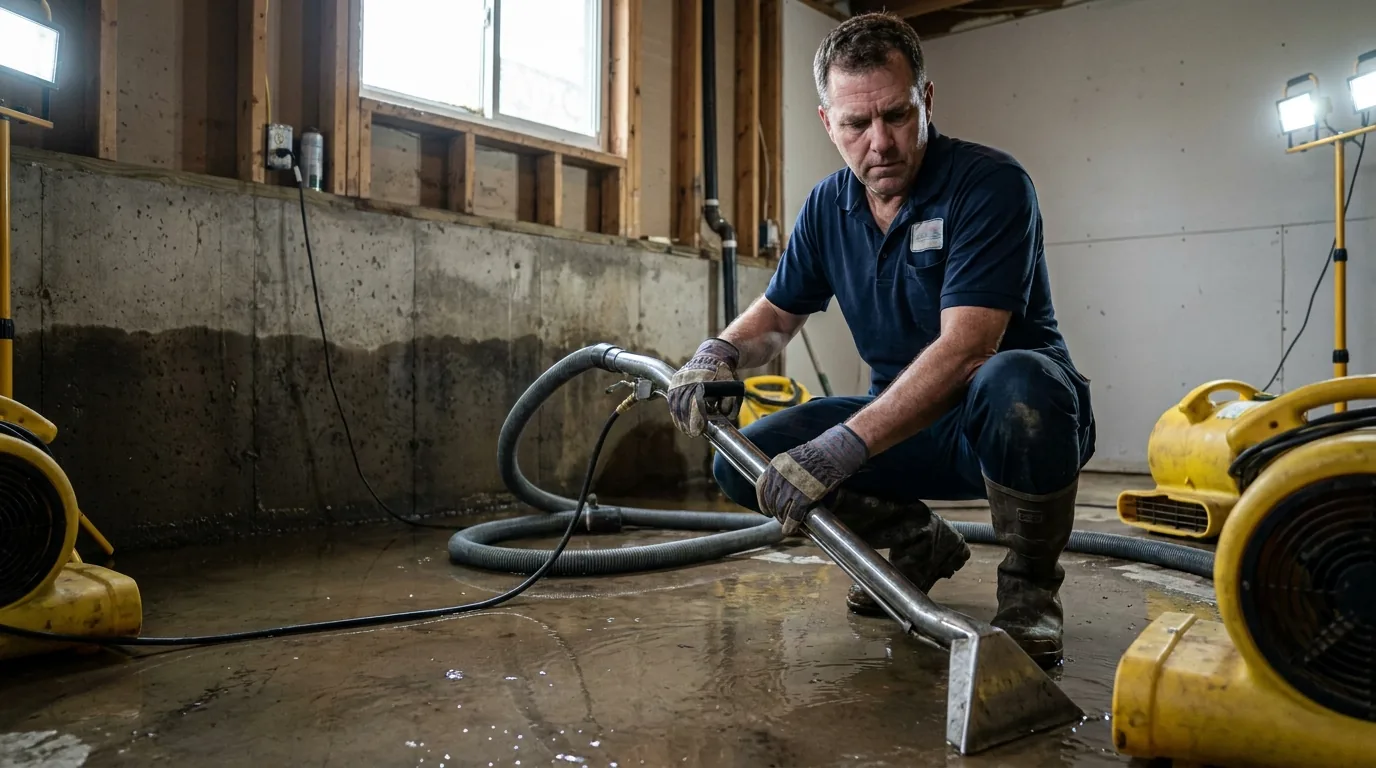
Professional basement water removal means deploying truck-mounted or portable extractors capable of pulling hundreds of gallons from carpet, padding, and porous concrete before any drying equipment is placed. After extraction, the drying phase uses high-capacity axial or centrifugal air movers paired with commercial LGR (low-grain refrigerant) dehumidifiers, not the box-store units that cycle off when the air feels dry to the touch. Moisture readings are taken with pin and pinless meters at the wall cavities, floor joists, and subfloor, and logged daily until all materials reach their target dry standard. A properly dried basement typically takes three to five days under active drying conditions; a basement that sat wet over a weekend before anyone called often takes longer.
Our process
-
Rapid water extraction. We arrive with truck-mounted extraction equipment and remove standing water from the floor, carpet, and any saturated materials before it migrates further. Every minute of contact time matters, water that sits longer penetrates deeper into concrete and framing.
-
Moisture mapping and category assessment. We classify the water source (clean supply line, gray water from a drain backup, or black water from sewage or exterior flooding) because Category 2 and Category 3 water require containment protocols and antimicrobial treatment that clean water losses don’t. We map moisture readings across every affected surface and photograph them for your insurance documentation.
-
Controlled demolition if required. Wet insulation never dries in place, it has to come out. Drywall saturated above the flood line is cut to the next stud bay above the moisture reading, not just to the visible waterline. This step is where inexperienced operators cut corners, and it’s where mold problems originate six weeks later.
-
Structural drying with daily monitoring. Commercial air movers and LGR dehumidifiers run continuously. We return daily to log psychrometric data, temperature, relative humidity, and grain depression, and adjust equipment placement as materials dry at different rates. You get a written moisture log that becomes part of your insurance claim file.
-
Final clearance and antimicrobial treatment. When all materials reach the IICRC S500 dry standard, we apply an EPA-registered antimicrobial to concrete, framing, and any remaining porous surfaces. We document final readings and provide a completion report before any reconstruction begins.
Basement flood cleanup in Saratoga Springs: why the local climate raises the stakes
Basement flood cleanup along the Wasatch Front carries a wrinkle milder regions don’t face: the freeze-thaw cycle. A supply line in an unheated basement or crawl space that freezes and splits in January can run for hours before anyone notices, and the same cold that caused the break slows evaporation to a crawl once the water is down. Snowmelt in early spring adds a second wave, pushing groundwater against foundations that stayed dry all winter. Both patterns mean the water often sits longer here than homeowners expect — which is exactly when hidden saturation in rim joists and sill plates turns into a mold problem weeks later. Fast, measured drying, not just extraction, is what keeps a Saratoga Springs basement flood from becoming a spring remediation project.
What separates a good basement flooding response from a bad one
The most common mistake is stopping at extraction. A wet-vac and a few fans feel like progress, but they move surface moisture into the air without removing it from the structure. Relative humidity climbs, the air feels clammy, and the framing stays wet. Mold doesn’t need much, 72 hours at elevated moisture and the right temperature is enough.
A second failure point is misclassifying the water source. A floor drain backup during a heavy rain event is almost always Category 3, it carries whatever was in the municipal sewer line. Treating it as a clean water loss without containment and antimicrobial protocol puts your family at risk and creates liability exposure for the contractor.
Insurance adjusters look for a moisture log with daily readings, photographic documentation of the waterline and affected materials before demolition, and a written scope that distinguishes extraction from drying from demo from antimicrobial. Carriers increasingly deny or reduce claims when that documentation doesn’t exist. Our IICRC-certified technicians (license #RC-25-0737) produce that file as a standard part of every job.
Seasonal and regional considerations
Saratoga Springs sits at roughly 4,500 feet, and the Wasatch Front’s freeze-thaw cycle creates two distinct flooding windows. Spring snowmelt, typically March through May, pushes hydrostatic pressure against basement walls and through foundation cracks in neighborhoods built on the clay-heavy soils common along the benches above Utah Lake. The second window is late-summer monsoon season, when afternoon storms overwhelm window wells and exterior drains faster than sump pumps can cycle. Homes in the newer developments south of Redwood Road often have deeper basements and finished lower levels, which means more square footage of finished material at risk when a sump pump fails at 2 a.m.
Service area
Home Pride Restoration and Cleaning is based in Saratoga Springs and provides basement flooding cleanup throughout the surrounding communities, including Eagle Mountain, Lehi, American Fork, Cedar Hills, Highland, and Herriman. Response times in our core service area are typically under 90 minutes.
If you’re standing in a wet basement right now, the clock is already running. Call (801) 995-2437 to start your basement water extraction, we’ll walk you through what to move, what not to touch, and what to tell your insurance company before we arrive.
Frequently Asked Questions
How long does structural drying typically take after a basement flood, and what affects that timeline?
What is the difference between Category 1, 2, and 3 basement flooding, and why does it change the cleanup process?
My basement flooded overnight — should I run my own fans and dehumidifier while I wait for a crew to arrive?
Why do technicians cut drywall above the visible waterline instead of just drying what's visibly wet?
What documentation should I collect from my restoration contractor to support my homeowner's insurance claim for a flooded basement?
Looking for the best basement flooding cleanup company in Saratoga Springs?
Home Pride Restoration and Cleaning provides licensed and insured basement flooding cleanup in Saratoga Springs, UT and the surrounding area, and has served local property owners since 1997. Customers rate us 5.0 out of 5 stars across 36 Google reviews. We answer calls 24/7 — call (801) 995-2437 for immediate help.
Need Basement Flooding Cleanup now?
We respond 24/7 across Saratoga Springs and surrounding UT cities.
Related Coverage
- Our Restoration Services
- Contact Home Pride Restoration and Cleaning
- Basement Flooding Cleanup in American Fork
- Basement Flooding Cleanup in Eagle Mountain
- Basement Flooding Cleanup in Herriman
- Basement Flooding Cleanup in Lehi
- Basement Flooding Cleanup in Orem
- Basement Flooding Cleanup in Pleasant Grove
- Basement Flooding Cleanup in Provo
- Basement Flooding Cleanup in Riverton
- Basement Flooding Cleanup in South Jordan