
Basement Flooding Cleanup in Pleasant Grove
24/7 basement flooding cleanup in Pleasant Grove, UT. IICRC-certified, insurance billing accepted. Call (801) 995-2437.
Our IICRC-certified technicians are dispatched from our Saratoga Springs, UT headquarters and are typically on-site in Pleasant Grove within 60 minutes of your call.
Pleasant Grove sits at the base of the Wasatch Front where spring snowmelt off Mount Timpanogos combines with heavy clay soils to push hydrostatic pressure against basement walls every March and April. When that pressure wins, or when a water heater line lets go at 2 a.m., you can be standing in four inches of water before sunrise. Home Pride Restoration and Cleaning has been responding to exactly these situations across Utah County since 1997, and our IICRC-certified crews know what a flooded basement in this city actually looks like.
Why Pleasant Grove Basements Flood More Than You’d Expect
The geology under Pleasant Grove is a big part of the story. The bench areas along the foothills sit on dense Bonneville lakebed clay that doesn’t drain quickly, water that can’t move sideways moves toward your foundation instead. Homes built in the 1970s and 1980s, which make up a large share of the housing stock here, typically used drain tile systems that are now 40–50 years old and either collapsed or clogged with mineral deposits from Utah’s notoriously hard water. When those systems fail during a heavy rain event or a rapid snowmelt week, water doesn’t seep in, it pours in through floor cracks and window wells simultaneously.
Sump pump failure is the other common culprit. Power outages during spring thunderstorms knock out pumps right when they’re needed most. If your sump pit doesn’t have a battery backup, a two-hour outage can mean a foot of standing water by the time power returns.
Our Basement Flooding Cleanup Process in Pleasant Grove
When we arrive, typically within 60–90 minutes of your call from our Saratoga Springs headquarters, the first priority is safety: we check for electrical hazards before anyone steps into standing water. From there, the process follows a deliberate sequence.
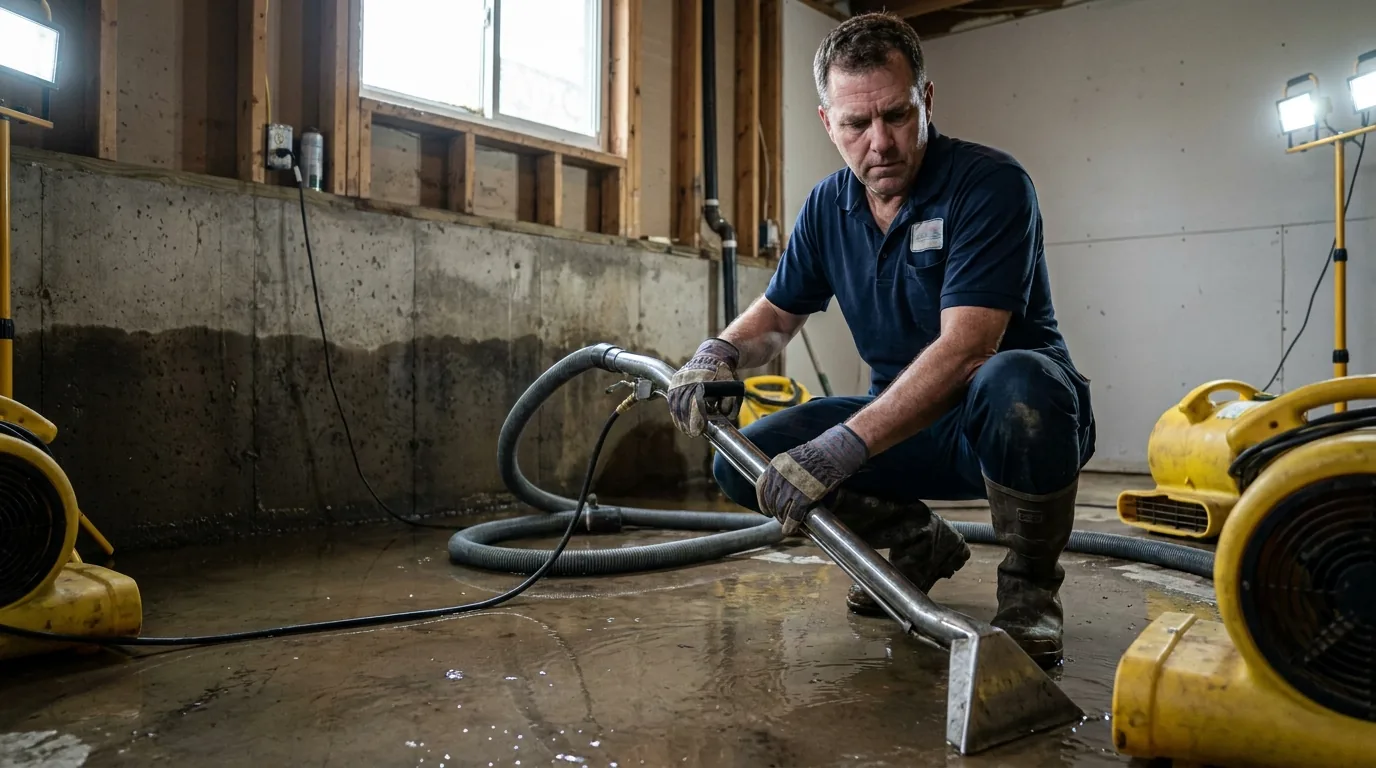
Water extraction comes first. Truck-mounted extraction units pull hundreds of gallons out of a basement floor faster than any portable unit can. We get into corners, under stairs, and along the perimeter where water pools deepest.
Moisture mapping follows immediately. Concrete basement floors and the framed walls above them hold water in ways that aren’t visible to the eye. We use thermal imaging and calibrated moisture meters to document every wet surface, this matters both for drying decisions and for your insurance claim.
Structural drying is where local conditions shape our setup. Pleasant Grove’s low ambient humidity in summer actually helps drying times, but if we’re working a spring flood during a stretch of wet weather, we bring in additional dehumidification capacity to compensate. We calculate the number of air movers and dehumidifiers based on the cubic footage of your specific basement, not a generic formula.
Content and flooring assessment runs parallel. Carpet and pad almost always come out, they trap contaminated water and slow structural drying significantly. Engineered hardwood over concrete subfloors is increasingly common in newer Pleasant Grove homes and requires a different drying protocol than solid wood.
We document every step with photos and moisture readings, which your insurance adjuster will need.
Response Time to Pleasant Grove
Our crews stage out of Saratoga Springs, which puts Pleasant Grove roughly 15–20 minutes away via US-89 North under normal traffic conditions. For addresses on the east side of the city closer to the foothills, we typically add no more than 5 minutes. We aim for a technician on your doorstep within 60–90 minutes of your call, any time of day or night. Call (801) 995-2437 and you’ll reach a live person, not a voicemail.
Working with Your Insurance in Pleasant Grove
Most standard homeowner policies cover sudden and accidental water damage, a burst pipe, an appliance failure, a sump pump overflow if you carry the rider. Gradual seepage from a failing drain tile system is often excluded, which is why our moisture mapping documentation matters: it helps establish the timeline of the loss. We work directly with all major carriers and can communicate with your adjuster on your behalf. Our license number is RC-25-0737, which adjusters may ask for when verifying contractor credentials.
A Local Note Worth Knowing
Pleasant Grove’s hard water, among the highest mineral content in Utah County, leaves calcium and iron deposits inside sump discharge lines and drain tile systems over time. We’ve seen lines that are effectively 30% blocked even in homes where the pump itself is only a few years old. When we’re on-site for a flooded basement cleanup, we flag this to homeowners because a clean extraction job won’t prevent the next flood if the discharge path is already compromised. It’s not something we remediate, but connecting you with a plumber who can scope the line before winter is part of leaving the job done right.
If your basement is wet right now, don’t wait to see if it dries on its own, mold colonization on drywall and wood framing can begin within 24–48 hours in a closed basement environment. Call Home Pride Restoration and Cleaning at (801) 995-2437. We serve all of Pleasant Grove, including the ZIP code 84062, and we’ll have a crew moving toward you within the hour.
Serving Pleasant Grove from our Saratoga Springs headquarters — ★ 5.0 · 36 Google reviews
“I was nervous at first, but the staff made me feel comfortable. They arrived quickly for emergency water removal and had the water out of my home in no time. I really appreciated their fast response and professional service.” — Amy, July 2026Read our reviews on Google →
Basement Flooding Cleanup in Pleasant Grove: Service Coverage
Frequently Asked Questions
How fast can you arrive for basement flooding cleanup in Pleasant Grove?
How quickly can Home Pride reach a flooded basement on Pleasant Grove's east bench near the foothills?
Does Pleasant Grove's heavy clay soil affect how basement flooding cleanup is done?
Are older Pleasant Grove homes built in the 1970s and 1980s harder to dry out after a basement flood?
How does Pleasant Grove's hard water affect basement flooding issues over time?
Will my homeowner's insurance cover basement flooding cleanup in Pleasant Grove?
Basement Flooding Cleanup response in Pleasant Grove
Most Pleasant Grove calls see a technician on-site within 60 minutes from our Saratoga Springs headquarters.