
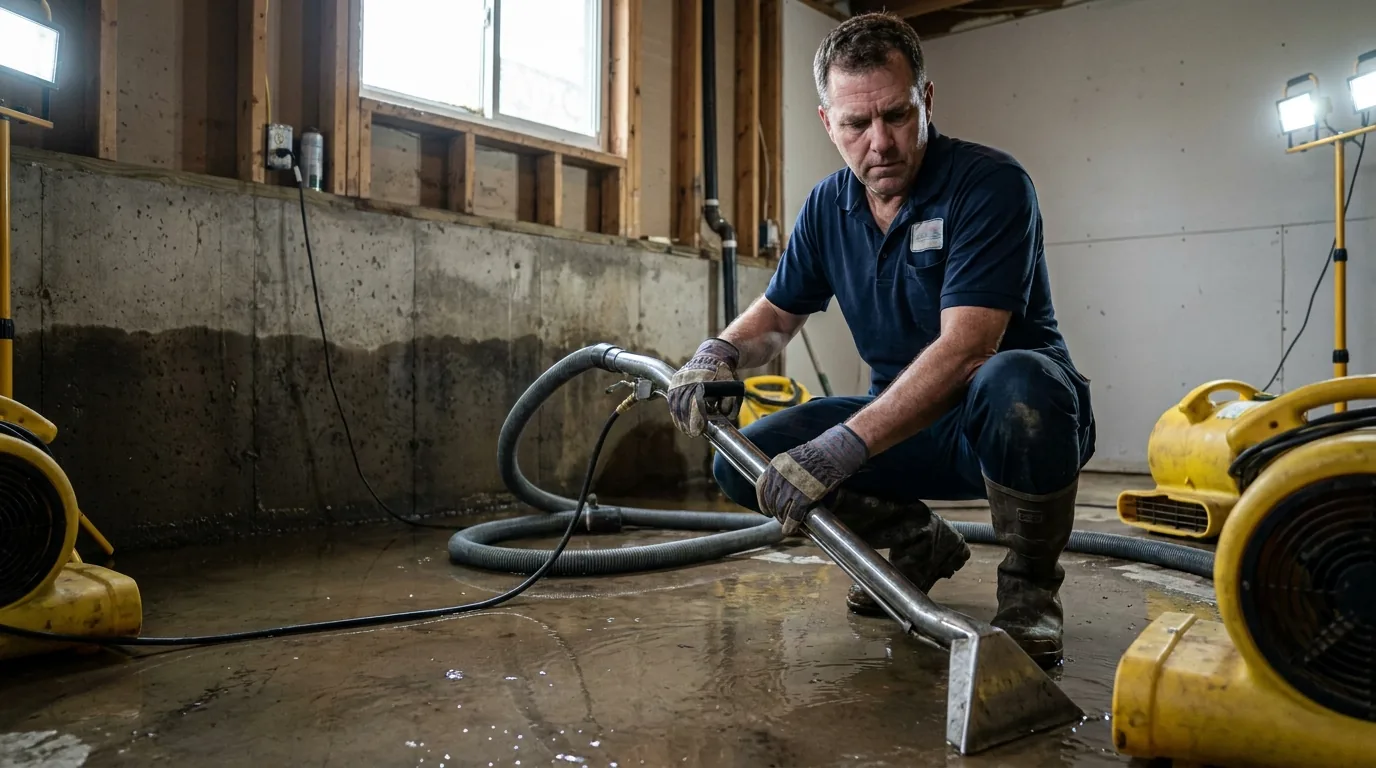
Basement Flooding Cleanup in Provo
24/7 basement flooding cleanup in Provo, UT. IICRC-certified, insurance billing accepted. Call (801) 995-2437.
Our IICRC-certified technicians are dispatched from our Saratoga Springs, UT headquarters and are typically on-site in Provo within 60 minutes of your call.
Provo sits in a valley where the Wasatch Front snowpack melts fast and the water table along the bench and lower neighborhoods can rise quickly in late winter and early spring, and when that moisture finds a crack in a foundation wall or an overwhelmed window well, a basement can go from dry to ankle-deep in hours. Whether the source is a ruptured supply line, a sump pump that gave out overnight, or groundwater pushing through a block foundation, the clock starts the moment water touches your floor. Home Pride Restoration and Cleaning has been responding to flooded basements across Utah County since 1997, and we know how Provo’s specific geography and housing stock shape every job.
Why Provo Basements Flood, and Why It Matters for Cleanup
Provo’s elevation and proximity to Utah Lake create a moisture dynamic that surprises a lot of homeowners. The bench areas east of University Avenue drain well, but the lower-lying streets near Center Street and the older neighborhoods closer to the lake sit on clay-heavy soil that doesn’t absorb water quickly. When that clay becomes saturated, during a rapid snowmelt event or a sustained spring rain, hydrostatic pressure builds against basement walls and floors, forcing water through hairline cracks that were invisible the day before.
The housing stock adds another layer of complexity. Provo has a significant number of homes built between the 1940s and 1970s, many of them in the 84601 ZIP code corridor. Those basements were often finished with older concrete block construction rather than poured concrete, and block walls wick moisture differently, water can migrate laterally through the mortar joints and show up several feet from the original entry point. Knowing that pattern changes where we place dehumidifiers and how we read moisture readings on the walls.
Our Basement Flooding Cleanup Process in Provo
When you call, a technician is dispatched immediately, not a scheduler, not a callback queue. The first priority on arrival is stopping any active water source and assessing whether the electrical panel needs to be isolated before anyone walks the space. From there, the process moves in a deliberate sequence:
Water extraction comes first. We use truck-mounted and portable extraction units to pull standing water from the floor, including water trapped under carpet pad or laminate. In older Provo homes with concrete slab floors and no subfloor, this step is faster, but the slab itself can hold significant moisture that a surface extraction won’t reach.
Structural drying follows. We set industrial air movers and desiccant or refrigerant dehumidifiers calibrated to the square footage and the ambient conditions. Provo’s dry high-desert air is actually an advantage here, lower ambient humidity means drying times can be shorter than in coastal markets, but we still use moisture meters and thermal imaging to confirm drying is complete before we close out, not just estimate by feel.
Content and material assessment happens throughout. Drywall, insulation, and framing that have been wet for more than 24–48 hours often need to come out. We document everything with photos for your insurance file and flag materials that contain potential hazards, relevant in homes built before the mid-1970s where older insulation products were common.
All work is performed by IICRC-certified technicians under license #RC-25-0737.
Response Time from Saratoga Springs to Provo
Our headquarters in Saratoga Springs puts us roughly 20–25 minutes from most of Provo under normal traffic conditions via US-89 south through Lehi and into the valley. For addresses near the BYU campus or south Provo along University Parkway, that drive runs closer to 25–30 minutes depending on time of day. We aim to have a technician on-site within 60 minutes of your call for most Provo addresses, faster for neighborhoods on the north end of the city.
We operate 24 hours a day, seven days a week. A flooded basement at 2 a.m. on a Sunday gets the same response as a Monday afternoon call.
Insurance Coordination for Provo Homeowners
Most standard homeowner policies in Utah cover sudden and accidental water damage, a burst pipe, an appliance failure, a water heater that let go, but exclude gradual seepage or groundwater intrusion. The distinction matters enormously for Provo homeowners dealing with spring flooding, because the cause of loss determines whether you have a covered claim.
We document the source and timeline of every job from the moment we arrive, which gives your adjuster the information they need to process the claim accurately. We work directly with all major carriers and can communicate with your adjuster on your behalf. We don’t guarantee claim outcomes, that’s between you and your insurer, but thorough documentation from the start gives you the strongest possible position.
Local Note
One thing we’ve learned from years of working Provo basements: homes in the older blocks near Center Street and 100 South often have a finished basement that was added or updated in the 1980s, and those remodels frequently used paper-faced drywall installed directly against the concrete block wall with no air gap. When that assembly gets wet, the paper facing becomes a mold substrate within 48–72 hours, and the moisture trapped between the drywall and the block can read much lower on a surface meter than what’s actually present. We probe those walls rather than relying on surface readings alone, a small difference in technique that prevents callbacks weeks later when mold shows up behind a wall that looked dry on paper.
If your Provo basement is wet right now, call Home Pride Restoration and Cleaning at (801) 995-2437. We’ll tell you exactly what we’re seeing, what needs to happen, and what it means for your home, no pressure, no vague estimates, just a clear path from flooded to dry.
Serving Provo from our Saratoga Springs headquarters — ★ 5.0 · 36 Google reviews
“He did an amazing job! My stairs were so bad and they looked brand new when he got done!” — B, August 2026Read our reviews on Google →
Basement Flooding Cleanup in Provo: Service Coverage
Frequently Asked Questions
How fast can you arrive for basement flooding cleanup in Provo?
How quickly can you reach south Provo neighborhoods near University Parkway when a basement floods?
Are older homes in the 84601 ZIP code more vulnerable to basement flooding damage than newer construction?
Does Provo's clay-heavy soil near Utah Lake affect how long basement drying takes?
Will my homeowner's insurance cover basement flooding from Provo's spring snowmelt?
How do you confirm a Provo basement is fully dry before closing out the job?
Basement Flooding Cleanup response in Provo
Most Provo calls see a technician on-site within 60 minutes from our Saratoga Springs headquarters.