Basement Flooding Cleanup in Lehi
24/7 basement flooding cleanup in Lehi, UT. IICRC-certified, insurance billing accepted. Call (801) 995-2437.
Our IICRC-certified technicians are dispatched from our Saratoga Springs, UT headquarters and are typically on-site in Lehi within 60 minutes of your call.
Lehi’s rapid growth along the I-15 corridor has pushed new subdivisions onto the bentonite-heavy clay soils that stretch from the foothills down toward Utah Lake, and that clay doesn’t drain. When a water heater fails, a window well fills during a spring thunderstorm, or a sewer line backs up in a finished basement, that standing water has nowhere to go fast. Home Pride Restoration and Cleaning has been responding to basement flooding calls across Utah County since 1997, and we know exactly what that wet carpet smell at the bottom of a Lehi staircase means for your timeline.
Why Lehi Basements Are Particularly Vulnerable
Lehi sits at roughly 4,550 feet elevation, which means freeze-thaw cycles hit harder and earlier than homeowners moving from lower elevations expect. Pipes that run through uninsulated rim joists, common in the tract homes built quickly during the tech-corridor boom of the early 2000s, can burst in a single overnight freeze in January or February. The resulting water doesn’t just pool; it wicks into OSB subfloor panels and LVP flooring within the first hour.
The clay-dominant soil profile in much of Lehi also creates hydrostatic pressure against foundation walls after heavy rain or rapid snowmelt. Homes in newer developments near Thanksgiving Point and along the Traverse Mountain foothills are particularly susceptible because the grading around foundations sometimes settles before landscaping is fully established, directing runoff toward the house rather than away from it. Window wells without properly sized gravel beds compound the problem every spring.
Finally, Lehi’s sewer infrastructure is still catching up with population growth. During heavy rain events, older lateral lines in more established neighborhoods can experience backflow, which is a different category of water damage than a clean-water pipe burst. Backflow contains contaminants that require Category 3 protocols: different PPE, different disposal procedures, and a longer remediation timeline.
Our Basement Flooding Cleanup Process in Lehi
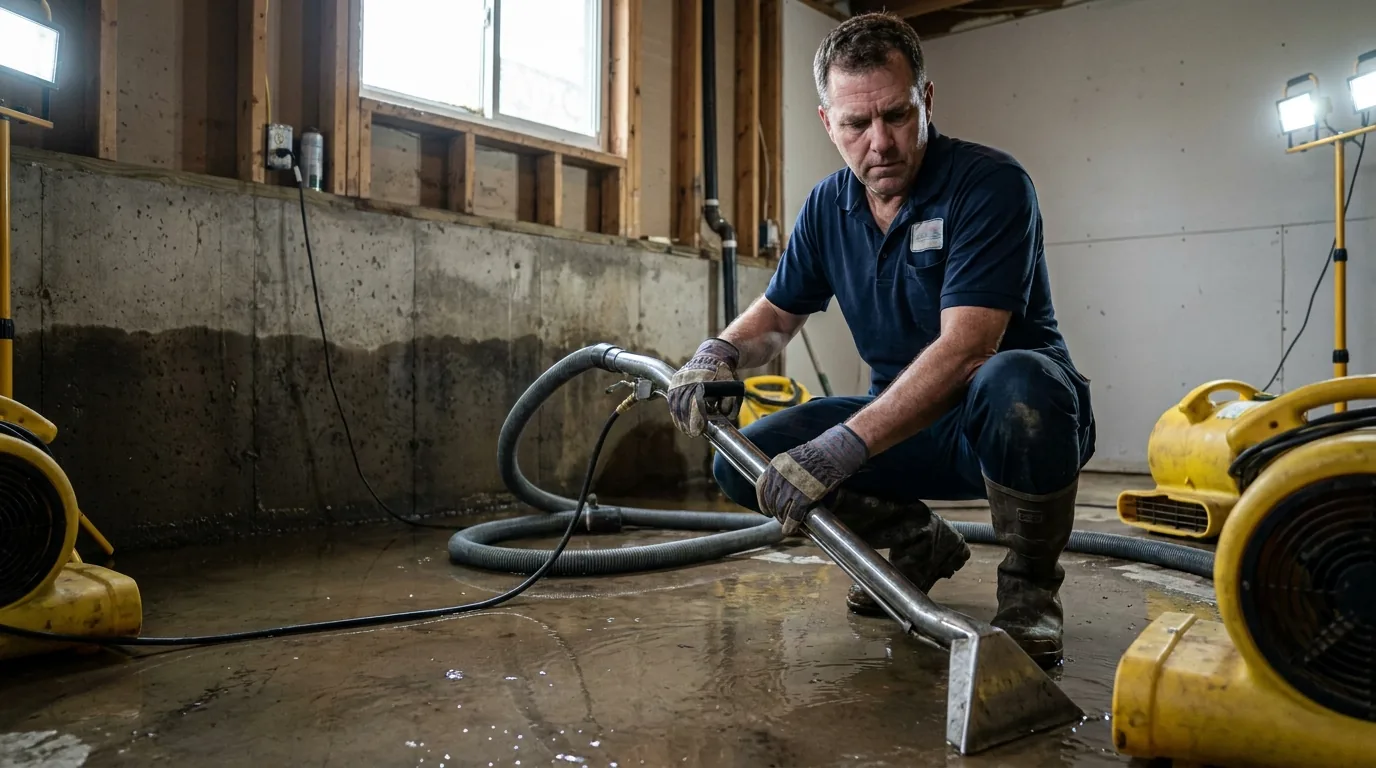
When you call (801) 995-2437, the first question we ask is whether the water source is still active. If it is, we walk you through shutting off the main, Jordan Valley Water Conservancy District customers can reach their emergency line, but the fastest fix is usually the shutoff valve inside the home. Our IICRC-certified technicians carry moisture meters, thermal imaging cameras, and truck-mounted extraction units on every vehicle.
Here’s what the process looks like on a typical Lehi basement job:
- Extraction, We remove standing water first, including water trapped under floating LVP or laminate flooring, which is extremely common in finished Lehi basements built after 2010.
- Moisture mapping, Thermal imaging identifies water that has migrated into wall cavities, under baseboards, and into the concrete slab itself. Clay-heavy soil beneath slabs retains moisture and can re-wet a slab from below if drying equipment is removed too soon.
- Structural drying, We deploy industrial air movers and LGR dehumidifiers calibrated to Lehi’s elevation. At 4,500+ feet, evaporation rates differ from sea-level calculations; standard drying timelines from lower-elevation markets underestimate how long a slab takes to release moisture here.
- Documentation, Every moisture reading is logged with a timestamp. This record is what your insurance adjuster needs to approve the claim.
- Antimicrobial treatment, Applied to any surface that was in contact with water for more than 24 hours, which is the window mold colonization can begin.
Response Time to Lehi
Our headquarters is in Saratoga Springs, which puts us roughly 10–15 minutes from most of Lehi via Redwood Road or Triumph Boulevard depending on traffic. Neighborhoods near Thanksgiving Point and the outlets on Cabela’s Drive are typically the fastest to reach, often under 15 minutes. Homes in the Traverse Mountain area add a few minutes due to the elevation gain on Traverse Ridge Road, but we still target arrival within 30–45 minutes for active flooding calls in the 84043 ZIP code.
We run 24/7 dispatch, which matters because most basement flooding events in Lehi happen either during the overnight freeze-thaw window in winter or during the afternoon thunderstorm pattern that builds over the Wasatch Front in July and August.
Local Note
One pattern we see repeatedly in Lehi’s newer subdivisions: builders often install sump pump pits but leave the homeowner to purchase and install the pump separately, or the pump is a builder-grade unit with no battery backup. When a summer storm knocks out power, which happens along the Traverse Mountain ridge more often than residents expect, the sump pit fills and overflows within 20–30 minutes. If your basement has flooded during a power outage, mention that when you call; it changes how we assess the source and whether a battery-backup recommendation is part of our post-job report.
If you’re dealing with water in your basement right now, whether it’s an inch of standing water or a slow seep that’s been soaking into drywall for two days, call (801) 995-2437. We serve Lehi and the surrounding Utah County area around the clock, and we’ll give you an honest assessment of what the damage looks like and what it will take to dry it out correctly.
Serving Lehi from our Saratoga Springs headquarters — ★ 5.0 · 36 Google reviews
“I called Home Pride Restoration and Cleaning after a burst pipe and was impressed by how quickly they responded. The team was professional, efficient, and very thorough—everything from emergency water extraction to carpet water extraction was handled smoothly. I appreciate the fast service and will…” — Joe, July 2026Read our reviews on Google →
Basement Flooding Cleanup in Lehi: Service Coverage
Frequently Asked Questions
How fast can you arrive for basement flooding cleanup in Lehi?
How quickly can you reach homes near Thanksgiving Point for a basement flooding emergency?
Does Lehi's clay soil affect how long basement drying takes compared to other areas?
My Lehi basement flooded during a power outage when the sump pump failed — is that covered differently by insurance?
What's different about basement flooding cleanup in Traverse Mountain homes versus lower-elevation parts of Lehi?
How long does a typical basement flooding cleanup take for a finished basement in Lehi?
Basement Flooding Cleanup response in Lehi
Most Lehi calls see a technician on-site within 60 minutes from our Saratoga Springs headquarters.