Tile & Grout Cleaning in Provo
24/7 tile & grout cleaning in Provo, UT. IICRC-certified, insurance billing accepted. Call (801) 995-2437.
Our IICRC-certified technicians are dispatched from our Saratoga Springs, UT headquarters and are typically on-site in Provo within 60 minutes of your call.
Provo’s high desert elevation, sitting at roughly 4,500 feet along the Wasatch Front, means hard, mineral-rich water flows through every tap in the city. That calcium and magnesium content leaves a chalky haze on bathroom tile and drives white crystalline deposits deep into grout lines faster than homeowners in more humid climates ever experience. Whether your kitchen floor is original saltillo tile in a 1960s ranch near the BYU campus or large-format porcelain in a newer build off University Parkway, that mineral buildup isn’t something a mop and a spray bottle will touch.
Why Provo Tile and Grout Deteriorates Faster Than You’d Expect
Utah County’s water hardness regularly tests above 200 parts per million, well into the “very hard” range. Every time water evaporates off a tile surface, it leaves a microscopic mineral film behind. Over months and years those films stack up, bonding with soap scum and foot traffic grime until grout goes from its original warm beige or gray to a dingy brown that looks permanently stained. In older homes near the Joaquin neighborhood, where original ceramic tile floors from the 1950s and 1960s are still common, the grout is often porous and unsealed, meaning it has been absorbing that mineral-laden water for decades. Restoration rather than replacement is almost always the better financial call on those floors, but it requires a different approach than cleaning newer, factory-sealed tile.
Provo’s dry winters also create a cycle that accelerates grout damage: low indoor humidity causes grout to contract slightly, and then summer monsoon moisture causes it to expand. That repeated movement over years opens micro-cracks that trap dirt and become impossible to clean with consumer products.
Our Tile and Grout Cleaning Process in Provo
The process starts with a dry inspection under strong lighting to map staining patterns, grout condition, and any cracked or missing grout that needs repair before cleaning. Cleaning cracked grout without addressing the cracks first just drives water and detergent into the subfloor, a mistake that causes more problems than it solves.
From there, a pH-appropriate pre-treatment solution is applied and given dwell time calibrated to the stain type: alkaline chemistry for grease and soap scum, acidic chemistry for mineral scale. Provo’s hard water almost always means some acid-side work is needed, even on floors that look like a simple soap-scum problem on the surface.
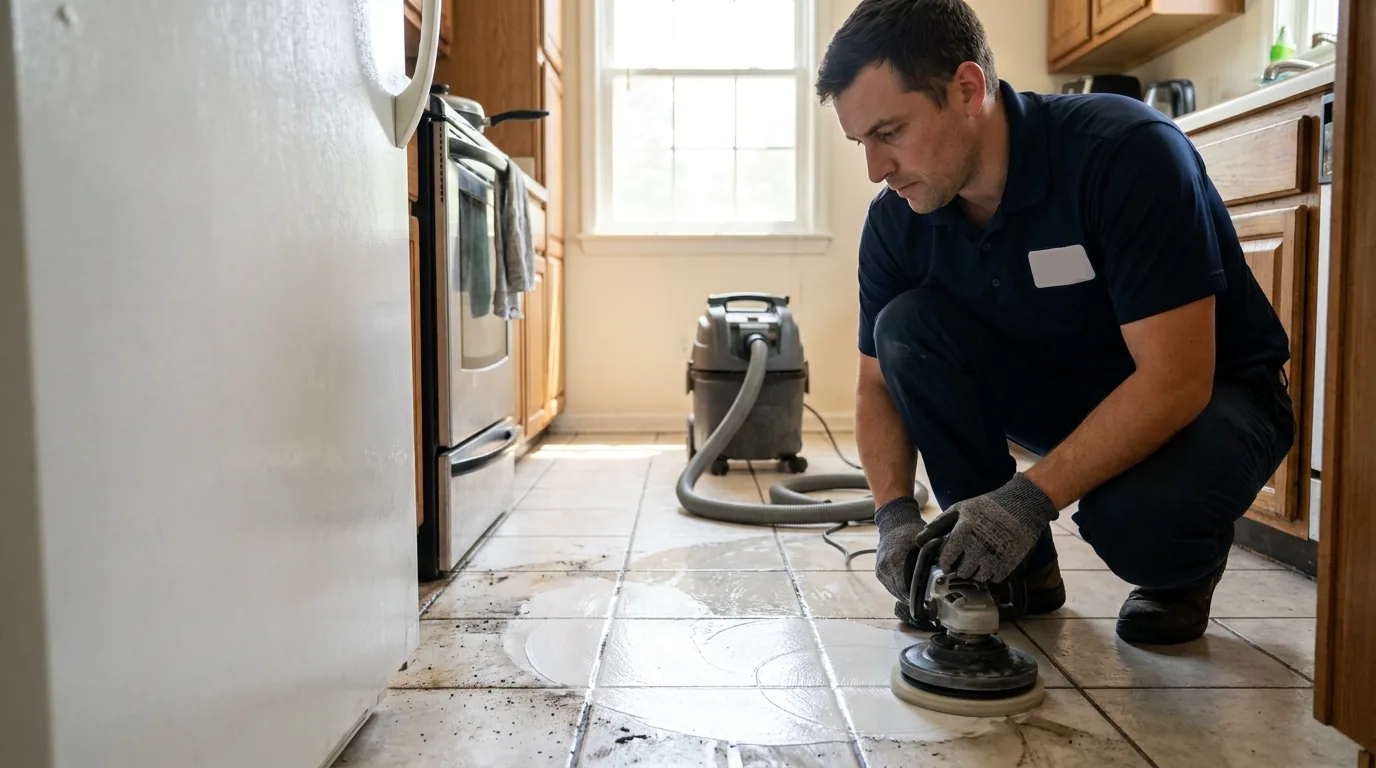
The core cleaning step uses truck-mounted hot-water extraction equipment with a specialized tile-cleaning head that spins pressurized water across the surface and simultaneously vacuums the dirty water away. Pressure and temperature are dialed in based on tile type, the original glazed ceramic common in older Provo homes can’t take the same pressure settings as modern porcelain without risking glaze damage. After a thorough rinse, grout lines are dried and then sealed with a penetrating sealer that blocks future mineral and organic staining without leaving a surface film that would make tile look plastic or artificial.
Response Time and Coverage Across Provo
Home Pride Restoration and Cleaning operates out of Saratoga Springs, roughly 20 miles northwest of central Provo via US-89 South. Under normal traffic conditions, a technician can reach most Provo addresses, including neighborhoods near the Provo City Center Temple or the streets around Brigham Young University, in 30 to 45 minutes. Areas in south Provo closer to the Springville border typically add 10 minutes. Scheduling is available six days a week, and most residential tile cleaning jobs in the Provo area are completed in a single visit of two to five hours depending on square footage.
Local Note: What Provo’s Water Does to “Clean” Grout
Here is something that surprises a lot of Provo homeowners: grout that was professionally cleaned two or three years ago can look nearly as bad as grout that has never been cleaned, if it wasn’t sealed afterward. Without a penetrating sealer, Provo’s hard water redeposits minerals into the freshly opened grout pores almost immediately. A cleaning without sealing in this market is essentially a temporary fix. Homes in the Joaquin neighborhood and other older Provo areas with unsealed original grout often need a light acid pre-treatment just to remove the mineral crust before the actual cleaning chemistry can reach the organic staining underneath. That two-step approach takes more time and product, but skipping it means the grout looks clean for about six weeks and then reverts. Knowing that pattern, and adjusting the process accordingly, is the difference between a job that lasts and one that doesn’t.
If your tile floors have been looking dingy despite regular mopping, or if grout lines have gone from gray to near-black, the problem almost certainly isn’t your cleaning habits, it’s Provo’s water chemistry working against you. Call Home Pride Restoration and Cleaning at (801) 995-2437 to schedule a Provo tile and grout cleaning appointment, and ask about sealing options that will keep those results looking sharp for two to three years instead of two to three months.
Serving Provo from our Saratoga Springs headquarters — ★ 5.0 · 36 Google reviews
“He did an amazing job! My stairs were so bad and they looked brand new when he got done!” — B, August 2026Read our reviews on Google →
Tile & Grout Cleaning in Provo: Service Coverage
Frequently Asked Questions
How fast can you arrive for tile & grout cleaning in Provo?
How does Provo's hard water affect how often tile and grout needs to be professionally cleaned?
Are older homes in the Joaquin neighborhood good candidates for grout restoration, or is replacement usually necessary?
Does Provo's dry winter climate cause any specific problems for tile grout that I should know about before scheduling service?
What's the difference between steam cleaning and the hot-water extraction method you use on Provo tile floors?
How long does a tile and grout cleaning job typically take for an average Provo home, and when can we walk on the floor again?
Will my homeowners insurance cover tile & grout cleaning in Provo?
Tile & Grout Cleaning response in Provo
Most Provo calls see a technician on-site within 60 minutes from our Saratoga Springs headquarters.