Fire Damage Restoration in Provo
24/7 fire damage restoration in Provo, UT. IICRC-certified, insurance billing accepted. Call (801) 995-2437.
Our IICRC-certified technicians are dispatched from our Saratoga Springs, UT headquarters and are typically on-site in Provo within 60 minutes of your call.
Provo sits at roughly 4,500 feet elevation in a high-desert valley where the air is bone-dry for most of the year, and that arid climate is one of the reasons fire moves fast and smoke penetrates deep when a home ignites. Whether it started in a kitchen near BYU campus, a garage off University Avenue, or a basement in one of the older neighborhoods east of Center Street, the hours immediately after a fire determine how much of your home can be saved. Home Pride Restoration and Cleaning has been responding to fire emergencies across Utah County since 1997, and our IICRC-certified crews understand exactly what post-fire conditions look like in Provo’s specific housing stock.
Why Provo Homes Face Distinctive Fire Damage Challenges
Provo’s building inventory spans more than a century. The blocks surrounding Joaquin neighborhood and the historic core near Academy Square include homes built in the 1920s through the 1950s, many with original wood-lathe construction, older knob-and-tube or early-generation wiring, and plaster walls that absorb smoke odor far more aggressively than modern drywall. When fire touches those materials, the char goes deeper and the odor compounds bind into the substrate in ways that surface cleaning cannot address.
Provo also experiences strong Wasatch Front inversion events every winter, where cold air traps pollutants, and smoke, close to the valley floor. If a fire occurs during an inversion period, smoke odor can re-enter a partially opened structure through negative pressure, complicating early ventilation efforts. Our crews account for inversion conditions when setting up air scrubbers and negative-pressure containment zones.
Beyond the structure itself, Provo’s dry climate means that soot, particularly the dry, powdery soot produced by fast-moving fires in low-humidity conditions, spreads further through HVAC systems and settles on surfaces in rooms that never saw flames. Every room in the house needs to be assessed, not just the origin point.
Our Fire Damage Restoration Process in Provo
When we arrive on-site, the first priority is a room-by-room damage assessment that separates primary fire and heat damage from secondary smoke and soot migration. In Provo’s older homes, that assessment includes checking crawl spaces and attic spaces where insulation can trap smoke particulates for months if not addressed.
From there, the process moves through these concrete phases:
- Emergency board-up and tarping, securing windows, doors, and any roof penetrations to prevent weather intrusion and unauthorized entry. Provo’s afternoon thunderstorms in late summer can push water into an open structure within hours.
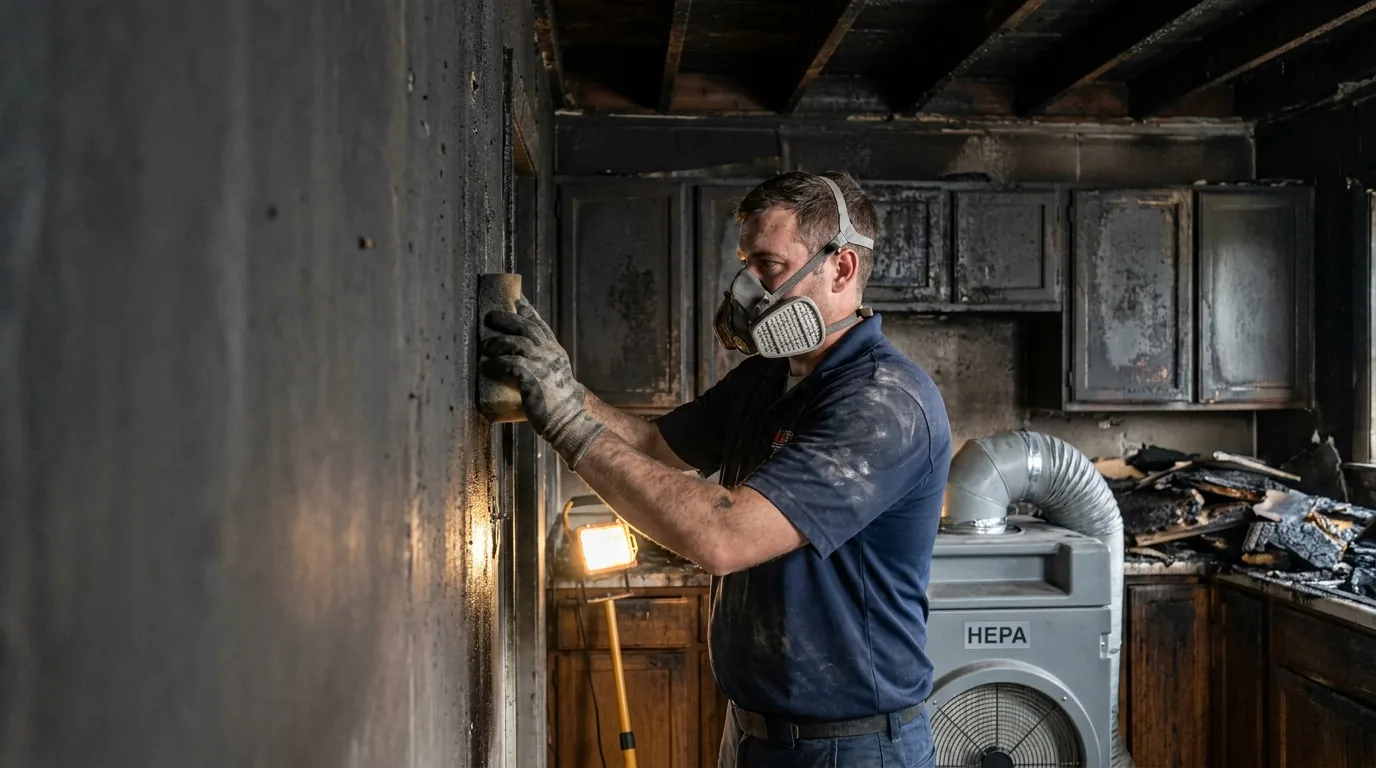
- Dry and wet soot removal, dry soot from fast-burning fires requires dry chemical sponges before any moisture is introduced; wet soot from slower, smoldering fires needs different chemical agents. The wrong sequence permanently sets staining.
- Structural drying and dehumidification, water from firefighting efforts must be extracted before reconstruction begins. Provo’s low ambient humidity actually accelerates drying timelines compared to coastal markets, but it also means materials can crack if dried too aggressively.
- Thermal fogging and hydroxyl treatment, for deep odor penetration in plaster walls and wood framing, we use thermal fogging agents that reach cavities no surface spray can access, followed by hydroxyl generators that neutralize odor molecules without requiring occupants to vacate for extended periods.
- Reconstruction coordination, once the structure is clean, dry, and documented, we coordinate with your insurance adjuster on scope and begin rebuild.
Response Time from Saratoga Springs to Provo
Our headquarters in Saratoga Springs sits roughly 20–25 minutes from central Provo under normal traffic conditions via Redwood Road south to I-15. For neighborhoods on the east bench, areas near Grandview Hill or the streets climbing toward the foothills above 900 East, we typically add 5–10 minutes depending on time of day. Most Provo calls see a crew on-site within 45–60 minutes of your call, day or night.
If you’re in the 84601 or 84604 ZIP codes, you’re squarely in our primary response corridor. We dispatch the moment we hang up, not after a scheduling queue.
Provo Insurance Coordination
Most standard homeowner policies in Utah cover sudden and accidental fire damage, including smoke and soot remediation and firefighting water removal. We document every phase of work with photographs, moisture readings, and air quality data that meet the evidentiary standards Utah insurance carriers expect. We communicate directly with your adjuster and can provide line-item Xactimate estimates, the estimating format most Utah County adjusters work from, so your claim moves without you having to translate between contractor and insurer.
Local Note
One thing we’ve learned working in Provo’s older neighborhoods: homes built in the 1940s and 1950s near the Joaquin area frequently have original redwood or fir framing that chars differently than modern dimensional lumber. That older-growth wood is denser, so it holds structural integrity longer after a fire, which is good news for salvageability, but it also holds smoke odor in the grain at a depth that requires two or three rounds of thermal fogging rather than one. We factor that into our scope from the first walk-through rather than discovering it mid-project.
If your home has been affected by fire, call Home Pride Restoration and Cleaning at (801) 995-2437. We’ll have a crew at your Provo address fast, with the equipment and the local knowledge to start protecting what’s salvageable from the moment we walk through the door.
Serving Provo from our Saratoga Springs headquarters — ★ 5.0 · 36 Google reviews
“He did an amazing job! My stairs were so bad and they looked brand new when he got done!” — B, August 2026Read our reviews on Google →
Fire Damage Restoration in Provo: Service Coverage
Frequently Asked Questions
How fast can you arrive for fire damage restoration in Provo?
How quickly can you reach the Joaquin neighborhood or the east bench areas of Provo after a fire call?
Do Provo's winter inversion conditions affect how you handle smoke and odor after a fire?
Are older homes in Provo's historic neighborhoods harder to restore after a fire?
What does fire damage restoration typically cost for a Provo home, and how does insurance work?
How does Provo's dry climate change the fire and smoke restoration process compared to other Utah markets?
Fire Damage Restoration response in Provo
Most Provo calls see a technician on-site within 60 minutes from our Saratoga Springs headquarters.