Tile & Grout Cleaning in Saratoga Springs
24/7 tile & grout cleaning in Saratoga Springs and surrounding areas. IICRC-certified, insurance billing accepted. Call (801) 995-2437.
Grout starts white or buff and ends up gray-brown, not because the tile is old, but because grout is porous. Every mop cycle pushes dirty water deeper into those microscopic channels, and over months the soil bonds to the calcium silicate structure of the grout itself. Surface scrubbing with a store-bought brush moves the top layer of grime around without touching what’s embedded below. The result is tile that looks permanently dingy no matter how often you clean it. Professional tile & grout cleaning breaks that cycle by extracting the contamination from inside the grout, not just from the surface.
What tile & grout cleaning actually involves
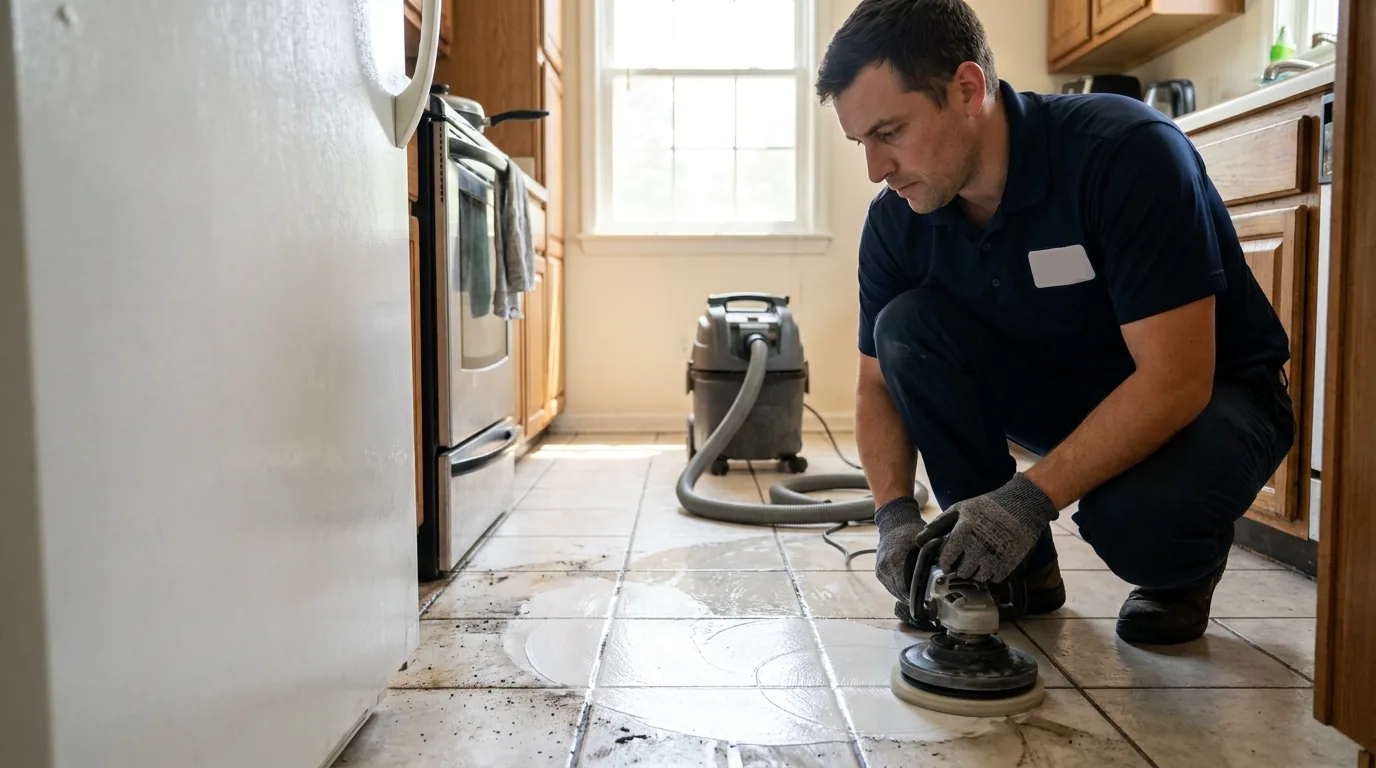
The core of professional grout cleaning is high-temperature, high-pressure hot water extraction applied directly to the grout line, not a mop, not a spin pad, not a steam mop from a hardware store. Commercial truck-mount and portable extraction units generate water temperatures between 200–230°F and pressures calibrated to the grout’s condition. That combination emulsifies bonded soil, soap scum, and biological residue (mildew, bacteria) and pulls it out of the pore structure rather than spreading it.
Before any water hits the floor, an alkaline or pH-appropriate pre-treatment dwell on the grout for 5–10 minutes, loosening the bond between contamination and the calcium silicate matrix. After extraction, the technician inspects individual grout lines under a work light, dark spots that survive the first pass get a second targeted application. On natural stone tile (travertine, slate, limestone), the chemistry shifts: acidic cleaners that work on ceramic will etch stone, so the pre-treatment and rinse chemistry changes entirely.
A full grout cleaning and sealing appointment on a standard kitchen or bathroom floor typically runs 2–4 hours. Large-format commercial floors or heavily neglected grout may run longer. The floor is walkable within 30–60 minutes of sealing, depending on the sealer type.
Our process
-
Surface inspection and pH test. Before any product touches the tile, the technician identifies the tile type (ceramic, porcelain, natural stone, glass mosaic), grout type (sanded, unsanded, epoxy), and existing sealer condition. A simple pH test on the grout surface guides pre-treatment selection. Skipping this step is how stone tile gets etched.
-
Pre-treatment application and dwell. An alkaline degreaser or stone-safe surfactant is applied to the grout lines and allowed to penetrate for 5–10 minutes. For heavy soap scum or hard-water scale, common in Utah County’s hard municipal water, a targeted descaling agent may be worked in by hand along the worst sections before the machine pass.
-
High-temperature pressure extraction. The technician runs a spinning jet tool or grout-line wand across the floor in overlapping passes. Water temperature, pressure, and vacuum recovery happen simultaneously, so the floor isn’t flooded. This is the step that physically removes what’s been living in the grout, not just what’s sitting on top of it.
-
Spot treatment and color-seal assessment. After the main extraction pass, the technician walks the floor under direct light. Persistent staining, often iron oxide (rust) from hard water, or dye transfer from colored cleaning products, gets a targeted treatment. At this point, if the grout has uneven color from years of differential soiling, color sealing is discussed as an option to restore visual uniformity.
-
Grout sealing. A penetrating siloxane or fluoropolymer sealer is applied to clean, dry grout lines. Penetrating sealers soak into the pore structure and repel water and oil at the molecular level; they don’t sit on top as a film that peels. The sealer needs 24 hours to fully cure, though light foot traffic is fine within an hour.
What separates a good tile & grout cleaning from a bad one
The most common shortcut in this industry is skipping the pre-treatment dwell time. Rushing straight to the pressure tool without letting chemistry do its work means the machine is moving surface dirt rather than extracting embedded contamination. You’ll see a dramatic improvement on the day, but the grout re-soils faster because the deeper layer was never addressed.
The second common failure is using the wrong chemistry on natural stone. Ceramic and porcelain tolerate a wide pH range; travertine, marble, and limestone do not. An acidic descaler that’s perfectly appropriate on a ceramic bathroom floor will dull and pit a travertine surround in one application. Any technician who doesn’t ask what kind of tile they’re working on before mixing product is a risk.
Finally, sealing without confirming the grout is dry is a guaranteed callback. Sealer applied over damp grout traps moisture inside, which accelerates mildew growth and causes the sealer to fail within weeks. Moisture meter readings on the grout before sealing aren’t optional, they’re the difference between a job that holds up for 3–5 years and one that fails by next season.
Seasonal and regional considerations
Saratoga Springs and the broader Utah Valley sit in a semi-arid climate, but interior humidity still fluctuates meaningfully between summer monsoon season (July–September) and the dry winter months. Grout sealer applied during the driest winter weeks cures faster and bonds more consistently than sealer applied during a humid August afternoon. If you’re planning a full bathroom or kitchen tile restoration, scheduling in late spring or early fall gives the best sealing conditions. Utah County’s water supply also runs notably hard, calcium and magnesium deposits build up in grout lines faster here than in softer-water markets, which is why descaling is a more frequent part of the pre-treatment process for homes in Saratoga Springs, Eagle Mountain, and Lehi.
Service area
Home Pride Restoration and Cleaning is based in Saratoga Springs and provides tile & grout cleaning throughout Utah County and the surrounding Wasatch Front, including Eagle Mountain, Lehi, American Fork, Pleasant Grove, Orem, and Provo. Dedicated service-area pages for each city link back here for the full technical detail on what the work actually involves.
If your tile floor looks like no amount of mopping is making a difference, that’s not a cleaning frequency problem, it’s a grout porosity problem. Call (801) 995-2437 to schedule your tile and grout restoration, and we’ll tell you within the first few minutes of the inspection whether sealing alone will do the job or whether the grout needs a full deep extraction first.
Frequently Asked Questions
How do I know if my grout needs cleaning, sealing, or full grout restoration — and what's the difference?
How long does grout sealer actually last, and what shortens its lifespan?
Can high-pressure cleaning crack or damage my tile or grout?
Why does my grout look clean right after mopping but gray again within a few days?
Is professional tile and grout cleaning safe for natural stone like travertine or marble?
Looking for the best tile & grout cleaning company in Saratoga Springs?
Home Pride Restoration and Cleaning provides licensed and insured tile & grout cleaning in Saratoga Springs, UT and the surrounding area, and has served local property owners since 1997. Customers rate us 5.0 out of 5 stars across 36 Google reviews. We answer calls 24/7 — call (801) 995-2437 for immediate help.
Need Tile & Grout Cleaning now?
We respond 24/7 across Saratoga Springs and surrounding UT cities.
Related Coverage
- Our Restoration Services
- Contact Home Pride Restoration and Cleaning
- Tile & Grout Cleaning in American Fork
- Tile & Grout Cleaning in Eagle Mountain
- Tile & Grout Cleaning in Herriman
- Tile & Grout Cleaning in Lehi
- Tile & Grout Cleaning in Orem
- Tile & Grout Cleaning in Pleasant Grove
- Tile & Grout Cleaning in Provo
- Tile & Grout Cleaning in Riverton
- Tile & Grout Cleaning in South Jordan