
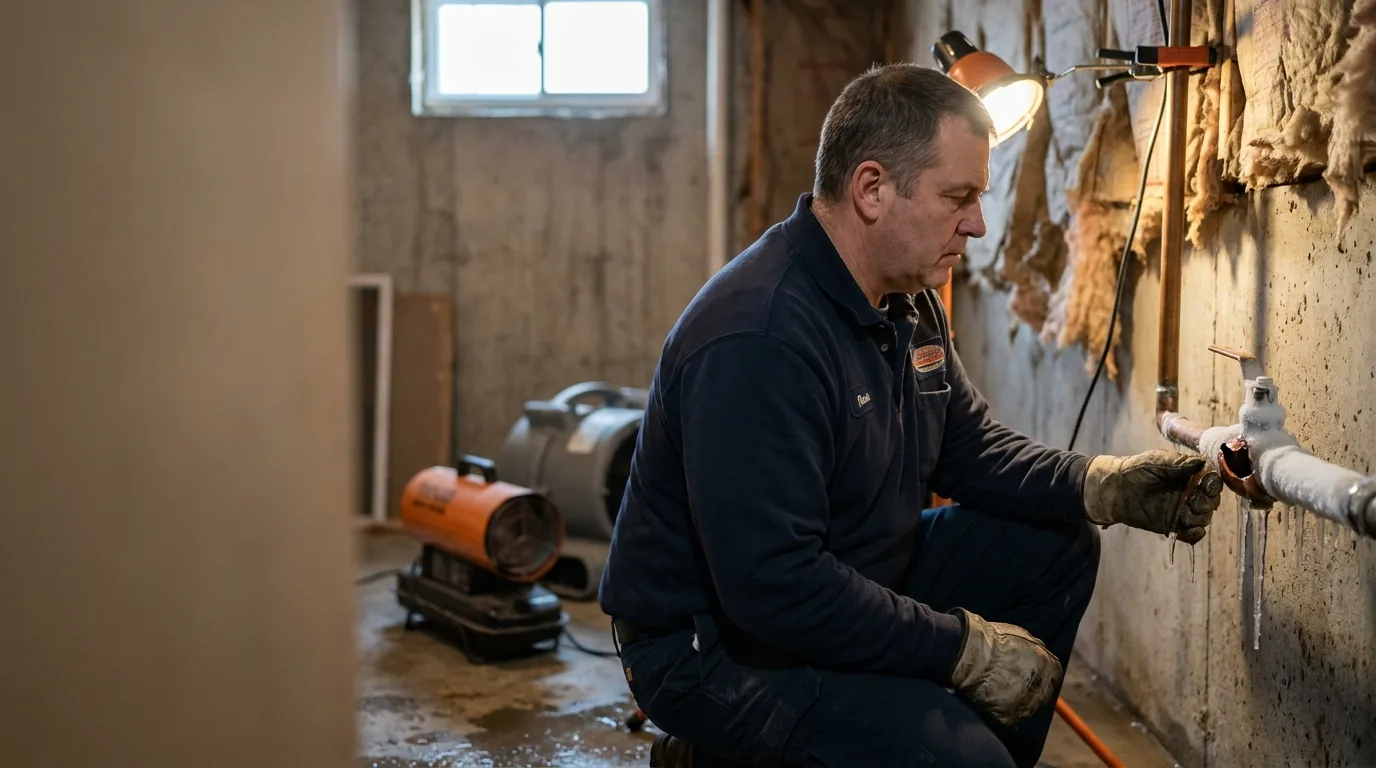
Frozen Pipe Restoration in Provo
24/7 frozen pipe restoration in Provo, UT. IICRC-certified, insurance billing accepted. Call (801) 995-2437.
Our IICRC-certified technicians are dispatched from our Saratoga Springs, UT headquarters and are typically on-site in Provo within 60 minutes of your call.
Provo winters are deceptively cold. The valley sits at roughly 4,500 feet, and when an Arctic inversion settles over Utah County and overnight lows drop into the single digits, the pipes inside uninsulated exterior walls, common in the older brick bungalows near the BYU campus and in the tightly packed neighborhoods east of University Avenue, can freeze solid in a matter of hours. When those pipes thaw, the water doesn’t politely announce itself. It soaks into subfloor sheathing, wicks up drywall, and starts the clock on secondary damage before most homeowners realize anything is wrong. Home Pride Restoration and Cleaning has been responding to exactly this scenario since 1997, and our IICRC-certified crews know what Provo’s climate does to residential plumbing.
Why Provo Properties Are Especially Vulnerable to Frozen Pipe Damage
Provo’s housing stock spans nearly a century of construction, and that range matters when a pipe bursts. Homes built in the 1940s and 1950s, concentrated in the Joaquin and Tree Streets neighborhoods, were often framed with minimal cavity insulation and plumbing routed along exterior walls in ways that wouldn’t pass a modern code inspection. When temperatures plunge below 20°F, those wall cavities act like a refrigerator around copper and galvanized supply lines.
The geography compounds the risk. Cold air drainage from the Wasatch Front funnels down into the valley floor, meaning neighborhoods closer to the foothills can see temperatures 5–8 degrees colder than what the official NWS station records at the Provo Airport. A homeowner who checks the forecast and thinks “it’s only 28 degrees tonight” may be looking at 20°F conditions inside a poorly insulated garage or crawl space. Provo also sits in a hard-water zone, the mineral buildup inside older galvanized pipes narrows the interior diameter over decades, which makes those pipes more susceptible to freeze-expansion cracking than newer copper or PEX lines.
Our Frozen Pipe Restoration Process in Provo
When you call us after a pipe has thawed and released water, the first priority is stopping the damage from spreading, not just mopping up what’s visible. Here’s how a typical Provo job unfolds:
1. Rapid assessment and water shutoff confirmation. We verify the main has been shut (Utah County homes are served by Provo City Power and Provo City water utilities; knowing the shutoff location matters). If water is still actively releasing, we help you locate the valve.
2. Moisture mapping. Using thermal imaging cameras and calibrated moisture meters, we trace water migration behind drywall, under flooring, and into subfloor assemblies. In older Provo homes with hardwood over board sheathing, common in the Joaquin neighborhood, water travels laterally much farther than it does under modern plywood subfloors.
3. Structural drying. We deploy commercial-grade desiccant dehumidifiers and air movers sized to the affected area. Provo’s low relative humidity in winter is actually an asset here, ambient conditions accelerate drying compared to coastal climates, but we still monitor psychrometric readings daily until the structure reaches target moisture levels.
4. Controlled demolition if needed. When wet insulation or saturated drywall can’t be dried in place within the acceptable window (typically 3–5 days to prevent secondary mold colonization), we remove the minimum necessary material, document everything for your insurance claim, and prepare the cavity for reconstruction.
5. Reconstruction and final documentation. Once dry standards are met, we rebuild, drywall, insulation, paint, flooring, and provide a written drying log for your insurer.
Response Time from Our Saratoga Springs HQ to Provo
Our headquarters is in Saratoga Springs, roughly 18 miles northwest of central Provo via US-89 South or I-15. Under normal conditions, that’s a 25–35 minute drive. During a winter storm event, the exact conditions that cause pipe failures, we budget 40–50 minutes and dispatch as soon as you call. For addresses in the 84601 ZIP code (central and south Provo, including neighborhoods near the Provo Towne Centre), we can typically have a crew on-site within the hour. We run 24/7 emergency response, so a 2 a.m. call on a January night gets the same crew mobilization as a weekday afternoon.
Local Note: What Provo’s Inversion Season Means for Drying Timelines
Here’s something that only comes up when you’ve worked Utah County winters for a while: during a persistent temperature inversion, outdoor air in the valley can actually be more humid than normal winter air because cold air traps moisture near the ground. If you open windows trying to air out a water-damaged room during an inversion event, you may be pulling in 60–70% relative humidity air rather than the dry 20–30% RH you’d expect in a Utah winter. We’ve seen homeowners inadvertently slow their own drying by ventilating at the wrong time. Our crews check current valley conditions before deciding whether to use fresh-air ventilation or run the structure as a closed drying system, a call that can shave a full day off your drying timeline.
If you’re dealing with a burst or thawed pipe right now, call Home Pride Restoration and Cleaning at (801) 995-2437. We’re licensed in Utah (RC-25-0737), IICRC certified, and we’ve been responding to Provo’s winter pipe emergencies long enough to know exactly what this valley’s climate throws at a house. The sooner the drying equipment is running, the less of your home ends up in a dumpster.
Serving Provo from our Saratoga Springs headquarters — ★ 5.0 · 36 Google reviews
“He did an amazing job! My stairs were so bad and they looked brand new when he got done!” — B, August 2026Read our reviews on Google →
Frozen Pipe Restoration in Provo: Service Coverage
Frequently Asked Questions
How fast can you arrive for frozen pipe restoration in Provo?
How quickly can you reach a home in the Joaquin neighborhood after a pipe bursts?
Are the older homes near BYU campus more likely to suffer serious damage from a frozen pipe than newer Provo construction?
Does Provo's hard water affect how frozen pipe damage is assessed or repaired?
Will my homeowner's insurance cover frozen pipe water damage in Utah, and can you help with the claim?
How long does the drying process typically take for a frozen pipe loss in a Provo home?
Frozen Pipe Restoration response in Provo
Most Provo calls see a technician on-site within 60 minutes from our Saratoga Springs headquarters.