
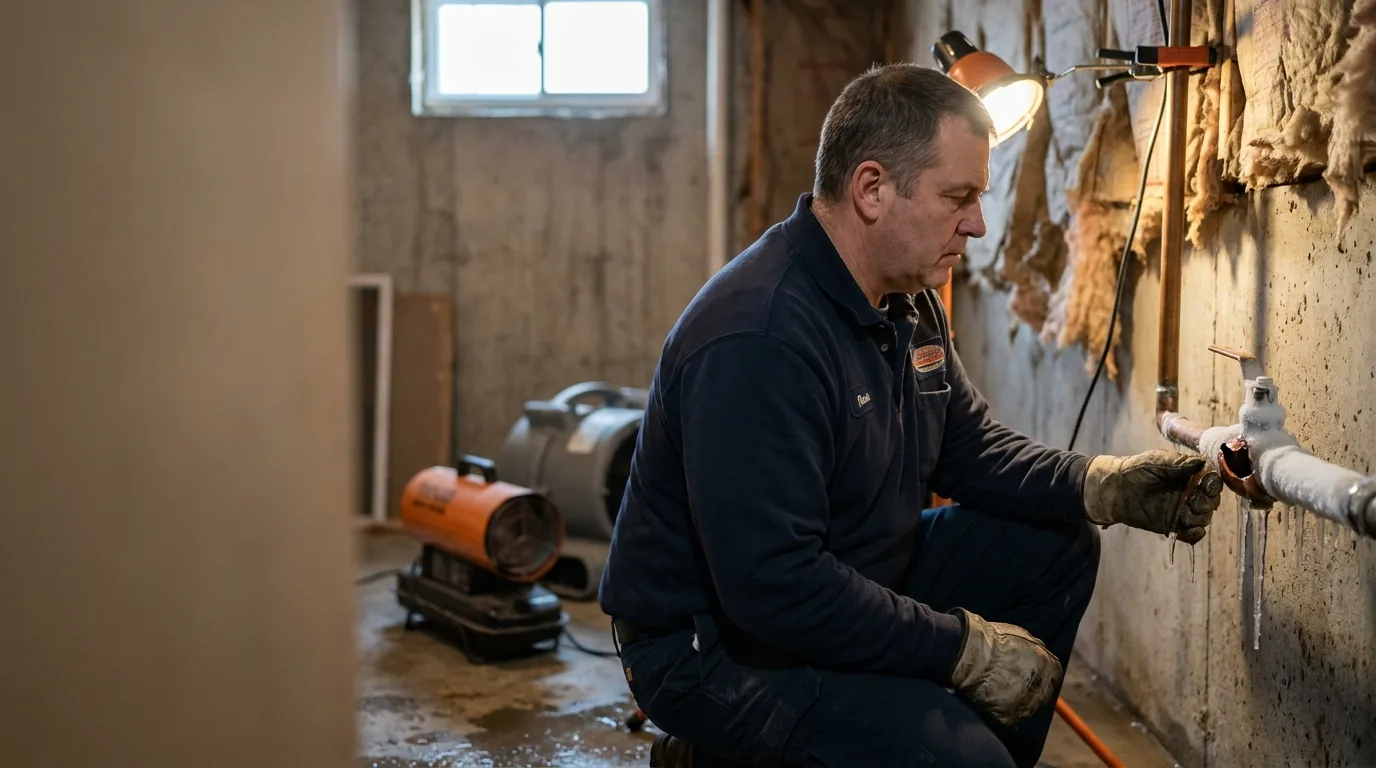
Frozen Pipe Restoration in Eagle Mountain
24/7 frozen pipe restoration in Eagle Mountain, UT. IICRC-certified, insurance billing accepted. Call (801) 995-2437.
Our IICRC-certified technicians are dispatched from our Saratoga Springs, UT headquarters and are typically on-site in Eagle Mountain within 60 minutes of your call.
Eagle Mountain sits at roughly 4,900 feet elevation on the western bench of Utah County, where January lows regularly drop into the single digits and wind off the Oquirrh Mountains can push wind-chill temperatures well below zero. That combination is hard on the copper and PEX supply lines running through exterior walls and uninsulated garage spaces in the city’s fast-built subdivisions, and when those pipes freeze and then thaw, the resulting water release can soak framing, insulation, and drywall in minutes. Home Pride Restoration and Cleaning has handled that exact sequence of events across Eagle Mountain since the city’s growth surge began, and we know what the damage looks like before the walls are even opened.
Why Eagle Mountain Homes See More Frozen Pipe Events Than Neighboring Cities
Eagle Mountain’s development pattern matters here. The bulk of the housing stock was built between 2000 and 2020 by production builders working quickly on large plats. In that era, it was common to route supply lines through exterior-facing walls in garage-adjacent spaces, areas that see almost no heat transfer on a cold night. Homes in subdivisions along Ranches Parkway and near the Pony Express Parkway corridor frequently have this configuration. When overnight temperatures fall below 10°F and the garage door is left cracked, or when a thermostat drops during a vacation, those lines freeze within a few hours. The pipe doesn’t burst while it’s frozen, it bursts when it thaws, often mid-morning when a homeowner is already at work. By the time anyone notices, water has been running inside the wall cavity for 30 minutes or more.
The city’s rapid growth also means some homes were built during periods of high contractor demand, when insulation installation wasn’t always inspected as closely as it should have been. Thin or missing insulation in rim joist areas and crawl spaces is a pattern we see repeatedly on Eagle Mountain service calls, particularly in homes built between 2004 and 2009.
Our Frozen Pipe Restoration Process in Eagle Mountain
When we arrive, the first priority is stopping active water flow, that means locating the main shutoff, which in Eagle Mountain’s newer homes is typically in the garage or utility room near the water heater. Once flow is controlled, we use thermal imaging cameras to trace the moisture migration inside walls and under flooring before anything is opened. This step matters because water in a framed wall cavity doesn’t stay put; it follows the path of least resistance downward, and in a two-story home it can travel a full floor before pooling.
After mapping the damage, we extract standing water with truck-mounted and portable extraction units, then set drying equipment, industrial desiccant or refrigerant dehumidifiers and high-velocity air movers, calibrated to the square footage and material types involved. Utah’s low ambient humidity actually helps drying times compared to coastal climates, but it doesn’t eliminate the risk of secondary mold growth if materials stay wet beyond 48–72 hours. We monitor moisture readings daily and don’t close out a job until structural readings return to regional baseline. As an IICRC-certified firm, our drying protocols follow the S500 standard for water damage restoration.
Response Time to Eagle Mountain
Our headquarters is in Saratoga Springs, which puts us roughly 10–15 minutes from most Eagle Mountain addresses via Redwood Road or the Pony Express Parkway interchange depending on traffic. For calls coming in during normal business hours, a technician is typically on-site within 45–60 minutes of your call. After-hours and weekend calls average 60–90 minutes given drive time and equipment staging. If you’re in the northern sections of Eagle Mountain closer to the Ranches area, add 5–10 minutes to those estimates, but we’ll give you a realistic ETA when you call (801) 995-2437 so you’re not waiting and wondering.
Eagle Mountain Insurance Coordination
Frozen pipe damage is generally covered under standard HO-3 homeowner policies as a sudden and accidental loss, but the documentation has to be thorough. Adjusters want to see moisture mapping data, equipment logs, and photo documentation of affected materials before and after. We provide all of that as a standard part of every job file, and we’re experienced working with the major carriers that cover Eagle Mountain’s large HOA-governed communities. If your subdivision has an HOA with its own master policy covering common elements, we can help clarify which policy responds to which portion of the damage, a question that comes up more than you’d expect in Eagle Mountain’s denser townhome sections.
Local Note: Garage Plumbing and Eagle Mountain’s Cold Snaps
One thing we’ve learned specifically from working Eagle Mountain over the years: the city’s elevation and its position on the valley bench mean cold snaps here can be 5–8 degrees colder than what’s showing on Salt Lake County weather apps, which many residents use as their reference. Homeowners who set their thermostat to 60°F during a weekend trip based on a Salt Lake forecast have come home to burst pipes because the actual overnight low at their address was closer to 5°F. If your home has any plumbing in an attached garage, a utility sink, a softener, a second water heater, those lines need either heat tape or a garage temp above 40°F on the coldest nights. It’s a small detail, but it’s the difference between a normal winter and a $15,000 claim.
If a pipe has already let go, call us at (801) 995-2437. We’ll be on the road to Eagle Mountain quickly, and we’ll handle the damage documentation, the drying, and the insurance coordination so you can focus on getting your home back to normal.
Serving Eagle Mountain from our Saratoga Springs headquarters — ★ 5.0 · 36 Google reviews
“I was nervous at first, but the staff made me feel comfortable. They arrived quickly for emergency water removal and had the water out of my home in no time. I really appreciated their fast response and professional service.” — Amy, July 2026Read our reviews on Google →
Frozen Pipe Restoration in Eagle Mountain: Service Coverage
Frequently Asked Questions
How fast can you arrive for frozen pipe restoration in Eagle Mountain?
How quickly can Home Pride reach homes near the Ranches Parkway area of Eagle Mountain during a pipe burst emergency?
Are Eagle Mountain homes built in the mid-2000s more vulnerable to frozen pipe damage than newer construction?
Does Eagle Mountain's elevation affect how long the drying process takes after a thawed pipe floods a room?
Will my homeowner's insurance cover frozen pipe water damage in Eagle Mountain, and what documentation do I need?
What's the biggest mistake Eagle Mountain homeowners make after discovering a burst pipe in winter?
Frozen Pipe Restoration response in Eagle Mountain
Most Eagle Mountain calls see a technician on-site within 60 minutes from our Saratoga Springs headquarters.