
Storm Damage Restoration in Pleasant Grove
24/7 storm damage restoration in Pleasant Grove, UT. IICRC-certified, insurance billing accepted. Call (801) 995-2437.
Our IICRC-certified technicians are dispatched from our Saratoga Springs, UT headquarters and are typically on-site in Pleasant Grove within 60 minutes of your call.
When a fast-moving storm rolls down the Wasatch Front and stalls over Utah Valley, Pleasant Grove tends to catch the worst of it. The city sits at the base of Mount Timpanogos, where cold canyon air funnels south along the foothills and collides with warmer valley air, a pattern that produces sudden microbursts, hail events, and wind gusts that routinely snap mature trees and strip roofing in a matter of minutes. If your home took a hit last night, the clock is already running on secondary damage.
Why Pleasant Grove Properties See Elevated Storm Damage Risk
The housing stock along the older residential streets near Grove Creek and the foothills includes a mix of mid-century ranch homes and newer two-story builds, and both have vulnerabilities that show up fast after a major storm. Older homes often have original wood fascia and soffits that have been painted over for decades; once wind-driven rain gets behind a compromised edge, it saturates the sheathing before you see a single interior stain. Newer homes in the developments closer to 2100 North frequently have steeper roof pitches that shed snow well but create more surface area for wind uplift during summer convective storms.
Utah Valley also sits in a hail corridor. Storms tracking northeast out of the Provo area regularly produce golf ball-sized hail before dissipating over the Traverse Mountains. That hail doesn’t just dent gutters, it fractures asphalt shingles in ways that aren’t visible from the ground, leaving a roof that looks intact but leaks every time it rains for the next six months.
Our Storm Damage Restoration Process in Pleasant Grove
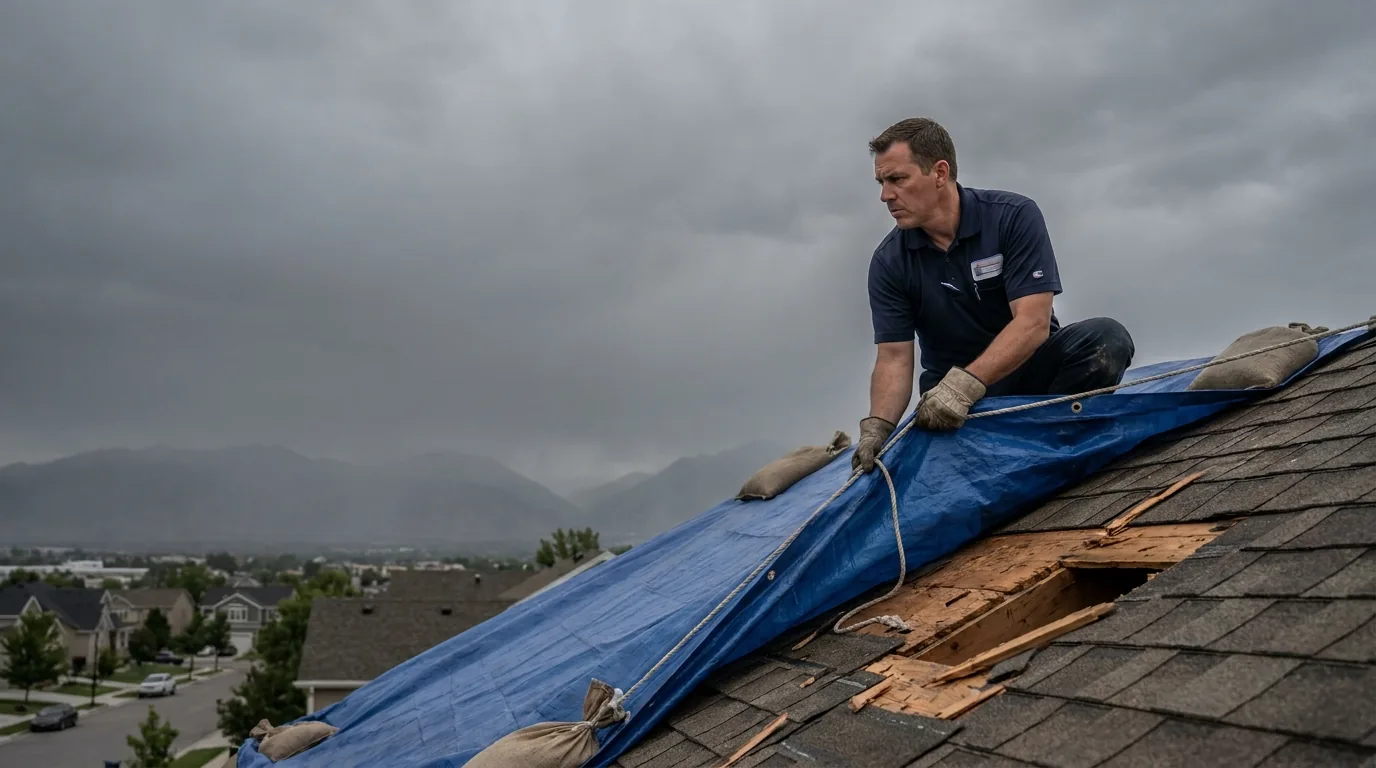
The first thing we do on-site is a structured damage assessment, roof, envelope, and interior in that order. We document everything with photos and moisture readings before a single piece of debris moves, because insurance adjusters need that baseline. If a tree has come through a roof or wall, we deploy emergency tarping and board-up immediately to stop active water intrusion while the full scope is being written.
Once the structure is stabilized, interior drying begins. Storm events in Pleasant Grove often drive water horizontally through window frames, attic vents, and soffit gaps, meaning the moisture path isn’t always where you’d expect it. We use thermal imaging to trace water migration behind walls and under flooring before setting drying equipment. Industrial air movers and desiccant dehumidifiers run on a documented drying protocol; we pull moisture readings every 24 hours and log them for the claim file.
Structural repairs, framing, sheathing, roofing, drywall, insulation, follow once materials are dry and the adjuster has signed off on scope. We carry License #RC-25-0737 and handle both the mitigation and the rebuild under one contract, which cuts weeks off the typical timeline.
Response Time to Pleasant Grove
Home Pride’s headquarters is in Saratoga Springs, roughly 15 minutes from Pleasant Grove via Redwood Road north to State Street. On a clear day with no canyon-road closures, we can have a crew staged at your address within 45 to 60 minutes of your call. During a widespread storm event, when multiple properties in Utah County are calling simultaneously, we triage by active water intrusion and structural exposure first. Calling (801) 995-2437 immediately after the storm passes, rather than waiting to assess damage yourself, keeps your position in that queue.
Pleasant Grove Insurance Coordination
Most homeowners’ policies in Utah County cover sudden storm damage, but the documentation requirements vary by carrier. We’ve worked with the full range of adjusters active in this market and know what they need to approve a claim efficiently: moisture logs, photo documentation with timestamps, a written scope of loss, and, for older homes, a clear distinction between storm-caused damage and pre-existing deterioration. We provide all of that as a standard part of the job, not an add-on.
If your neighborhood has an HOA, check your CC&Rs before any exterior repairs begin. Some developments near the newer subdivisions off Battle Creek Drive require HOA approval for roofing material changes, even on a storm-damage replacement. We flag those situations early so a color or material mismatch doesn’t create a compliance issue after the work is done.
Local Note
One thing we’ve learned working the Pleasant Grove foothills: cottonwood and box elder trees, common in yards backing up to the Grove Creek drainage corridor, have shallow root systems that make them prone to uprooting in saturated soil. After a heavy rain event followed by high winds, these trees fall whole rather than snapping, and the root ball pulls up a significant section of yard, sometimes taking irrigation lines and fence footings with it. That’s a different cleanup and grading situation than a simple tree-on-roof call, and it’s worth mentioning when you call so we bring the right equipment.
If your property in the 84062 ZIP code took storm damage last night, don’t wait to see if it dries on its own. Call (801) 995-2437, we’ve been handling Utah Valley storm response since 1997, and we’re IICRC Certified in the restoration methods that protect your home and your claim.
Serving Pleasant Grove from our Saratoga Springs headquarters — ★ 5.0 · 36 Google reviews
“I was nervous at first, but the staff made me feel comfortable. They arrived quickly for emergency water removal and had the water out of my home in no time. I really appreciated their fast response and professional service.” — Amy, July 2026Read our reviews on Google →
Storm Damage Restoration in Pleasant Grove: Service Coverage
Frequently Asked Questions
How fast can you arrive for storm damage restoration in Pleasant Grove?
How quickly can Home Pride reach a Pleasant Grove address after a storm?
Are homes near the Grove Creek corridor in Pleasant Grove more vulnerable to storm damage?
Does Pleasant Grove's position at the base of Mount Timpanogos affect the type of storm damage we should expect?
What does the storm damage restoration process look like from first call to finished repairs?
Do HOA rules in Pleasant Grove's newer subdivisions affect storm damage repairs?
Will my homeowners insurance cover storm damage restoration in Pleasant Grove?
Storm Damage Restoration response in Pleasant Grove
Most Pleasant Grove calls see a technician on-site within 60 minutes from our Saratoga Springs headquarters.