
Storm Damage Restoration in Eagle Mountain
24/7 storm damage restoration in Eagle Mountain, UT. IICRC-certified, insurance billing accepted. Call (801) 995-2437.
Our IICRC-certified technicians are dispatched from our Saratoga Springs, UT headquarters and are typically on-site in Eagle Mountain within 60 minutes of your call.
Eagle Mountain sits at roughly 4,900 feet on the western bench of Utah County, where fast-moving storm cells rolling off the Oquirrh Mountains can drop golf ball–sized hail, snap mature trees, and leave standing water in finished basements within the same hour. When that happens, the clock starts immediately, wet insulation begins to compress and lose R-value within hours, and saturated OSB sheathing in the newer construction that dominates Eagle Mountain’s subdivisions can begin to delaminate before the rain even stops. Home Pride Restoration and Cleaning has been responding to those calls since 1997, and our Saratoga Springs headquarters puts us minutes from the communities most likely to take a hit.
Why Eagle Mountain Properties Are Especially Vulnerable to Storm Damage
Eagle Mountain’s rapid growth, most of the housing stock here was built between 2000 and the present, means the city is full of large-footprint homes with wide, low-pitched rooflines that collect debris and standing water efficiently. That’s a structural advantage in calm weather and a liability during a severe storm. Flat or gently sloped sections of roofing common in many Ranches at Eagle Mountain and Pony Express communities can hold water long enough for a single compromised shingle tab to allow significant intrusion.
The soil profile matters too. Much of Eagle Mountain is built on expansive clay soils that shed water quickly when saturated, redirecting runoff toward foundation walls and window wells rather than absorbing it. A storm that drops two inches of rain in forty minutes, not unusual during a July monsoon push, can overwhelm window well drains and send water into lower-level living spaces faster than most homeowners expect. Combine that with the area’s elevation-driven wind exposure and you have a consistent pattern: roof damage above, water intrusion below, often in the same event.
Our Storm Damage Restoration Process in Eagle Mountain
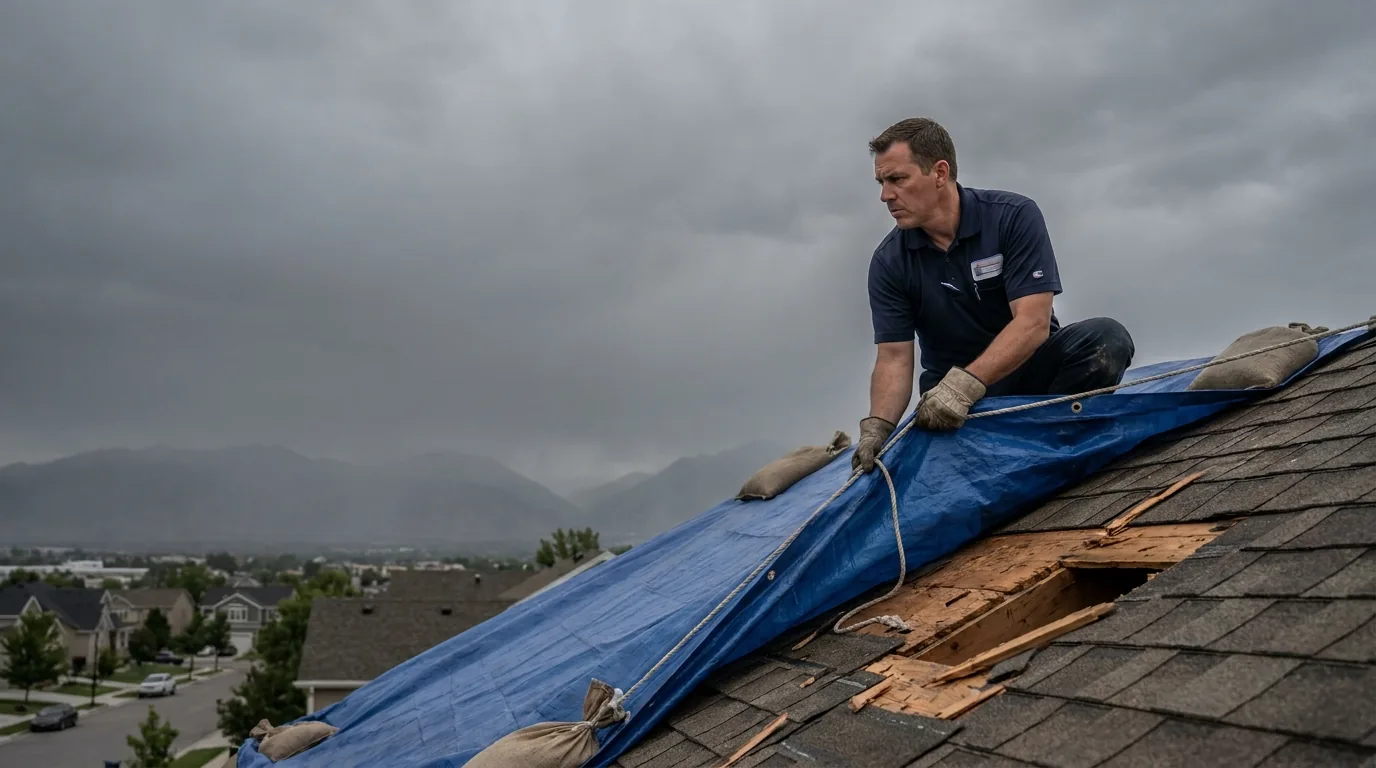
The first thing we do on arrival is a rapid exterior triage, we’re looking at the roof, soffits, fascia, and any compromised windows or doors before we step inside. Temporary tarping and board-up happen the same visit when needed, because a secondary rain event is always possible and a covered opening is the difference between a contained loss and a worsening one.
Inside, we use thermal imaging cameras and calibrated moisture meters to map exactly where water has traveled. In Eagle Mountain’s newer builds, water often tracks along the vapor barrier between the foundation and framing before appearing in a finished space, which means the visible damage is rarely the full picture. We document everything with photographs and written moisture readings before extraction begins, because that documentation is what your insurance adjuster needs to approve the full scope of work.
Structural drying follows extraction using commercial-grade desiccant dehumidifiers and high-velocity air movers sized to the actual cubic footage of the affected space, not a one-size estimate. We monitor daily and adjust equipment placement as readings change. Our IICRC-certified technicians follow S500 and S110 drying standards throughout.
Response Time to Eagle Mountain
From our Saratoga Springs location, we reach most of Eagle Mountain via Pioneer Crossing or Pony Express Parkway in under 30 minutes under normal traffic conditions. The Ranches communities on the north end of the city and the newer developments near Ridgeline Drive typically add five to ten minutes depending on the specific address and time of day. We aim to have a crew on-site within 60 minutes of your call for emergency storm response, not a callback window, an actual arrival.
If you’re in the 84005 ZIP code and the storm has just passed, call us before you start pulling up wet carpet yourself. Disturbing saturated materials without proper containment can spread contamination from roof debris or backed-up drains into areas that were previously unaffected.
Eagle Mountain Insurance Coordination
Most storm damage claims in Eagle Mountain run through standard homeowner’s policies, and the documentation we build during our initial assessment is structured to match what adjusters from the major carriers operating in Utah County expect to see. We work directly with your adjuster, provide itemized moisture logs and photo evidence, and can meet on-site during the inspection if that helps move the claim forward. We do not inflate scopes to chase payouts, that approach creates disputes that delay your repair and ultimately cost you more time in a disrupted home.
Local Note
One pattern we’ve seen repeatedly in Eagle Mountain’s Pony Express and Ranches subdivisions: the large three-car garages common in these floor plans often have a subtle negative slope toward the interior that wasn’t an issue when the home was new but becomes a significant water intrusion point after years of minor settling. During a heavy storm, water sheets off the driveway and under the garage door seal before the drain can handle the volume. If your garage shares a wall with finished living space, that water has a direct path to drywall and flooring. It’s worth checking that threshold seal annually, and if you’ve had a storm event, it’s worth having us check behind that shared wall even if the garage floor looks dry.
If a storm has already hit your home, call Home Pride Restoration and Cleaning at (801) 995-2437. We’ll be on-site fast, document everything your insurance company needs, and get Eagle Mountain’s newest and most established neighborhoods dried out and back to normal.
Serving Eagle Mountain from our Saratoga Springs headquarters — ★ 5.0 · 36 Google reviews
“I was nervous at first, but the staff made me feel comfortable. They arrived quickly for emergency water removal and had the water out of my home in no time. I really appreciated their fast response and professional service.” — Amy, July 2026Read our reviews on Google →
Storm Damage Restoration in Eagle Mountain: Service Coverage
Frequently Asked Questions
How fast can you arrive for storm damage restoration in Eagle Mountain?
How quickly can you reach the Ranches at Eagle Mountain after a storm call?
Does Eagle Mountain's clay soil affect how water damage spreads after a storm?
Are the newer homes in Eagle Mountain's Pony Express subdivisions harder to dry out after storm damage?
What does storm damage restoration actually involve beyond tarping the roof?
Will my homeowner's insurance cover storm damage repair in the 84005 ZIP code, and how do you help with the claim?
Storm Damage Restoration response in Eagle Mountain
Most Eagle Mountain calls see a technician on-site within 60 minutes from our Saratoga Springs headquarters.