
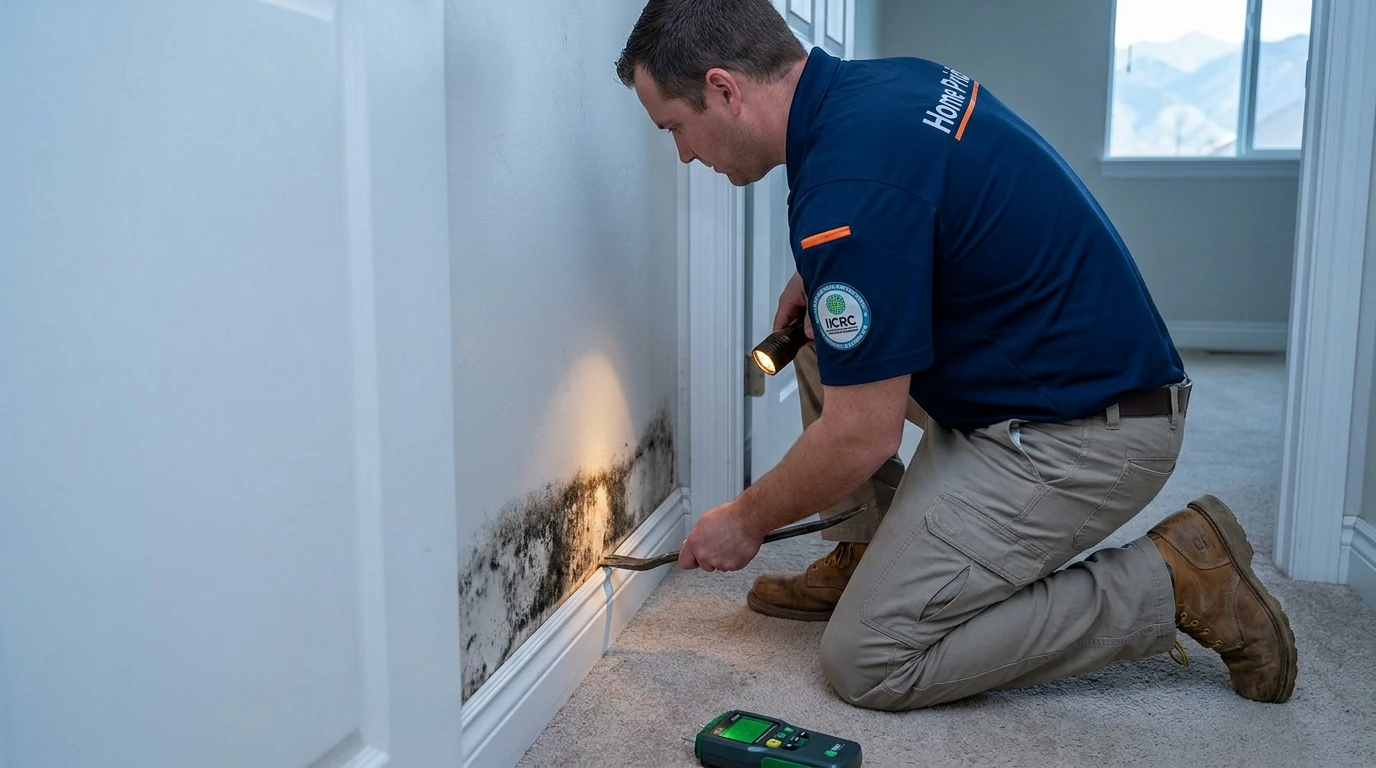
Hidden mold doesn’t announce itself. It grows behind drywall, under flooring, inside HVAC ducts, and inside wall cavities, often for weeks or months before you notice anything wrong. By the time a visible patch appears, the colony is usually far larger than what you can see. The seven signs below are the ones homeowners most commonly overlook, along with what each one actually means and what to do the moment you spot it.
The 7 Signs, What They Look Like and Where to Find Them
1. A musty smell that doesn’t go away after airing out
Mold produces volatile organic compounds (VOCs) as it digests organic material, wood, drywall paper, insulation. The result is a damp, earthy, sometimes sour smell that’s easy to dismiss as an old house quirk. The tell is persistence: if opening windows for a day clears the odor, it’s likely surface-level moisture. If it comes back within 24–48 hours, or if it’s stronger in one specific room, closet, or corner, that’s a sign of an active colony somewhere nearby.
2. Warped, buckled, or soft spots in flooring
Hardwood and laminate floors absorb moisture from below. If a section of your floor feels spongy underfoot, or if boards have started to bow upward, there’s likely water trapped between the subfloor and the finished surface. Mold can colonize a wet subfloor in as little as 24–48 hours under warm conditions, a timeline that’s easy to hit in a Utah summer. Don’t assume the floor dried out just because the leak stopped.
3. Discoloration on walls or ceilings that isn’t a clean water stain
A fresh water stain is usually tan or light brown with a defined ring. Mold staining tends to be gray, green, black, or pinkish, and it often looks fuzzy or irregular at the edges. It may also appear in clusters of small dots rather than one uniform patch. If you see discoloration that doesn’t match the shape of a roof leak or plumbing fixture above it, treat it as mold until proven otherwise.
4. Allergy or respiratory symptoms that improve when you leave home
This one is easy to attribute to seasonal allergies, especially during Utah’s high-pollen spring. The distinguishing factor is location: if your symptoms, sneezing, congestion, itchy eyes, or a persistent cough, consistently improve when you spend a day outside or travel overnight, and return when you come back, the indoor air quality of your home is worth investigating. This isn’t a diagnosis, but it’s a pattern worth taking seriously.
5. Peeling paint or wallpaper with no obvious water source
Paint and wallpaper adhesive fail when the substrate behind them gets wet. If paint is bubbling or peeling in an area that hasn’t been directly splashed or flooded, moisture is migrating through the wall from inside, often from a slow pipe leak or condensation buildup in an exterior wall. In Saratoga Springs, exterior walls on the north and west sides of homes are especially prone to condensation issues during freeze-thaw cycles in late winter.
6. Visible mold in one spot, but only a small amount
This sounds counterintuitive, but a small visible patch is often a sign of a much larger hidden colony. Mold visible on a surface is the fruiting body; the root structure (called hyphae) penetrates deep into porous materials. A two-inch spot on drywall can correspond to a colony covering several square feet on the paper backing and inside the wall cavity. Cleaning the surface with bleach removes the color but not the roots, and the colony typically regrows within days.
7. A history of water intrusion, even one that was “fixed”
If your home has had a burst pipe, a roof leak, a flooded basement, or a slow drip under a sink, even one that was repaired months or years ago, mold may have established itself before the moisture was fully removed. This is especially common in finished basements where carpet and drywall were dried with fans but never tested for residual moisture. Water damage that wasn’t professionally dried and documented is one of the most reliable predictors of a hidden mold problem.
What To Do Right Now If You Recognize These Signs
Don’t start demolishing walls or scrubbing surfaces yet. Here’s a practical sequence:
- Stop any active moisture source first. If there’s a dripping pipe, a leaking appliance, or a roof issue, address that before anything else. Mold remediation is pointless if the moisture source remains.
- Reduce humidity in the affected area. Run a dehumidifier if you have one. Keep the space ventilated but don’t use fans to blow air across a suspected mold area, that disperses spores into other rooms.
- Document what you’re seeing. Take photos and note when you first noticed the smell, stain, or symptom. This documentation matters for insurance claims.
- Don’t paint over it, bleach it, or seal it. These approaches mask the problem and can make professional testing harder. They also don’t kill mold inside porous materials.
- Call for a professional assessment if the affected area is larger than about 10 square feet, or if you can’t identify the moisture source. The EPA’s general guidance treats 10 square feet as the threshold above which professional remediation is recommended.
What NOT To Do
- Don’t run your HVAC system if you suspect mold in or near the air handler, ductwork, or return vents. Forced air will carry spores throughout the house.
- Don’t cut into walls yourself without understanding containment. Opening a mold-affected wall cavity without plastic sheeting and negative air pressure releases a concentrated burst of spores.
- Don’t assume it’s just mildew. Surface mildew on a shower tile is a different problem than mold inside a wall cavity. If it’s growing on a non-bathroom surface and keeps coming back, it isn’t mildew.
- Don’t rely on a visual inspection alone. Moisture meters, air sampling, and surface swabs are the only reliable ways to confirm what type of mold is present and how far it has spread.
When To Call a Professional
Call a certified mold remediation company if:
- The visible area is larger than 10 square feet
- You can smell mold but can’t find the source
- Anyone in the home has respiratory conditions, is immunocompromised, or is pregnant
- The mold is near or inside your HVAC system
- The moisture source was a sewage backup or contaminated water
- You’ve already tried cleaning it and it came back within two weeks
A professional assessment typically includes moisture mapping with a non-invasive meter, air quality sampling, and a written scope of work before any demolition begins. IICRC-certified technicians follow the S520 Standard for Mold Remediation, which governs containment, removal, and post-remediation verification testing.
What the Remediation Process Actually Looks Like
If a professional determines remediation is needed, the general sequence is: containment of the affected area with plastic sheeting and negative air pressure, removal of mold-affected porous materials (drywall, insulation, flooring), HEPA vacuuming and antimicrobial treatment of structural surfaces, and a final air clearance test before containment is removed. The timeline for a typical single-room remediation runs two to five days. Reconstruction, replacing drywall, flooring, and finishes, happens after clearance testing confirms the space is clean.
If you’re in the Saratoga Springs area and something on this list sounds familiar, the next step is a professional moisture assessment, not a guess. Home Pride Restoration and Cleaning offers mold inspections and full remediation services for homes across Utah County. You can reach the team directly at (801) 995-2437.