Mold can begin colonizing a wet surface in as little as 24 to 48 hours after water damage, sometimes faster in Utah’s dry-but-warm summer interiors where HVAC systems keep indoor humidity surprisingly hospitable. That window is not a comfortable buffer; it’s a hard deadline. If a pipe burst last night, a roof leak soaked your attic during last week’s storm, or your basement flooded after the Jordan River overflow, the clock started the moment the water arrived.
Why Mold Grows So Fast After a Leak
Mold spores are already in your home. That’s normal, they float in through open windows, ride in on shoes, and drift through HVAC ducts. Under dry conditions they’re dormant and harmless. Add moisture, and the biology changes fast.
Within the first 24 hours, spores that land on wet drywall, wood framing, carpet padding, or insulation begin absorbing water and germinating. By 48 hours, early-stage colonies are anchoring into porous materials. By 72 hours, visible growth, that fuzzy gray, green, or black discoloration, can appear, especially in dark, poorly ventilated spaces like wall cavities, under subfloors, and inside cabinets.
A few conditions accelerate that timeline:
- Temperature between 60°F and 80°F, exactly the range most Saratoga Springs homes sit at year-round
- Relative humidity above 60%, easy to hit inside wet wall cavities even when the rest of the house feels dry
- Organic material, drywall paper, wood studs, and carpet backing are essentially food for mold
- Darkness and still air, the inside of a soaked wall is a perfect incubator
This is why a slow drip behind a bathroom vanity can produce a serious mold problem before you ever smell anything.
The 24-Hour Window: What to Do Right Now
If the water damage happened recently, these steps matter more than any cleanup product you can buy at a hardware store.
- Stop the water source. Turn off the supply valve under the fixture, or the main shutoff if you can’t isolate it. Every minute of active flow makes the remediation harder.
- Remove standing water immediately. A wet-dry shop vac works for small amounts. For anything more than a few gallons, a submersible pump is faster. Don’t let water sit on hardwood or concrete, it wicks into adjacent materials quickly.
- Pull up saturated rugs and carpet padding. The padding beneath carpet holds water like a sponge and is almost impossible to dry in place. It usually needs to go.
- Open cabinets and closet doors. Airflow is your ally. Closed spaces trap humidity and create the dark, still environment mold loves.
- Run fans and a dehumidifier. Point box fans across wet surfaces, not at them, you want to move humid air out of the room, not just circulate it. A dehumidifier pulling 50+ pints per day is meaningful; a small bedroom unit is not.
- Document everything with photos and video. If you have homeowner’s insurance, you’ll need this. Photograph the source, the affected materials, and any visible damage before you move anything.
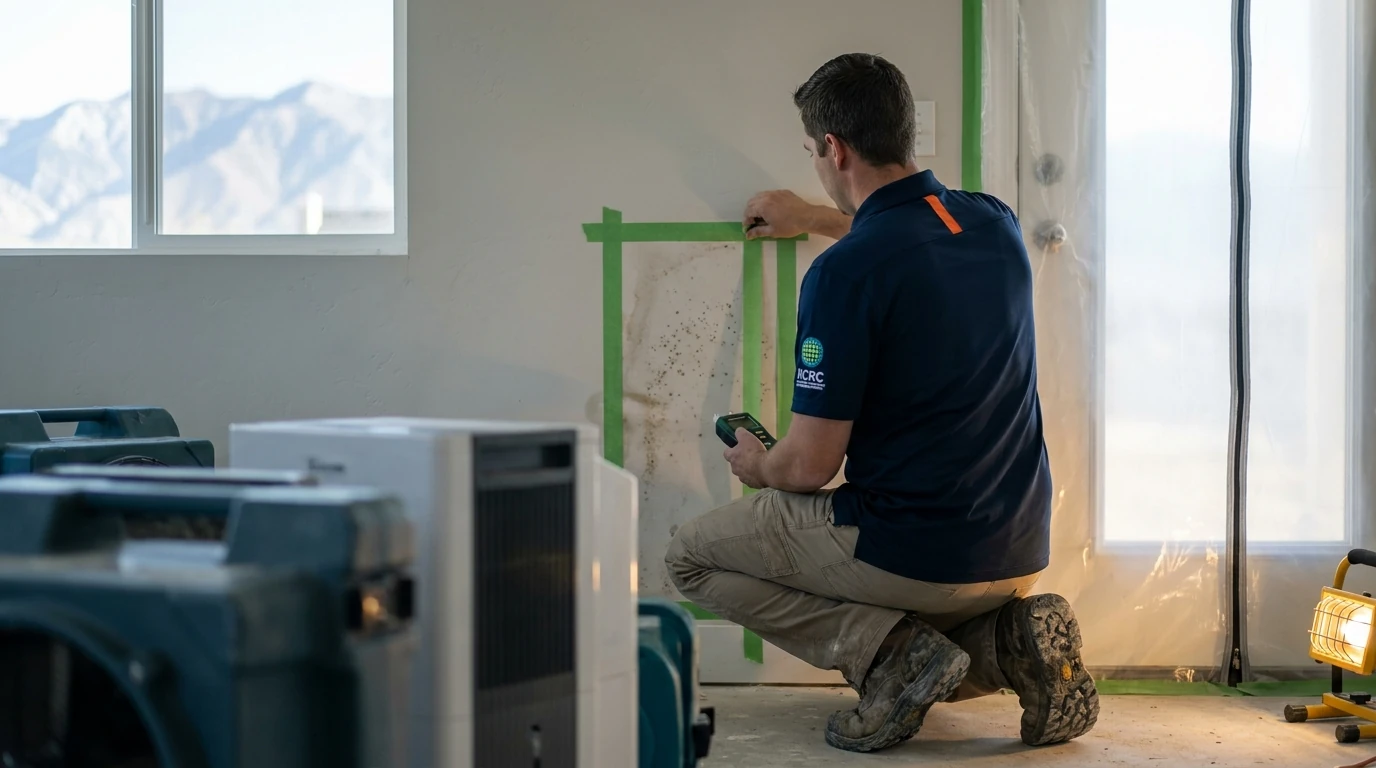
What you’re trying to do in this window is reduce the moisture content of building materials below the threshold where mold can grow, roughly below 16% moisture content in wood, measured with a pin-type moisture meter. That’s the same standard IICRC-certified technicians use when they assess a water loss.
What NOT to Do After Water Damage
Some common instincts make the mold problem worse.
Don’t paint over discoloration or stains. If you see a water stain or early mold growth and paint over it, you’re trapping moisture and organic material behind a sealed surface. The colony continues growing; you just can’t see it anymore.
Don’t run the HVAC to dry things out. If mold spores are already elevated in the affected area, your forced-air system will distribute them to every room in the house. Close off the area and use standalone fans and dehumidifiers instead.
Don’t assume it dried on its own. A ceiling that looks dry two days after a roof leak may have wet insulation above it and wet framing inside the wall. Surface dryness is not structural dryness. This is the most common reason homeowners call for mold remediation months after a water event they thought they handled.
Don’t use bleach on porous materials. Bleach kills surface mold on non-porous materials like tile. On drywall or wood, the water carrier soaks in and feeds the deeper colony while the bleach evaporates off the surface. It looks like it worked. It didn’t.
When the Situation Requires a Professional
Some water damage is genuinely DIY-manageable, a small appliance leak caught within a few hours, on a tile floor, with no adjacent drywall involvement. Most is not.
Call a water damage and mold remediation professional if:
- The water source was a sewage line, toilet overflow, or outdoor flooding (these are Category 3 “black water” losses and carry pathogens, not just mold risk)
- The affected area is larger than roughly 10 square feet of visible mold, the EPA’s general threshold for professional involvement
- Water was present for more than 48 hours before you discovered it
- You can smell a musty odor but can’t find visible growth (growth is likely inside a wall or under flooring)
- Anyone in the home has respiratory sensitivities, asthma, or a compromised immune system
- The damage involves your HVAC system, ductwork, or air handler
A certified technician will use thermal imaging cameras and moisture meters to find water that’s migrated beyond the obvious wet area, often into wall cavities, under hardwood, or into subfloor layers. That hidden moisture is exactly what becomes a mold problem three weeks later.
Home Pride Restoration and Cleaning handles both water damage restoration and mold remediation for homes throughout Saratoga Springs and the surrounding Utah County communities. If you’re not sure whether your situation warrants a call, you can reach the team at (801) 995-2437, they can walk you through what you’re seeing and help you decide.
What Happens If Mold Is Already Growing
If you’re past the 48-hour window and you’re already seeing or smelling mold, the process shifts from prevention to remediation.
Professional mold remediation typically involves:
- Containment, plastic sheeting and negative air pressure to prevent spores from spreading during removal
- Removal of affected materials, drywall, insulation, and sometimes framing that can’t be dried and treated in place
- HEPA vacuuming and antimicrobial treatment of structural surfaces
- Air scrubbing with HEPA filtration to reduce airborne spore counts
- Moisture verification before any reconstruction begins, rebuilding over wet materials is how mold comes back
The reconstruction phase, new drywall, insulation, paint, and finish work, follows only after clearance testing confirms the area is clean and dry. Skipping that verification step is how a remediation job turns into a second remediation job six months later.
If you found this post because you’re looking at a wet wall or a suspicious stain right now, the most useful thing you can do is act on the timeline above, not tomorrow, today. The difference between a $400 drying job and a $4,000 remediation project is often measured in hours, not weeks.