Testing for mold starts with knowing what you’re actually looking for, and understanding that a positive result is only half the answer. If you’ve noticed a musty smell, seen discoloration on drywall, or had a slow leak that sat for more than 48 hours, there’s a real chance mold has already colonized somewhere you can’t see. DIY test kits can confirm that mold spores exist in your air or on a surface, but they can’t tell you the species, the concentration, or, most importantly, where the source colony is hiding. A professional inspection does all three.
What DIY Mold Test Kits Actually Measure
The test kits sold at hardware stores (typically $10–$50) fall into two categories: air sampling plates and surface swab kits.
- Air sampling plates (also called petri dish tests) sit open in a room for a set period, usually 48 hours, then you seal them and mail them to a lab. The lab reports back which mold genera grew on the plate.
- Surface swab kits work faster: you swab a stained or suspect area, seal the sample, and send it off. Results usually come back within a week.
Both methods have a real limitation: mold spores are everywhere. Outdoor air in Utah carries Cladosporium and Alternaria year-round, and a petri dish left open in any room will grow something. The lab report tells you a colony formed, it doesn’t tell you whether the count is elevated above normal background levels, what species poses a health concern, or whether the spores are coming from a wall cavity three feet away or drifting in through an open window.
That said, DIY kits are genuinely useful for one thing: ruling out a problem quickly on a tight budget. If a surface swab on a suspicious dark stain comes back negative for mold genera, you can reasonably conclude that stain is dirt or mineral deposit, not an active colony. That’s worth $20.
Signs You’re Dealing with More Than a Surface Stain
Before you decide which testing route to take, look for the indicators that suggest a larger hidden problem:
- A persistent musty or earthy smell that doesn’t go away after cleaning, mold produces microbial volatile organic compounds (mVOCs) that have a distinctive damp-basement odor even when the colony itself isn’t visible.
- Discoloration that returns within days of cleaning with a bleach solution. Surface mold that keeps coming back usually has a moisture source feeding it from behind the wall.
- Warped, soft, or spongy drywall, especially near baseboards or around windows. In Utah’s high-desert climate, exterior walls and window frames are common entry points for condensation moisture during winter temperature swings.
- Recent water intrusion that wasn’t dried out within 24–48 hours. Mold can begin colonizing porous materials like drywall and insulation in as little as 24 to 48 hours under the right temperature and humidity conditions.
- Unexplained respiratory symptoms, congestion, eye irritation, or worsening asthma, that improve when you leave the house for several days.
If two or more of these apply, a DIY kit is unlikely to give you the full picture.
What a Professional Mold Inspection Includes
A certified mold inspector does several things a petri dish can’t:
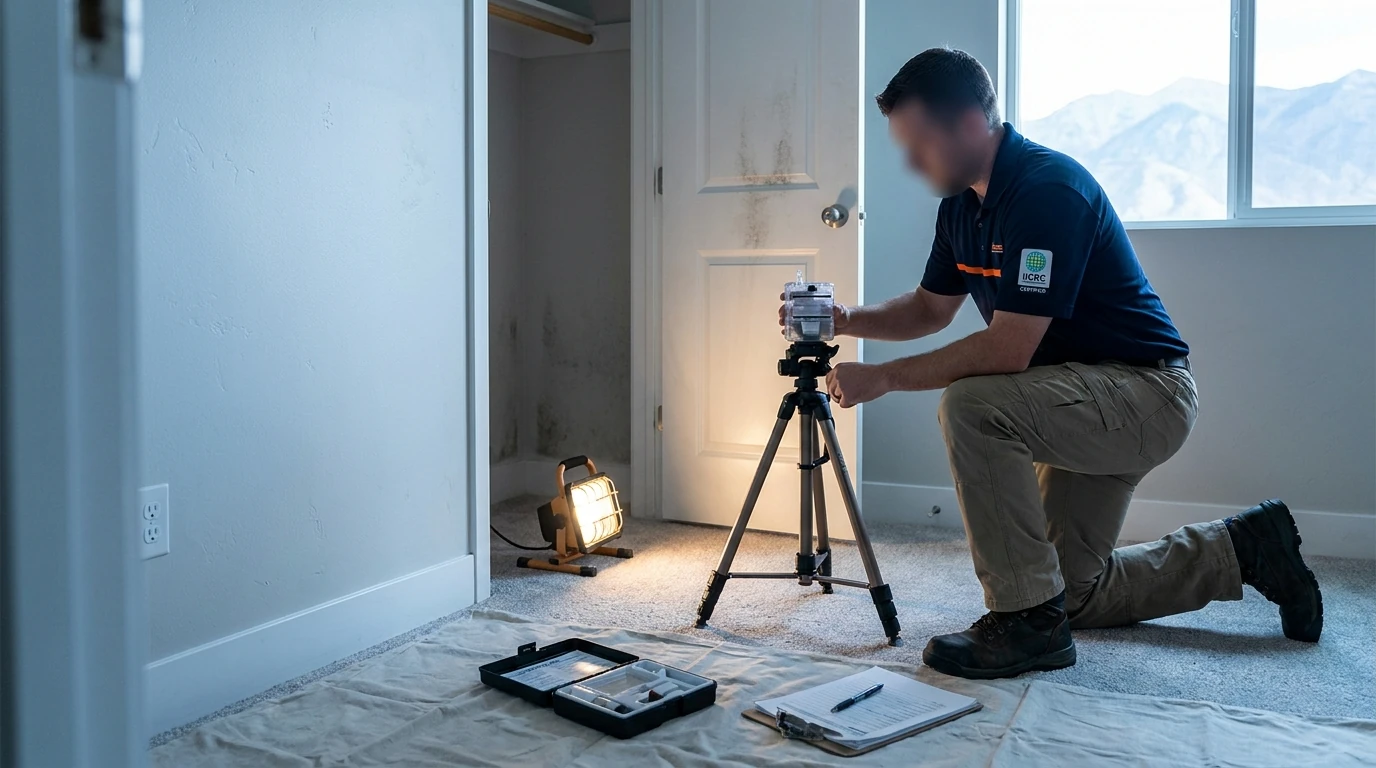
- Moisture mapping. Using a non-invasive moisture meter and sometimes an infrared thermal camera, an inspector can identify wet areas behind walls and under flooring without tearing anything open. This is often where the actual colony is.
- Calibrated air sampling. Professional air samples are collected with a pump that draws a precise volume of air through a cassette. The lab then reports spore counts per cubic meter, not just whether mold grew, but how much and what type, compared against an outdoor baseline sample taken the same day.
- Surface and bulk sampling. If a suspect area is found, the inspector takes a tape lift or a small material sample for lab analysis. This identifies the specific genus and species, which matters because some species (like certain strains of Stachybotrys chartarum, commonly called black mold) have different remediation protocols.
- A written report. A professional inspection produces documentation, useful for insurance claims, real estate transactions, and establishing a baseline before remediation begins.
In the Saratoga Springs and Utah County area, inspectors certified through the IICRC or holding a CMI (Certified Mold Inspector) credential follow standardized sampling protocols. If you’re hiring someone, ask specifically for those credentials and for a lab report from an accredited third-party laboratory, not just a verbal assessment.
What NOT to Do Before Testing
A few common mistakes that skew results or make the problem worse:
- Don’t run HVAC or fans before air sampling. Running forced air before a test redistributes spores through the house and can artificially inflate counts in rooms far from the source, or dilute counts in the room where the problem actually is. If you’re planning a professional inspection, ask the inspector whether to run or shut off your system beforehand.
- Don’t bleach the surface before swabbing it. Bleach kills surface mold cells but doesn’t penetrate porous materials, and it will invalidate a surface swab sample. Test first, then treat.
- Don’t open windows to “air out” the space right before testing. Outdoor spores will flood the sample and make indoor counts look normal even if there’s an active indoor source.
- Don’t assume a negative DIY test clears the house. If the smell persists or symptoms continue after a negative kit result, the colony may be behind a wall where neither an open petri dish nor a surface swab can reach it.
When to Skip the DIY Kit and Call a Professional
Some situations call for a professional inspection from the start, not because DIY kits are useless, but because the cost of a wrong answer is too high:
- After any significant water damage, a burst pipe, a roof leak, a flooded basement, where materials stayed wet for more than 48 hours. By the time you’re wondering whether to test, mold may already be established inside wall cavities.
- Before buying or selling a home. A DIY kit result won’t satisfy a lender, an insurance underwriter, or a buyer’s attorney. You need a signed, lab-backed report.
- If a household member has a compromised immune system, asthma, or a documented mold sensitivity. In these cases, the species identification and spore concentration data from a professional sample matters for medical context, though a mold inspector is not a physician and a mold report is not a medical diagnosis.
- If you’ve already had mold remediated and want to confirm the work is complete. Post-remediation verification (PRV) testing compares indoor spore counts against outdoor baselines to confirm the affected area has returned to normal fungal ecology. This is typically done by a third party, separate from the company that performed the remediation.
Home Pride Restoration and Cleaning offers professional mold inspection and testing for homeowners in Saratoga Springs and the surrounding Utah County area, including the documentation and lab reporting you’d need for insurance or real estate purposes. If the inspection confirms an active colony, the same team can move directly into remediation, which saves time when you’re working against a moisture source that’s still present.
The Bottom Line
A DIY kit is a reasonable first step if you’re on a budget and want to confirm whether a surface stain is actually mold before spending more. But if there’s a smell without a visible source, a history of water intrusion, or any health concern in the household, a professional inspection gives you the species identification, the moisture source location, and the written documentation that a petri dish simply can’t provide. If you’re in the Saratoga Springs area and want a professional set of eyes on the problem, call Home Pride Restoration and Cleaning at (801) 995-2437, even a quick conversation can help you figure out which path makes sense for your situation.