TL;DR: Fire damage restoration in Utah typically costs $3,000–$15,000 for smoke and soot cleanup on a single floor, and $20,000–$75,000 or more when structural repairs are involved. The biggest cost drivers are how many square feet burned, whether framing or drywall needs replacement, and how deeply smoke penetrated the HVAC system. Most standard homeowners policies cover fire damage in full, minus your deductible, but the scope of work your contractor documents is what determines your payout.
You just got the all-clear to re-enter your home, and now the adjuster is asking for a restoration estimate. Or maybe the fire was contained to one room and you’re trying to figure out whether to file a claim at all. Either way, you need real numbers, not a range so wide it’s useless. This guide breaks down fire damage restoration costs for Utah County and Wasatch Front homeowners, by damage level, square footage, and what insurance actually pays.
What Does Fire Damage Restoration Actually Cost?
Fire damage restoration costs in Utah range from about $3,000 for a minor kitchen fire with limited soot spread to $75,000 or more for a whole-home loss with structural damage. The national average sits around $12,000–$25,000, but Utah County’s labor market and housing stock push mid-range jobs toward the lower end of that band. Here’s how costs break down by severity:
Level 1, Smoke and soot only, no structural damage This covers fires that were extinguished quickly: a stovetop fire, a small electrical spark, a contained garage fire. Damage is surface-level, soot on walls, ceilings, and contents; smoke odor throughout the home.
- Typical cost: $3,000–$8,000
- What’s included: HEPA air scrubbing, dry-chemical sponge cleaning of walls and ceilings, ozone or hydroxyl treatment for odor, content cleaning
- Cost per square foot: $4–$8 for affected areas
Level 2, Partial structural damage (one room or one floor) A bedroom fire that burned through drywall, charred framing, and spread smoke through adjacent rooms. Structural components need replacement, not just cleaning.
- Typical cost: $10,000–$30,000
- What’s included: everything in Level 1, plus drywall tear-out and replacement, framing inspection and repair, subfloor assessment, painting, and possible HVAC cleaning
- Cost per square foot: $15–$30 for the affected zone
Level 3, Major structural damage (multiple rooms or whole home) A fire that burned through multiple rooms, compromised load-bearing walls, or required the roof to be opened for suppression. These jobs often involve temporary housing for weeks or months.
- Typical cost: $30,000–$75,000+
- What’s included: full demolition of affected areas, structural rebuild, electrical and plumbing inspection, full HVAC decontamination, exterior repairs, and complete interior restoration
- Cost per square foot: $30–$60+ depending on rebuild scope
These ranges assume a standard single-family home in the Saratoga Springs, Lehi, or Eagle Mountain area. Larger homes, homes with finished basements, and properties with vaulted ceilings or custom finishes will land at the higher end.
What Line Items Drive the Final Bill?
Fire restoration estimates are not a single number, they’re a stack of individual scopes. Knowing what each costs helps you read an estimate without getting lost.
Emergency board-up and securing the property If windows broke or the roof was opened, this happens first. Expect $500–$2,500 depending on how many openings need covering.
Debris removal and demolition Charred drywall, burned flooring, and damaged contents have to go before restoration can start. Junk and debris removal is typically billed by volume or by the hour, budget $800–$3,500 for a single-room fire, $4,000–$10,000 for larger losses.
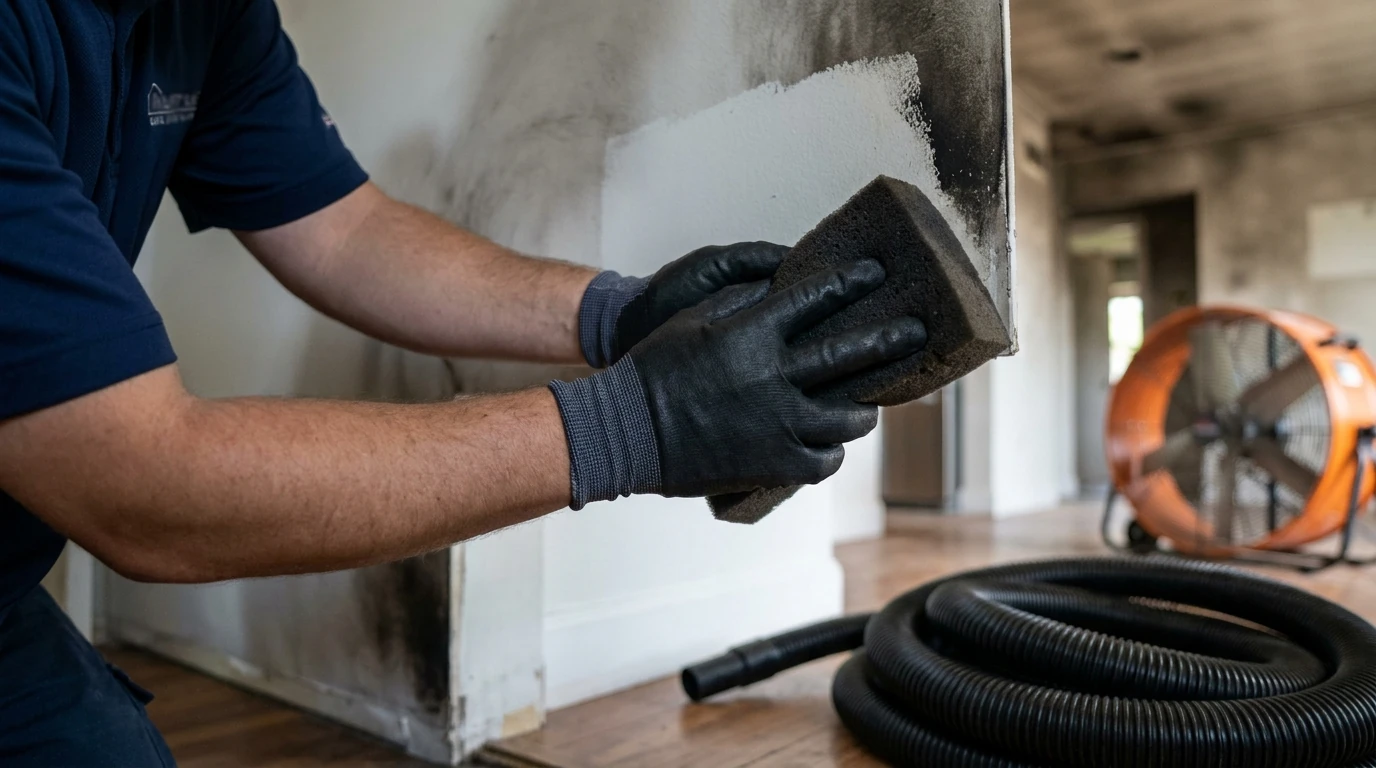
Soot and smoke cleaning This is the most labor-intensive line item on most fire jobs. Technicians use dry-chemical sponges, HEPA vacuums, and chemical sponge wipes to clean every surface, including inside cabinets, inside closets, and inside ductwork. For a 2,000 sq ft home with smoke spread throughout, cleaning alone can run $4,000–$9,000. See our smoke damage restoration service for what this scope covers.
Odor removal Smoke odor doesn’t wash off. Effective treatment uses thermal fogging, ozone generation, or hydroxyl generators to break down odor-causing compounds at the molecular level. This typically adds $500–$2,500 to the job. Our post on how professionals remove smoke odor explains why DIY air fresheners fail.
HVAC decontamination Smoke travels through duct systems fast. If the HVAC ran during or after the fire, every register and duct run likely has soot coating. Full duct cleaning and decontamination adds $1,500–$4,000 on a typical Utah County home.
Drywall, framing, and structural repairs This is where costs accelerate. Replacing drywall in a single room runs $1,500–$4,000 installed. If framing is charred, an engineer may need to assess load-bearing capacity before work begins, add $500–$1,500 for the inspection. Full structural rebuilds are priced by the square foot of rebuild, not by the fire’s footprint.
Contents cleaning and pack-out Furniture, clothing, electronics, and personal items that survived the fire often need professional cleaning off-site. Pack-out, cleaning, and storage typically runs $2,000–$8,000 depending on volume.
Painting and finish work Even rooms that weren’t structurally damaged often need a full repaint after smoke cleaning, soot residue bleeds through standard paint if you skip the right primer. Budget $1,500–$4,000 for painting a typical single-story home.
Does Homeowners Insurance Cover Fire Damage Restoration?
Yes, fire is one of the most clearly covered perils in a standard homeowners policy. Unlike water damage, where coverage depends on the source, fire damage from an accidental or unintentional fire is covered under virtually every HO-3 policy. The Insurance Information Institute confirms that fire and smoke damage are named perils under both dwelling (Coverage A) and personal property (Coverage C) sections.
Here’s what that means practically:
- Dwelling coverage (Coverage A) pays for structural repairs and restoration of the home itself, up to your policy’s dwelling limit.
- Personal property coverage (Coverage C) pays for damaged contents, furniture, clothing, electronics, up to your personal property limit.
- Additional living expenses (Coverage D or ALE) pays for temporary housing, meals, and related costs while your home is uninhabitable. Most policies cover ALE for up to 12–24 months.
- Your deductible comes off the top. Common deductibles in Utah run $1,000–$2,500 for standard policies.
What insurance typically does NOT cover: fires caused by arson by the policyholder, fires resulting from a vacant property exclusion, or damage to structures specifically excluded in your policy (some detached garages or outbuildings have separate sub-limits).
One practical note: your insurance payout is tied directly to the scope of work your restoration contractor documents. A detailed written estimate with line-item pricing, photos, and moisture or air-quality readings supports a stronger claim than a vague one-page quote. When you work with an IICRC-certified contractor, their documentation follows standards the adjuster recognizes, that matters at settlement time.
How Do You Get an Accurate Estimate?
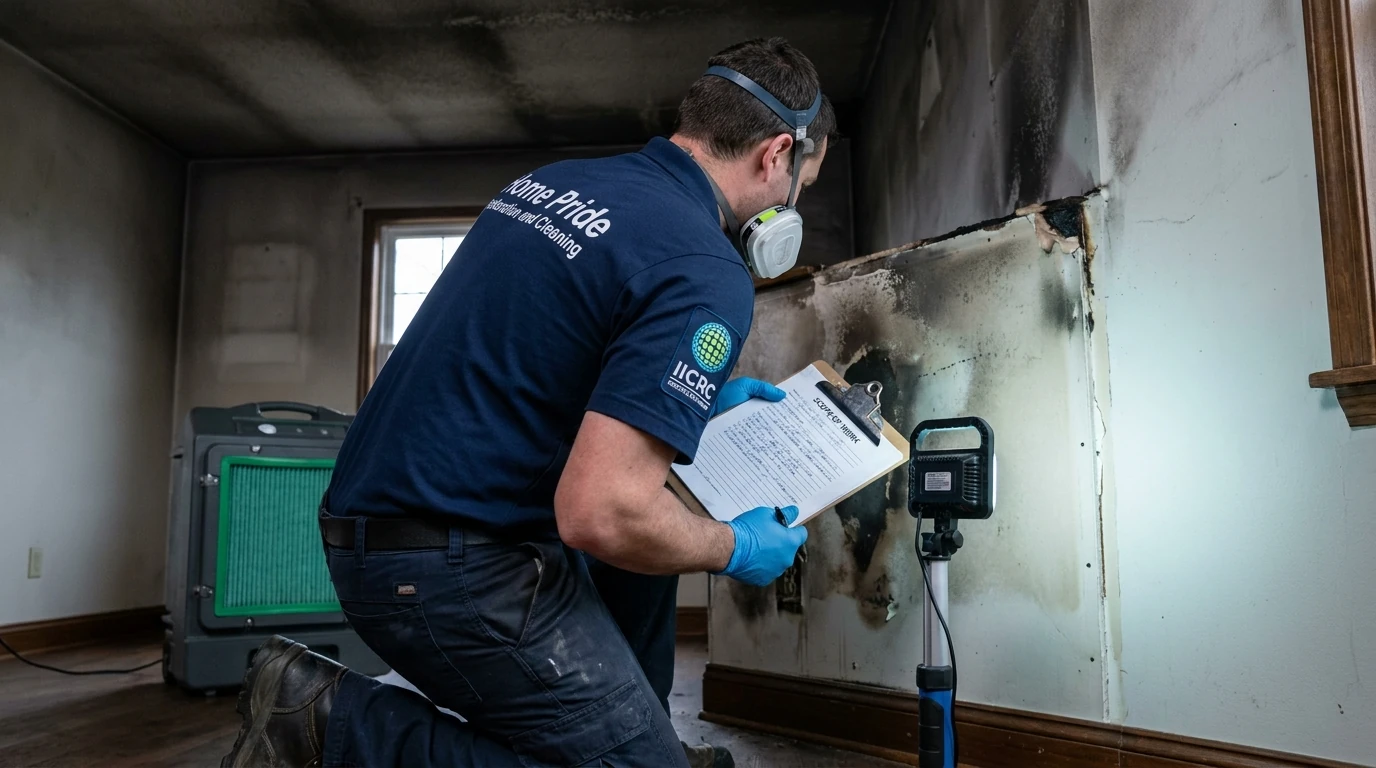
Getting an accurate fire damage estimate requires an in-person inspection, no reputable contractor can price a fire job from photos alone. Here’s what to expect from a proper assessment:
- Walk-through of all affected areas, including rooms that didn’t burn but may have smoke penetration
- Air quality testing to measure soot particulate levels in different zones
- Moisture readings, water from firefighting suppression can cause secondary damage if not addressed
- HVAC inspection to determine whether duct cleaning is necessary
- Structural assessment of any burned framing, subfloor, or roof components
- Written scope of work broken into line items by trade (cleaning, demo, structural, HVAC, contents, painting)
Be cautious of any contractor who gives you a single lump-sum number on the first visit without walking every room. And be cautious of contractors who ask you to sign a direction-to-pay or assignment-of-benefits form before your insurer has seen the scope, that arrangement can complicate your claim.
For a detailed look at what happens after the estimate is approved, our post on the fire damage restoration process walks through each phase from emergency stabilization through final reconstruction.
If you’re ready to get a written estimate for a fire loss in Utah County or the Wasatch Front, Home Pride Restoration and Cleaning’s IICRC-certified team responds 24/7. Call (801) 995-2437 to schedule an on-site assessment.
About Home Pride Restoration and Cleaning
Home Pride Restoration and Cleaning is an IICRC-certified restoration company serving Saratoga Springs, Lehi, Eagle Mountain, Provo, and the broader Utah County and Wasatch Front area since 1997 (license RC-25-0737). Their crews handle fire, smoke, water, and mold losses for residential and commercial property owners, and work directly with insurance adjusters to document scope and support claims. Available 24/7 at (801) 995-2437.