Roof Leak Cleanup and Repair in Saratoga Springs
24/7 roof leak cleanup and repair in Saratoga Springs and surrounding areas. IICRC-certified, insurance billing accepted. Call (801) 995-2437.
A brown stain on the ceiling after last night’s storm is easy to dismiss, paint over it, move on. But the water that made that stain didn’t stop at the drywall. It traveled down rafters, pooled in insulation, and started a clock: within 24 to 48 hours, wet cellulose insulation and wood framing become a hospitable environment for mold. Roof leak cleanup isn’t just about drying out what got wet, it’s about tracing where the water actually went, which is rarely where the stain is.
What roof leak cleanup and repair actually involves
The visible damage, a water ring on a bedroom ceiling, a soft spot in drywall, a warped piece of trim, represents the end of the water’s journey, not the beginning. The real work starts above: in the attic, along the rafters, inside the wall cavities where water runs silently before it ever shows up on a finished surface.
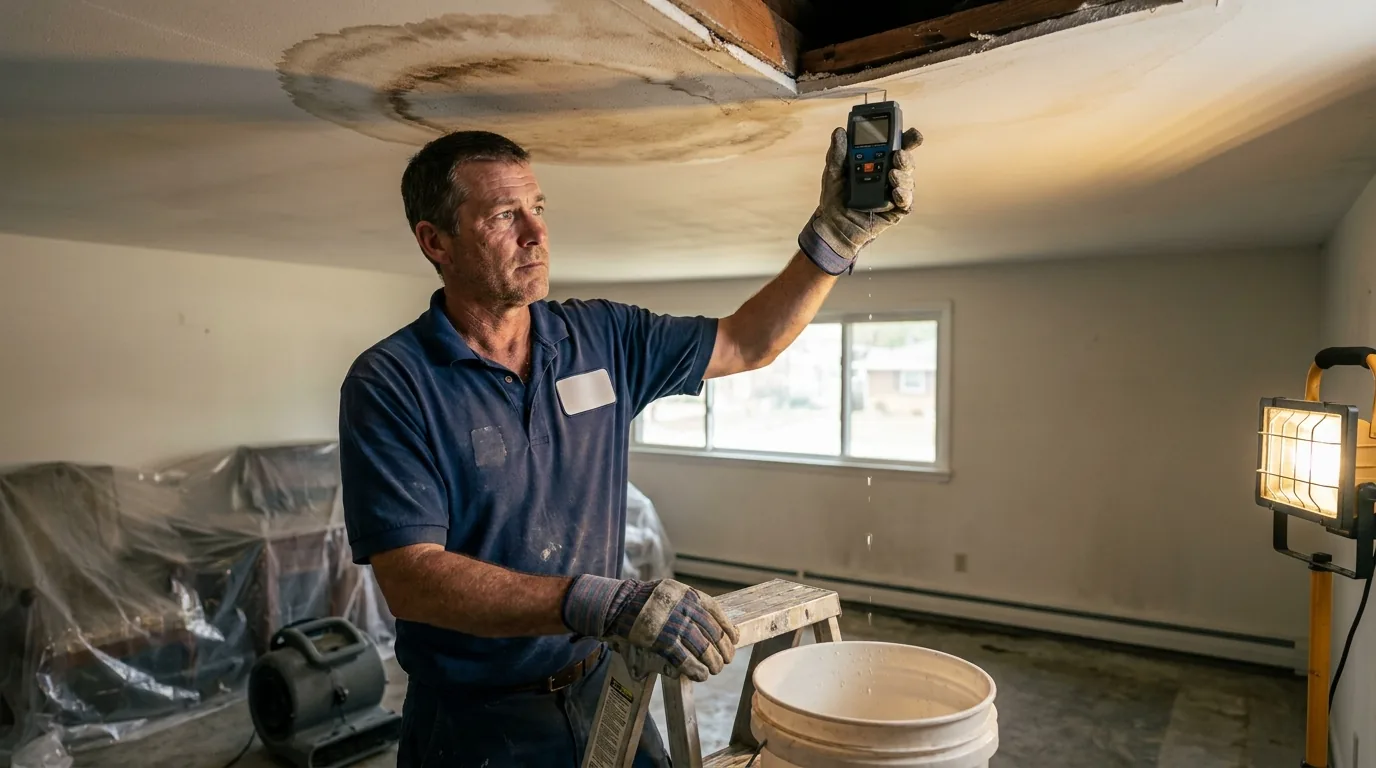
A thorough roof leak response combines moisture mapping with structural assessment. Technicians use thermal imaging cameras and pin-type moisture meters to trace saturation through insulation batts, sheathing, and framing members. Wet fiberglass insulation loses most of its R-value and doesn’t recover once it’s been compressed by water weight, it has to come out. Wet blown-in cellulose is worse: it clumps, retains moisture for weeks, and accelerates wood rot from below.
On the interior side, ceiling water damage often means saturated drywall that has lost structural integrity. Drywall that has been wet for more than 24 hours typically cannot be dried in place, the paper facing traps moisture and becomes a mold substrate. Affected sections are removed, the cavity behind them is dried with directed airflow and dehumidification, and moisture readings are documented before any new material goes in.
Timeline from first call to completed dry-out: most residential roof leak jobs, a single penetration point, one or two affected rooms, run 3 to 5 days of active drying after the source is controlled. Larger attic water damage events, or jobs where the leak went undetected for weeks, can run longer.
Our process
-
Source control and emergency tarping. Before any interior work begins, the entry point has to be addressed. If the roof is actively leaking, we deploy heavy-duty polyethylene tarping over the affected section to stop ongoing intrusion. This isn’t a cosmetic fix, it’s a prerequisite. Drying out a structure while water is still entering is wasted effort.
-
Moisture mapping and damage documentation. Using thermal imaging and calibrated moisture meters, we map the full extent of saturation, ceiling plane, wall cavities, attic floor, and framing members. Every reading is photographed and logged. This documentation is what your insurance adjuster needs to authorize a proper scope of work, and it’s what protects you if secondary damage surfaces later.
-
Contaminated material removal. Saturated insulation, compromised drywall, and any material showing visible microbial growth is removed, bagged, and disposed of before drying equipment is set. Leaving wet insulation in place and running fans around it doesn’t work, it just moves moisture-laden air through the structure.
-
Structural drying with monitored airflow and dehumidification. Commercial-grade LGR dehumidifiers and axial air movers are positioned to create a controlled drying envelope. We return daily to log moisture readings and adjust equipment placement. Drying is not complete when the surface feels dry, it’s complete when framing members and subfloor readings return to acceptable equilibrium moisture content for the local climate.
-
Roof repair coordination and interior reconstruction. Once the structure is dry, the roof penetration is permanently repaired, flashing, shingles, or membrane work depending on roof type. Interior reconstruction (insulation replacement, drywall, paint, trim) follows with the same attention to matching existing finishes.
What separates a good roof leak response from a bad one
The most common failure in interior roof leak damage work is treating the symptom without mapping the source. Water follows the path of least resistance, it enters at a failed flashing or cracked shingle, runs along a rafter for six feet, then drops through a gap in the top plate into a wall cavity. The stain on the ceiling is three rooms away from where the water entered. Operators who skip thermal imaging and go straight to patching the ceiling miss this every time.
A second common failure is inadequate attic assessment. Attic water damage is easy to underscope because it’s out of sight. Wet OSB sheathing that isn’t dried properly delaminates, loses fastener holding strength, and develops mold on the underside, none of which is visible from the living space below. Insurance adjusters increasingly require moisture readings at the sheathing level, not just at the ceiling drywall, before approving a full scope.
Finally, roof repairs performed without addressing the interior moisture leave a structure that looks repaired but continues to degrade. Mold doesn’t care that the roof is patched.
Seasonal and regional considerations
Saratoga Springs and the broader Utah Valley sit at roughly 4,500 feet elevation, which creates a specific set of roof leak risks that don’t apply everywhere. Spring snowmelt events, particularly the rapid melt cycles in March and April when daytime temps spike, drive ice dam formation along eaves and push water under shingles before it can drain. Summer monsoon moisture from mid-July through September brings intense, short-duration storms that overwhelm valley flashing details on older homes. Fall leaf accumulation clogs gutters and creates standing water at fascia lines. Each season produces a different failure mode, which means the source-tracing step looks different depending on when the leak occurred.
Service area
Home Pride Restoration and Cleaning is based in Saratoga Springs and serves homeowners and property managers throughout Utah County and the surrounding region, including Eagle Mountain, Lehi, American Fork, Cedar Hills, Highland, and Pleasant Grove. The city-specific pages for each area link back here for full service details.
If you’ve found water stains, soft drywall, or a musty smell in your attic after a storm or a hard winter, call (801) 995-2437 to schedule a moisture assessment and roof leak inspection. The sooner the source is mapped, the smaller the repair scope, and the lower the risk of a mold problem developing behind walls you can’t see.
Frequently Asked Questions
How do I know if my ceiling water stain is from an active roof leak or an old one that already dried out?
What should I do immediately after noticing a roof leak before a technician arrives?
Does a roof leak always mean the insulation in my attic needs to be replaced?
How does ice dam damage differ from a standard roof leak, and does the cleanup process change?
What documentation does my insurance company typically need for a roof leak claim?
Looking for the best roof leak cleanup and repair company in Saratoga Springs?
Home Pride Restoration and Cleaning provides licensed and insured roof leak cleanup and repair in Saratoga Springs, UT and the surrounding area, and has served local property owners since 1997. Customers rate us 5.0 out of 5 stars across 36 Google reviews. We answer calls 24/7 — call (801) 995-2437 for immediate help.
Need Roof Leak Cleanup and Repair now?
We respond 24/7 across Saratoga Springs and surrounding UT cities.
Related Coverage
- Our Restoration Services
- Contact Home Pride Restoration and Cleaning
- Roof Leak Cleanup and Repair in American Fork
- Roof Leak Cleanup and Repair in Eagle Mountain
- Roof Leak Cleanup and Repair in Herriman
- Roof Leak Cleanup and Repair in Lehi
- Roof Leak Cleanup and Repair in Orem
- Roof Leak Cleanup and Repair in Pleasant Grove
- Roof Leak Cleanup and Repair in Provo
- Roof Leak Cleanup and Repair in Riverton
- Roof Leak Cleanup and Repair in South Jordan