Appliance Leak Cleanup in Saratoga Springs
24/7 appliance leak cleanup in Saratoga Springs and surrounding areas. IICRC-certified, insurance billing accepted. Call (801) 995-2437.
The leak you almost missed
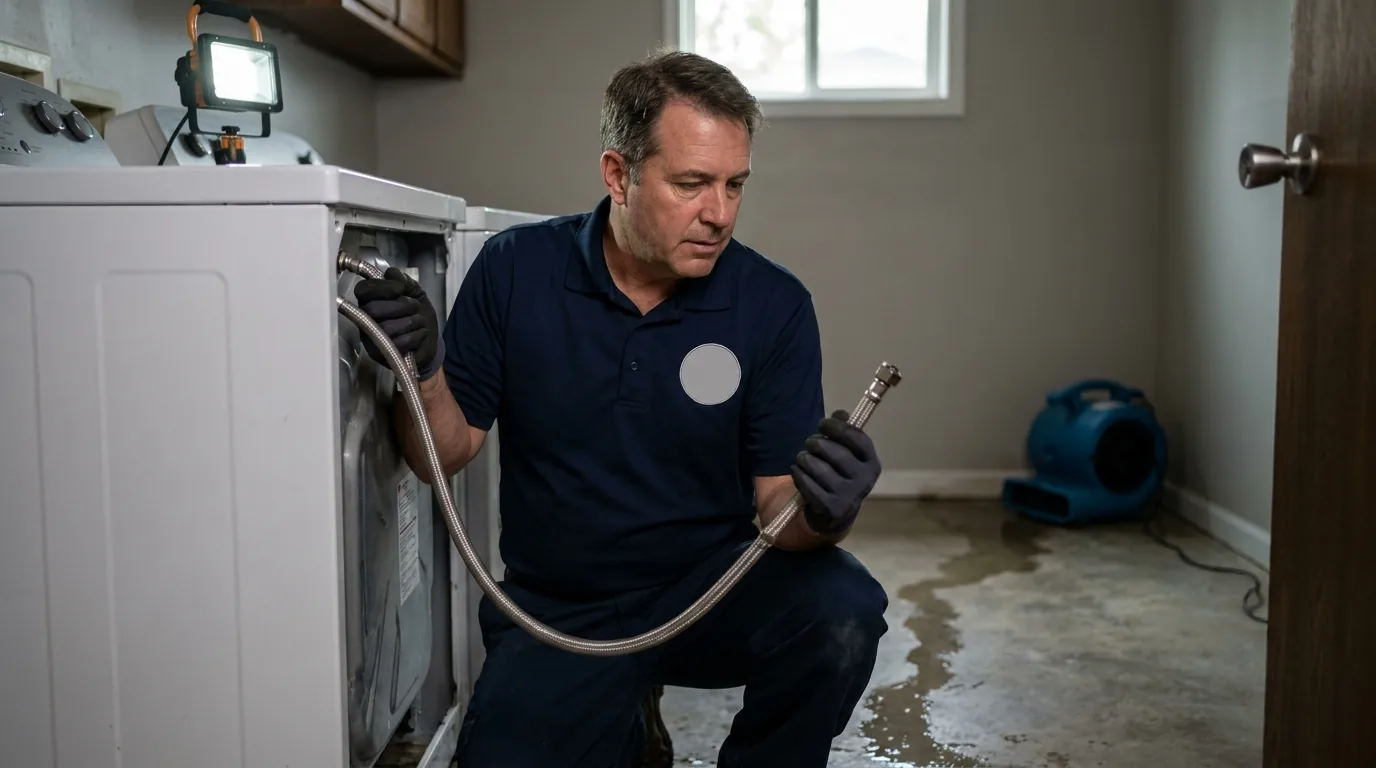
Most appliance leaks don’t announce themselves with a flood. They start as a slow drip from a refrigerator ice maker line pooling under the toe kick, a dishwasher door seal that’s been weeping onto the subfloor for weeks, or a washing machine supply hose that finally gave out while you were at work. By the time you find the water, the damage is already layered, soaked cabinets, swollen subfloor, and in some cases, the early musty signal that mold has started colonizing the cavity beneath your flooring. Appliance leak cleanup is its own category of water damage work, and it requires a different approach than a burst pipe or storm flood.
What appliance leak cleanup actually involves
Appliance leaks are almost always Category 1 water at the source, clean supply-line water, but that classification can change fast. Water that has sat under a dishwasher or refrigerator for more than 24–48 hours, or that has wicked into particleboard cabinetry or OSB subfloor, is no longer clean. The materials themselves introduce contaminants, and the confined, dark space under appliances is exactly the environment mold needs.
The work involves more than pulling the appliance and running a fan. Technicians use thermal imaging cameras and non-invasive moisture meters to map exactly how far water has traveled, under adjacent cabinets, into wall cavities, beneath flooring that looks dry on the surface. In Saratoga Springs homes, where builders commonly used engineered wood subfloor over a crawl space, moisture can wick laterally several feet from the appliance before it shows any visible sign. Extraction equipment removes standing water, and then desiccant or refrigerant dehumidifiers combined with air movers are positioned to dry the structure from the inside out. The goal is to bring affected materials to their pre-loss moisture content, verified with readings, not by feel.
Timeline depends on saturation depth. A refrigerator ice maker line caught within a day typically dries in 2–3 days. A washing machine flood that soaked through to the subfloor can run 4–5 days of active drying with daily moisture monitoring.
Our process
-
Source confirmation and water shutoff. Before anything else, the supply line or appliance connection causing the leak is identified and isolated. This sounds obvious, but slow leaks from ice maker lines or dishwasher drain connections are sometimes still active when a crew arrives. Stopping the source is step one.
-
Moisture mapping with thermal imaging and meters. A thermal camera identifies temperature differentials that reveal hidden moisture migration, under cabinets, behind kickplates, inside wall cavities adjacent to the appliance. Moisture readings are logged at every affected material as the baseline for drying documentation.
-
Extraction and material assessment. Standing water is extracted. Affected cabinetry, flooring, and subfloor are assessed for salvageability. Particleboard cabinet bases that have swollen and delaminated typically cannot be dried back to structural integrity and are documented for replacement. Solid wood and plywood have better recovery odds when caught early.
-
Structural drying with daily monitoring. Commercial-grade dehumidifiers and air movers are placed according to the moisture map. Readings are taken and logged each day, not just to track progress, but to create the documentation record your insurance adjuster will want. Drying is considered complete when affected materials reach equilibrium with unaffected reference materials in the same room, not when surfaces feel dry to the touch.
-
Final inspection and clearance. A final moisture scan confirms the structure has returned to acceptable levels. If any mold growth was identified during the process, that finding is documented separately and a remediation scope is written before any reconstruction begins.
What separates a good appliance leak response from a bad one
The most common mistake in appliance leak cleanup is treating it like a surface problem. A technician who pulls the refrigerator, wipes up visible water, and leaves a single fan running has not done the job, they’ve created the conditions for a mold claim three weeks later.
Experienced operators know to check the subfloor cavity, not just the surface. In homes with hardwood or luxury vinyl plank over a wood subfloor, moisture migrates under the flooring and doesn’t evaporate because the floor covering acts as a vapor barrier. Thermal imaging catches this; a visual inspection won’t.
Insurance adjusters reviewing appliance leak claims look for a few specific things: a documented moisture map taken at the time of loss, daily drying logs with meter readings, and a clear record of which materials were salvaged versus removed. Without that documentation, supplements and replacement claims are harder to support. IICRC-certified technicians follow the S500 standard for water damage, which defines the drying protocols and documentation requirements adjusters expect to see.
Another common gap: failing to check the wall cavity behind a dishwasher or washing machine. Water that has followed the drain line or supply line into the wall can saturate insulation and framing without any visible sign on the drywall surface for days.
Seasonal and regional considerations
Saratoga Springs sits at roughly 4,500 feet elevation, and the high-desert climate creates a specific wrinkle for appliance leak cleanup. Ambient humidity here runs low, often 20–30% indoors in winter, which sounds like it should help drying. In practice, very low humidity causes wood materials to dry unevenly, which can cause cupping and cracking in hardwood floors if drying equipment isn’t balanced carefully. Rushing the process in dry conditions can cause as much secondary damage as the leak itself. Winter also means crawl spaces and garage utility areas where water heaters often sit can drop below 50°F, slowing evaporation and requiring adjusted equipment placement.
Service area
Home Pride Restoration and Cleaning is based in Saratoga Springs and responds to appliance leak calls throughout Utah County and the surrounding area, including Eagle Mountain, Lehi, American Fork, Highland, Cedar Hills, and Herriman. Appliance leak cleanup in Saratoga Springs and neighboring communities is typically on-site within 60–90 minutes of your call.
If you’ve found water under an appliance, or you’re not sure where it came from, call (801) 995-2437 to have a technician map the moisture and stop the damage before it goes further.
Frequently Asked Questions
My refrigerator leaked overnight. How do I know if the subfloor is damaged if the surface looks dry?
What's the difference between how a dishwasher leak and a washing machine flood are handled?
Can particleboard cabinet bases be dried and saved after a dishwasher or refrigerator leak?
What documentation should I gather before the restoration crew arrives after an appliance leak?
How do I know when structural drying is actually complete after a water heater or washing machine leak?
Looking for the best appliance leak cleanup company in Saratoga Springs?
Home Pride Restoration and Cleaning provides licensed and insured appliance leak cleanup in Saratoga Springs, UT and the surrounding area, and has served local property owners since 1997. Customers rate us 5.0 out of 5 stars across 36 Google reviews. We answer calls 24/7 — call (801) 995-2437 for immediate help.
Need Appliance Leak Cleanup now?
We respond 24/7 across Saratoga Springs and surrounding UT cities.
Related Coverage
- Our Restoration Services
- Contact Home Pride Restoration and Cleaning
- Appliance Leak Cleanup in American Fork
- Appliance Leak Cleanup in Eagle Mountain
- Appliance Leak Cleanup in Herriman
- Appliance Leak Cleanup in Lehi
- Appliance Leak Cleanup in Orem
- Appliance Leak Cleanup in Pleasant Grove
- Appliance Leak Cleanup in Provo
- Appliance Leak Cleanup in Riverton
- Appliance Leak Cleanup in South Jordan
- Burst Pipe Emergency Checklist: Step-by-Step Response