
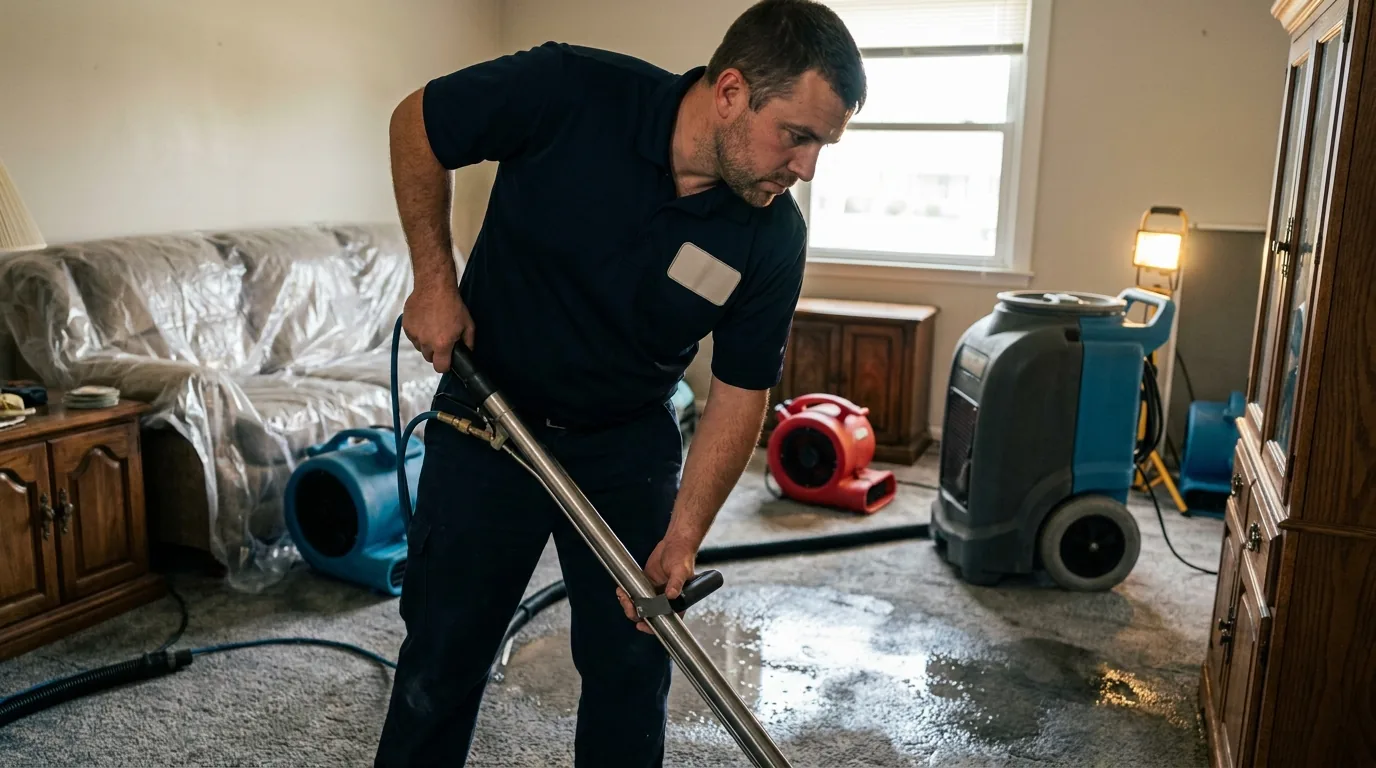
Water Damage Restoration in Saratoga Springs
24/7 water damage restoration in Saratoga Springs, UT. IICRC-certified, insurance billing accepted. Call (801) 995-2437.
Our IICRC-certified technicians are headquartered right here in Saratoga Springs and are typically on-site within 60 minutes of your call.
Saratoga Springs sits at the edge of Utah Lake, and that proximity shapes water damage in ways that catch a lot of homeowners off guard. The high water table along the lakeside developments means that when a supply line fails or a washing machine hose lets go, water doesn’t just spread across the floor — it finds the subfloor, the crawl space, and sometimes the foundation stem wall before anyone notices the smell. Home Pride Restoration and Cleaning has been running water extraction and structural drying jobs out of Saratoga Springs since 1997, and the calls we get here have a distinct character compared to the landlocked suburbs to the east.
Why Saratoga Springs Properties See More Water Damage Than You’d Expect
The city’s rapid growth since the early 2000s means the housing stock spans a wide range of construction eras and quality tiers. Subdivisions closest to Redwood Road and the lake were built quickly during the mid-2000s boom, and some of those homes have plumbing fittings and water heater installations that are now pushing 18–20 years old — right in the window when failures spike. At the same time, the newer master-planned communities on the west benches use engineered lumber and OSB sheathing that swells and delaminates fast when wet, sometimes within 24–48 hours of a slow leak going undetected.
Utah Lake’s influence on local humidity is real but subtle. During spring snowmelt, the ambient moisture in the 84045 ZIP code area stays elevated for weeks, which slows evaporation-based drying and means passive ventilation alone won’t get structural materials to safe moisture levels. That’s why equipment selection — refrigerant dehumidifiers sized to the actual cubic footage, not a one-size guess — matters here more than in drier inland markets.
Our Water Damage Restoration Process in Saratoga Springs
Every job starts the same way: a technician arrives, walks the affected area, and takes moisture readings with a calibrated meter before a single piece of equipment is placed. This baseline matters because it documents pre-existing conditions for your insurance adjuster and tells us exactly how far water has migrated — often farther than the visible stain.
From there, the process moves through five concrete phases:
- Water extraction — truck-mounted or portable extraction units pull standing water from hard floors, carpet, and pad. In homes with finished basements near the lake corridor, we often find water has wicked into the bottom course of drywall even when the floor looks dry.
- Controlled demolition — saturated drywall, insulation, and flooring that can’t be dried in place gets removed. We document everything photographically before removal for your claim.
- Structural drying — commercial-grade desiccant or refrigerant dehumidifiers and high-velocity air movers run in a calculated configuration. Drying typically takes 3–5 days depending on materials and initial saturation.
- Daily monitoring — a technician checks moisture readings each day and adjusts equipment placement. We don’t set it and forget it.
- Clearance and documentation — when materials reach industry-standard dry goals (per IICRC S500 guidelines), we document final readings and prepare a drying log for your insurer.
Home Pride Restoration and Cleaning is IICRC Certified and licensed under Utah contractor license #RC-25-0737, which means our drying protocols meet the standards insurers expect to see in a completed claim file.
Response Time from Our Saratoga Springs HQ
Our office is in Saratoga Springs, not a regional dispatch hub 45 minutes away. When a pipe bursts in a home near Redwood Road or in one of the developments off Pony Express Parkway, a technician is typically on-site within 60–90 minutes of your call — often faster for addresses close to our shop. We answer the phone at (801) 995-2437 around the clock because water damage doesn’t schedule itself for business hours.
For homeowners in the lakeside neighborhoods, that response window matters. Water migrates roughly one foot per hour through porous subfloor materials under normal conditions. Every hour between the failure and extraction is another foot of spread and another day of drying time.
Local Note: What the Lake Elevation Does to Drying Timelines
Here’s something specific to this market that doesn’t show up in generic restoration guides: properties within about a half-mile of Utah Lake’s shoreline sit at an elevation where overnight temperatures during spring and fall can drop enough to cause condensation on cold concrete sllab surfaces even while dehumidifiers are running. We’ve learned to adjust equipment cycles and check slab temps separately from air readings on those jobs. If a contractor sets up drying equipment and only checks ambient air humidity, they can get a false “dry” reading while the slab is still holding moisture — leading to mold colonization under flooring that was signed off as complete. We use thermal imaging alongside moisture meters on any job within the lake corridor to catch exactly this scenario.
If your home near Pony Express Parkway or along the western developments has had a water loss and you’re not sure whether the drying was thorough, a post-remediation moisture inspection is worth scheduling before you put flooring back down.
When water damage hits your Saratoga Springs home, the first 24 hours determine how much of your structure you save and how long your family is displaced. Call (801) 995-2437 now — a local technician will be at your door fast, with the equipment and documentation your insurance company needs to move your claim forward.
Headquartered right here in Saratoga Springs — ★ 5.0 · 34 Google reviews
“I’ve hired Curt multiple times for carpet cleaning and once for a couch cleaning and he does a great job every time! Affordable, friendly, reliable. 10/10 recommend!” — Shannon, June 2026
Water Damage Restoration in Saratoga Springs: Service Coverage Map
Frequently Asked Questions
How fast can you arrive for water damage restoration in Saratoga Springs?
How quickly can you reach homes near Pony Express Parkway or the lakeside developments in Saratoga Springs?
Does the high water table near Utah Lake affect how water damage is dried in Saratoga Springs homes?
Are the mid-2000s boom-era homes in Saratoga Springs more vulnerable to water damage spreading quickly?
What does the structural drying process actually involve, and how long does it take?
Will my homeowner's insurance cover water damage restoration in the 84045 ZIP code, and do you handle the billing?
Watch: Water Damage Restoration in Saratoga Springs
Water Damage Restoration response in Saratoga Springs
Most Saratoga Springs calls see a technician on-site within 60 minutes from our Saratoga Springs headquarters.