
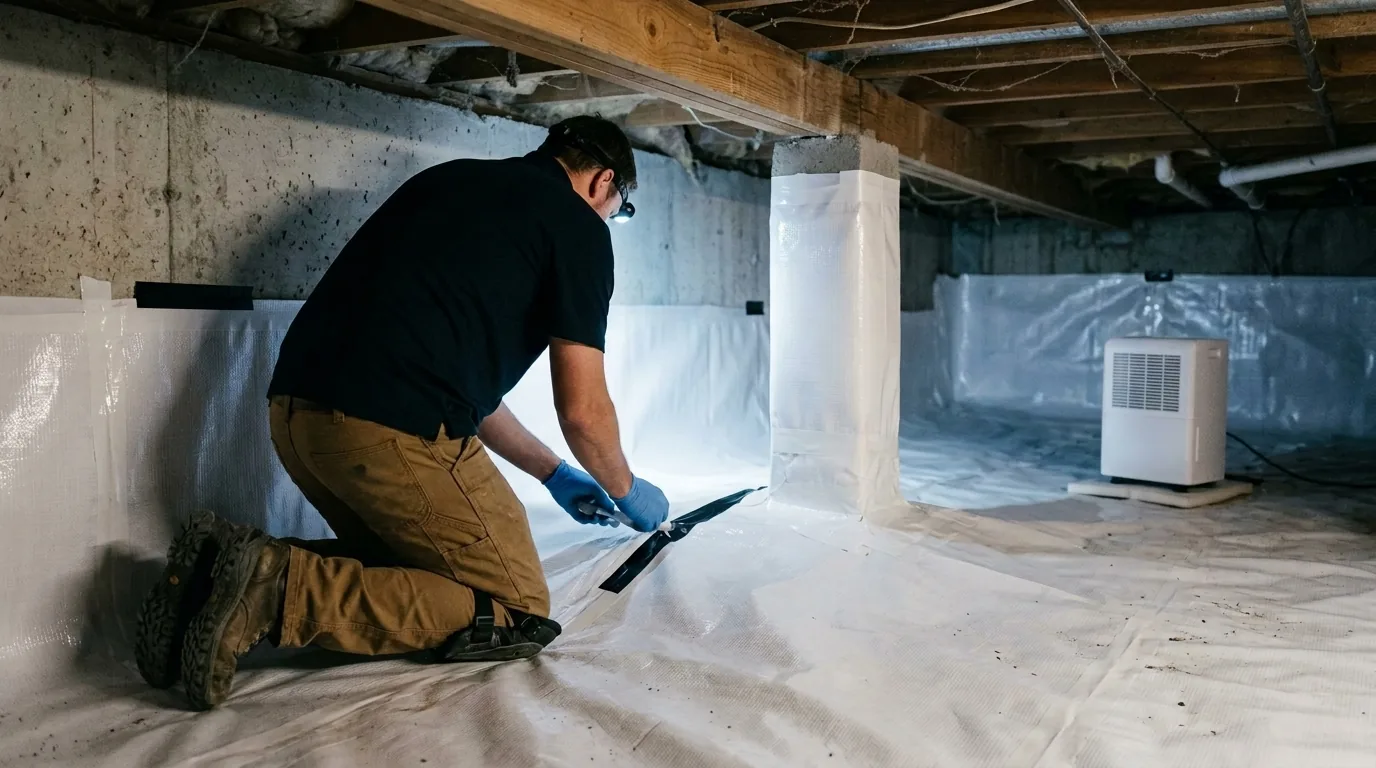
Crawl Space Encapsulation in Saratoga Springs
24/7 crawl space encapsulation in Saratoga Springs, UT. IICRC-certified, insurance billing accepted. Call (801) 995-2437.
Our IICRC-certified technicians are headquartered right here in Saratoga Springs and are typically on-site within 60 minutes of your call.
Saratoga Springs sits at the edge of Utah Lake, and that proximity matters more than most homeowners realize — especially beneath their homes. The high water table along the lake’s northeastern shoreline, combined with the clay-heavy soils common throughout the 84045 ZIP code, means crawl spaces here cycle through wet and dry extremes that raw dirt floors and fiberglass batts simply can’t handle. Moisture wicks up through the soil year-round, and by the time you notice a musty smell or soft subfloor, the damage has usually been building for months.
Why Saratoga Springs Crawl Spaces Face Unusual Moisture Pressure
Utah’s climate looks dry on paper, but Saratoga Springs is a local exception. The lake effect keeps relative humidity elevated through spring and early summer, and the freeze-thaw cycles between November and March push groundwater up through expansive soils in ways that surprise homeowners who moved here from drier parts of the Wasatch Front. Clay soils don’t drain — they hold water against your foundation walls and beneath your slab or crawl space floor.
The newer subdivisions built along the western benches of Saratoga Springs during the 2000s and 2010s were constructed quickly on lots that weren’t always graded aggressively enough to push water away from the structure. That means even homes that are only 10–15 years old can already show signs of chronic crawl space moisture: efflorescence on block piers, rusting hardware, insulation that has sagged and gone black at the bottom edge. These aren’t signs of a defective home — they’re signs of a crawl space that was never sealed against the conditions it actually lives in.
Our Crawl Space Encapsulation Process in Saratoga Springs
Encapsulation isn’t a single product — it’s a system, and every component has to work together. Here’s how the process runs on a typical Saratoga Springs job:
Assessment and moisture mapping. Before any material goes down, we measure moisture levels in the soil, the wood framing, and the ambient air. In high-water-table areas near the lake, we sometimes find vapor readings that are two to three times what we’d see on a hillside lot in Eagle Mountain. That reading drives every decision that follows.
Drainage and grading corrections. If water is actively pooling in the crawl space, we address the source before encapsulating. Sealing over a drainage problem just moves it somewhere worse.
20-mil reinforced poly barrier installation. We use a heavy-duty, puncture-resistant liner — not the thin sheeting sold at hardware stores — and run it up the foundation walls, overlapping seams by at least 12 inches and taping every joint. In Saratoga Springs crawl spaces with uneven soil or rock intrusions, this step takes longer than average because every seam has to lie flat and sealed.
Rim joist and wall insulation. Open rim joists are one of the biggest heat and moisture entry points in a crawl space. We seal and insulate them with closed-cell spray foam or rigid foam board, depending on access and clearance.
Ventilation or dehumidification. Depending on your crawl space configuration and whether it’s vented or unvented, we install a crawl space dehumidifier sized to the square footage and the local humidity load. A unit sized for a dry Phoenix crawl space will run constantly and fail early in a Saratoga Springs home near the lake.
Equipment and Methods We Use
The liner matters, but so does what goes under and over it. We use drainage matting beneath the vapor barrier on jobs where soil moisture is actively moving — this lets water migrate to a sump rather than pressing up against the liner and finding a seam. For homes with existing sump pits, we inspect and test the pump before encapsulating; a failed sump under a sealed crawl space creates a much bigger problem than a failed sump in an open one.
Dehumidifiers we install are Energy Star rated and include a condensate pump so they can drain automatically — important in a crawl space where you won’t be checking it weekly. We size them by measured cubic footage, not by the square footage rule-of-thumb that often leads to undersized equipment.
Local Note: What We’ve Learned Working in Saratoga Springs
Homes built on the flatter parcels closer to the lake — particularly in the developments that went up between 2005 and 2012 — often have crawl space access hatches that were framed to minimum code dimensions. That 18-by-24-inch opening makes it genuinely difficult to get a full-size dehumidifier or drainage mat rolls into the space without disassembly. We’ve learned to pre-stage equipment and sometimes to enter through a larger floor access if one exists in a utility closet. It adds time, but cutting corners on equipment sizing because the hatch is tight isn’t a trade-off worth making.
Also worth knowing: Saratoga Springs building inspections for crawl space work can run 2–3 weeks out during the busy spring season. If your encapsulation project requires a permit (typically when mechanical systems are added or modified), we file early and schedule around the inspection window so your project doesn’t stall.
If your crawl space smells like wet soil, if your floors feel soft in spots, or if your energy bills have crept up without explanation, the crawl space is often the first place to look. Home Pride Restoration and Cleaning is based right here in Saratoga Springs and has been doing this work since 1997. Call us at (801) 995-2437 — we’ll come out, take measurements, and give you a straight assessment of what your crawl space actually needs.
Headquartered right here in Saratoga Springs — ★ 5.0 · 30 Google reviews
“Home Pride Restoration and Cleaning was incredibly fast and responsive when my pipe burst. The crew was professional, efficient, and did a thorough job with the water damage restoration and drying. I especially appreciated the emergency water extraction and the careful cleanup of the carpet. Highly…” — James, May 2026
Crawl Space Encapsulation in Saratoga Springs: Service Coverage Map
Frequently Asked Questions
How fast can you arrive for crawl space encapsulation in Saratoga Springs?
Does the high water table near Utah Lake affect how crawl space encapsulation is done in Saratoga Springs?
Are newer Saratoga Springs subdivisions just as likely to need encapsulation as older homes?
Does Saratoga Springs require a permit for crawl space encapsulation?
What thickness of vapor barrier do you use, and why does it matter in this climate?
How long does a crawl space encapsulation take for a typical Saratoga Springs home, and will I need to leave the house?
Will my homeowners insurance cover crawl space encapsulation in Saratoga Springs?
Crawl Space Encapsulation response in Saratoga Springs
Most Saratoga Springs calls see a technician on-site within 60 minutes from our Saratoga Springs headquarters.