
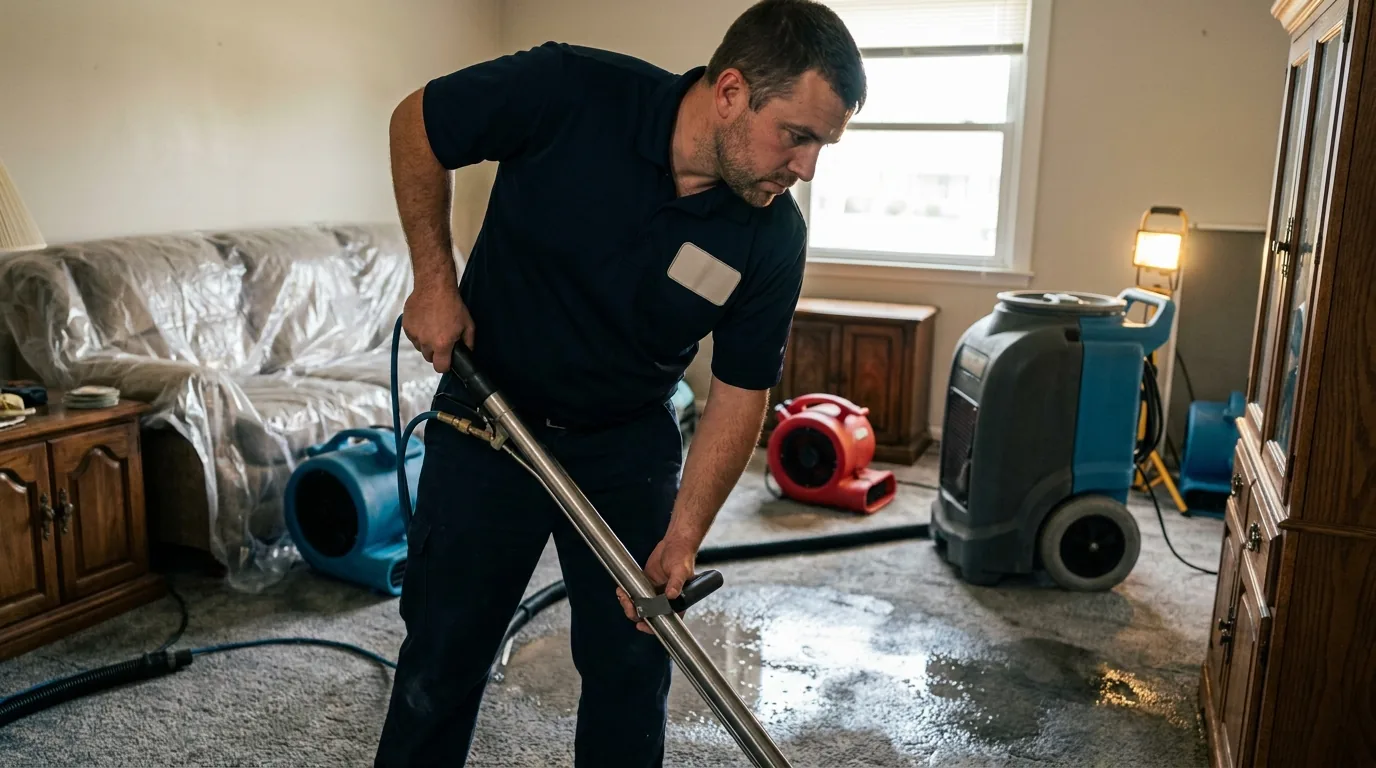
Water Damage Restoration in Pleasant Grove
24/7 water damage restoration in Pleasant Grove, UT. IICRC-certified, insurance billing accepted. Call (801) 995-2437.
Our IICRC-certified technicians are dispatched from our Saratoga Springs, UT headquarters and are typically on-site in Pleasant Grove within 60 minutes of your call.
Pleasant Grove sits in a narrow band between Utah Lake’s moisture-laden air and the Wasatch foothills, where spring snowmelt and summer cloudbursts can overwhelm drainage systems faster than most homeowners expect. When a supply line fails at 2 a.m. or a storm pushes water through a basement window well, the clock starts immediately, mold colonization can begin in as little as 24 to 48 hours, and the porous concrete foundations common in Pleasant Grove’s older neighborhoods absorb standing water quickly. Home Pride Restoration and Cleaning has handled water emergencies across Utah County since 1997, and our IICRC-certified crews know exactly what this city’s homes demand.
Why Pleasant Grove Properties See Water Damage Issues
The soil composition along the benches east of State Street tends toward clay-heavy substrate that drains poorly after heavy precipitation. During spring runoff, typically March through May, that clay holds moisture against foundation walls, creating hydrostatic pressure that forces water through hairline cracks in block or poured-concrete basements. Homes built in the 1960s and 1970s near the older residential streets west of Grove Drive often have galvanized steel supply lines that are well past their service life; a pinhole leak behind a finished wall can saturate insulation and framing for weeks before anyone notices the soft spot in the drywall.
Utah Lake’s proximity also means that when temperatures swing dramatically in late fall, condensation inside crawl spaces can rival a slow leak in the damage it does to subfloor sheathing. Add in the irrigation infrastructure that runs through many Pleasant Grove neighborhoods, pressurized lines that can fail at fittings, and the risk profile here is genuinely different from a drier inland city.
Our Water Damage Restoration Process in Pleasant Grove
Every job starts with moisture mapping. Before a single pump runs, our technicians use thermal imaging cameras and calibrated moisture meters to trace exactly where water has traveled, under tile, behind baseboards, into wall cavities. In Pleasant Grove’s ranch-style homes, water from a kitchen or laundry leak frequently migrates toward the garage slab before it becomes visible, so we check those transition zones first.
From there, the process moves through five concrete stages:
- Water extraction, truck-mounted extractors remove standing water from flooring and subfloor assemblies in minutes, not hours.
- Controlled demolition, saturated drywall, insulation, and flooring that can’t be saved are removed to the flood cut line to expose framing for drying.
- Structural drying, industrial desiccant dehumidifiers and high-velocity air movers run continuously; we monitor psychrometric readings daily until materials reach target moisture levels.
- Antimicrobial treatment, affected cavities are treated to interrupt microbial growth before reconstruction begins.
- Documentation, moisture logs, photos, and equipment placement records are packaged for your insurance adjuster.
For homes in the 84062 ZIP code with finished basements, a very common configuration in Pleasant Grove’s newer subdivisions, we pay particular attention to LVP and engineered hardwood flooring, which can trap moisture underneath even when the surface looks dry.
Response Time to Pleasant Grove
Our headquarters is in Saratoga Springs, roughly 10 to 15 minutes from Pleasant Grove via Redwood Road and State Street under normal traffic conditions. That puts a crew at most Pleasant Grove addresses within 45 to 60 minutes of your call, day or night. Neighborhoods along the east bench near the mouth of Grove Creek Canyon can add a few minutes depending on road conditions in winter, but we route accordingly. Call (801) 995-2437 and you’ll speak with a live dispatcher, not a voicemail, who will confirm an ETA before you hang up.
Pleasant Grove Insurance Coordination
Most standard homeowners policies in Utah cover sudden and accidental water discharge, a burst pipe, an appliance failure, an overflowing fixture, but they draw a hard line at gradual leaks and ground seepage. We’ve worked with nearly every major carrier active in Utah County and we document jobs specifically to support the claim language adjusters need: scope of loss, moisture readings at intake, equipment logs, and daily progress photos. We submit directly to your carrier and can work with your adjuster on a supplement if hidden damage is discovered during drying. License #RC-25-0737.
Local Note
Here’s something we’ve learned specifically from working Pleasant Grove jobs over the years: homes built on the east-side bench lots often have a layer of decorative river rock or gravel backfill against the foundation, a landscaping choice that looks clean but acts like a reservoir after heavy rain, holding water in direct contact with the foundation wall for days after a storm passes. If your basement took on water during or after a storm and you have that type of landscaping, tell us when you call. We’ll bring the right equipment to address both the interior moisture and help you understand what’s happening at the wall plane, so the same storm doesn’t send water in twice.
If your home or rental property in Pleasant Grove is dealing with water damage right now, call (801) 995-2437. We’ll have a crew moving toward you within the hour.
Serving Pleasant Grove from our Saratoga Springs headquarters — ★ 5.0 · 36 Google reviews
“I was nervous at first, but the staff made me feel comfortable. They arrived quickly for emergency water removal and had the water out of my home in no time. I really appreciated their fast response and professional service.” — Amy, July 2026Read our reviews on Google →
Water Damage Restoration in Pleasant Grove: Service Coverage
Frequently Asked Questions
How fast can you arrive for water damage restoration in Pleasant Grove?
How quickly can you reach a home near the east bench neighborhoods in Pleasant Grove?
Are Pleasant Grove homes with finished basements harder to dry out after a water loss?
Does Pleasant Grove's clay-heavy soil affect how you approach a foundation water intrusion job?
What does structural drying actually involve, and how long does it typically take in a Pleasant Grove home?
Will my homeowners insurance cover water damage from a burst pipe in Pleasant Grove, and do you help with the claim?
Water Damage Restoration response in Pleasant Grove
Most Pleasant Grove calls see a technician on-site within 60 minutes from our Saratoga Springs headquarters.