
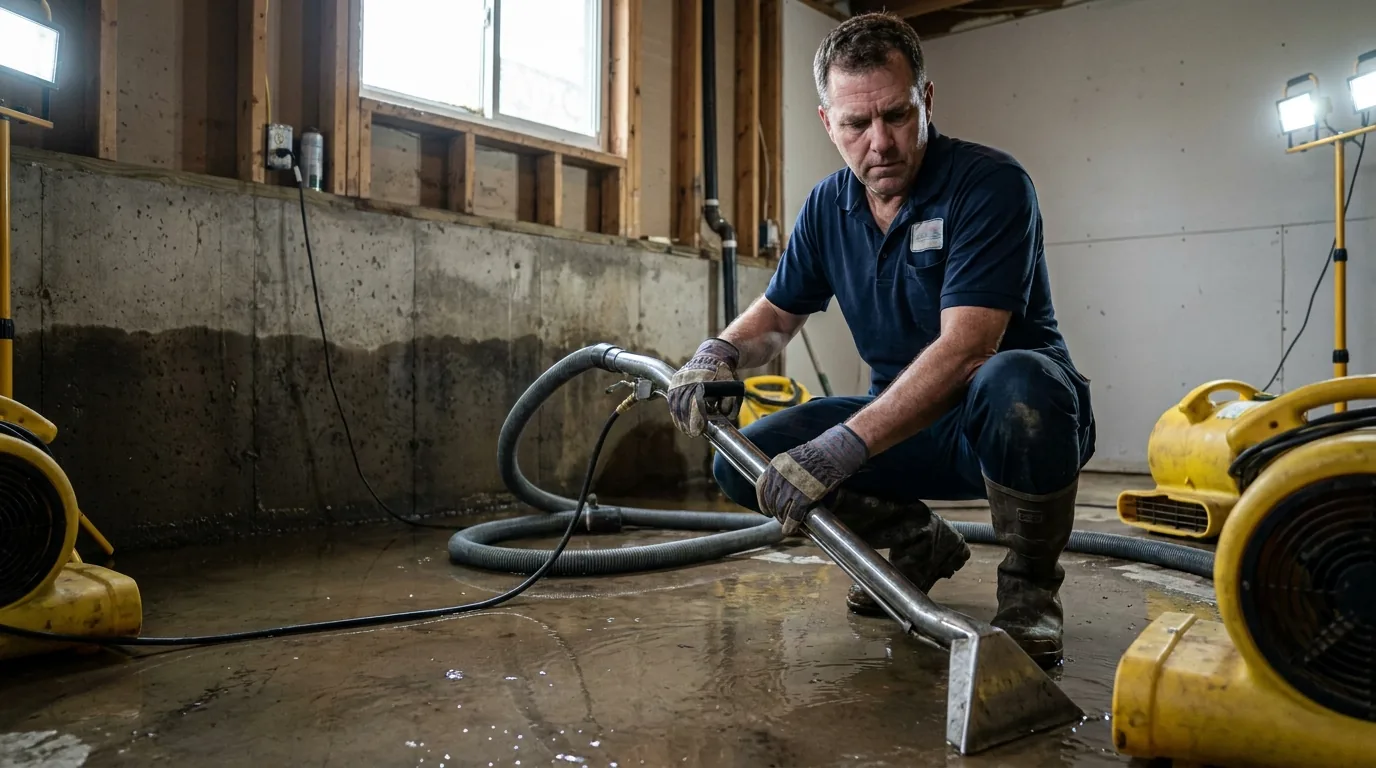
Basement Flooding Cleanup in Park City
24/7 basement flooding cleanup in Park City, UT. IICRC-certified, insurance billing accepted. Call (801) 995-2437.
Our IICRC-certified technicians are dispatched from our Saratoga Springs, UT headquarters and are typically on-site in Park City within 60 minutes of your call.
Park City’s snowmelt season hits fast. When the Wasatch snowpack starts releasing in late March and April, water doesn’t just run off, it saturates the ground around foundations that have been frozen solid all winter, then suddenly can’t drain. If your basement is taking on water right now, you’re likely dealing with that exact pressure: hydrostatic force pushing through foundation walls or floor seams, not a simple pipe drip. Home Pride Restoration and Cleaning has been responding to exactly this kind of flooding since 1997, and the conditions here require a different approach than a typical valley flood call.
Why Park City Basements Flood Differently Than Most Utah Homes
At 6,900 feet elevation, Park City sits in a climate band where freeze-thaw cycles happen dozens of times each winter, not just in January, but well into spring. That repeated expansion and contraction works on foundation mortar, concrete block joints, and window well seals in ways that lower-elevation homes in the Salt Lake Valley rarely experience. By the time a homeowner notices water on the basement floor, the entry point has often been widening for years.
The housing stock adds another layer of complexity. Many homes in the Old Town area were built in the late 1800s and early 1900s to house silver miners, with stone or unreinforced block foundations that were never designed to manage modern snowmelt volumes. Newer construction in the Deer Valley and Snyderville Basin areas tends to have better waterproofing, but those homes often sit on steeper lots where surface water channels directly toward the structure during heavy melt events. Neither profile is simple to dry out.
Soil composition around Park City also matters. The mix of clay-heavy soils and decomposed granite common on the mountain’s flanks drains poorly when saturated, meaning water lingers against foundation walls far longer than it would in sandy valley soils. That extended contact time is exactly the window in which mold colonization begins, typically within 24 to 48 hours of initial saturation.
Our Basement Flooding Cleanup Process in Park City
When we arrive, the first priority is stopping the water source if it’s still active, whether that’s a sump pump that failed during a power outage, a backed-up floor drain, or active seepage through a foundation wall. We don’t start drying until the inflow is controlled.
From there, the process moves through several concrete steps:
- Extraction, Truck-mounted and portable extractors pull standing water from the floor. In finished basements, we check under floating floors and behind baseboards, where water migrates invisibly.
- Moisture mapping, Thermal imaging and calibrated moisture meters document the full extent of saturation, including walls and subfloor assemblies. This documentation also matters for your insurance claim.
- Structural drying, Industrial desiccant dehumidifiers and high-velocity air movers run in a calculated configuration based on the room’s cubic footage and the measured grain depression. At Park City’s altitude, ambient air holds less moisture than at sea level, which actually aids evaporation, but the colder baseline temperatures mean heating the space is often necessary to keep drying rates on track.
- Antimicrobial treatment, Applied to all affected surfaces before any reconstruction begins.
- Final clearance readings, We don’t pack up equipment until moisture readings return to pre-loss baselines, documented in writing.
All work is performed by IICRC Certified technicians under license #RC-25-0737.
Response Time from Saratoga Springs to Park City
Home Pride’s headquarters is in Saratoga Springs, roughly 35 miles southwest of Park City via US-40 and I-80. Under normal conditions, that’s a 40- to 50-minute drive. During peak ski season, when traffic on I-80 through Parley’s Canyon backs up, we route through US-189 and SR-248 to come in from the Kimball Junction side, which typically saves 10 to 15 minutes compared to sitting in resort traffic.
For addresses in the 84060 ZIP code, which covers Old Town, the Park City Mountain area, and much of the historic core, expect a technician on-site within 60 to 75 minutes of your call during off-peak hours. We communicate an ETA at the time of dispatch and update you if road conditions change.
Local Note: Old Town Foundations Behave Like Sponges
One thing that surprises homeowners in Old Town Park City: the original stone foundations on many of those century-old homes don’t just let water in through cracks, the stone itself is porous and wicks moisture upward into the framing above the foundation line. We’ve seen cases where the basement floor reads dry on a moisture meter, but the rim joist area two feet above it is at 28% moisture content. If you have a home in the 84060 ZIP code built before 1950, budget for a more thorough moisture mapping sweep than a newer home would require. Missing that upper-wall saturation is how mold ends up in a place nobody checked.
Call (801) 995-2437 any time, basement flooding in Park City doesn’t wait for business hours, and neither do we. Whether you’re dealing with snowmelt seepage in Old Town or a sump failure in Snyderville Basin, we’ll give you an honest assessment of what’s wet, what it will take to dry it, and what your insurance carrier will need to process the claim.
Serving Park City from our Saratoga Springs headquarters — ★ 5.0 · 36 Google reviews
“Curt was soooo amazing! Fast and efficient! Very sweet and kind! Would use again if we weren’t moving out of state!!!!!” — Kristina, August 2026
Basement Flooding Cleanup in Park City: Service Coverage Map
Frequently Asked Questions
How fast can you arrive for basement flooding cleanup in Park City?
How quickly can you reach Old Town Park City for a basement flooding emergency?
Does Park City's high elevation affect how long basement drying takes?
Are homes in Park City's Old Town area more prone to foundation water intrusion than newer construction?
What causes the surge in basement flooding calls in Park City each spring?
Will my homeowner's insurance cover basement flooding cleanup in Park City, and what documentation do I need?
Basement Flooding Cleanup response in Park City
Most Park City calls see a technician on-site within 60 minutes from our Saratoga Springs headquarters.