Sewage Cleanup and Sanitization in Orem
24/7 sewage cleanup and sanitization in Orem, UT. IICRC-certified, insurance billing accepted. Call (801) 995-2437.
Our IICRC-certified technicians are dispatched from our Saratoga Springs, UT headquarters and are typically on-site in Orem within 60 minutes of your call.
When a sewer line backs up or a septic system overflows in Orem, the clock starts immediately. Raw sewage carries bacteria, viruses, and parasites classified as Category 3 water, the most hazardous contamination level in the restoration industry, and Utah Valley’s clay-heavy soil means standing effluent doesn’t drain away on its own. It migrates. Within hours it can saturate subfloor framing, wick into drywall, and reach wall cavities that won’t show visible damage until mold has already taken hold. If you’re dealing with sewage in your home or business right now, call (801) 995-2437.
Why Orem Properties Are Vulnerable to Sewage Backups
Orem sits in a bowl formed by the Wasatch Front to the east and Utah Lake to the west, and that geography shapes how the city’s drainage and sewer infrastructure behaves. Much of the residential grid, particularly in older established neighborhoods near Center Street and the areas surrounding Orem’s historic core, was built on sewer laterals that are now 40 to 60 years old. Cast iron and clay tile pipes at that age are prone to root intrusion from the mature trees lining those streets, and Utah Valley’s freeze-thaw cycles each winter create ground movement that can crack or offset pipe joints.
Orem also sits on expansive soils that shift seasonally. When the ground heaves in late winter and settles again in spring, it can stress sewer connections at the foundation, a pattern we see repeatedly in homes near the Timpanogos area and in subdivisions built in the 1970s and 1980s along the east bench. Septic systems in the older residential pockets on Orem’s fringe are equally susceptible: a saturated drain field after heavy snowmelt can push effluent back through floor drains before a homeowner realizes anything is wrong.
Our Sewage Cleanup and Sanitization Process in Orem
Every sewage job follows a structured sequence because skipping steps creates liability, for the homeowner and for us.
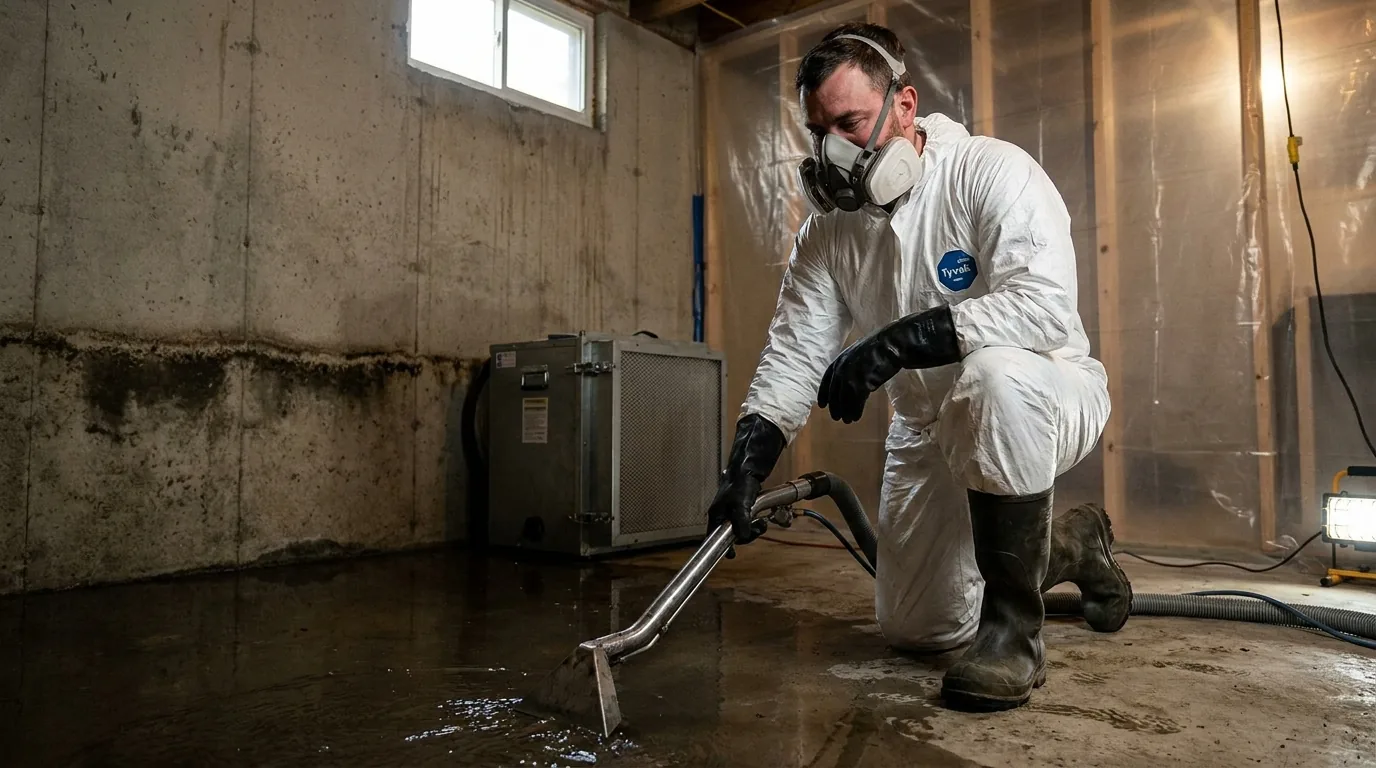
Containment first. We isolate the affected zone with poly sheeting and establish negative air pressure before anyone begins extraction. This prevents aerosolized contaminants from spreading to clean areas of the home.
Extraction and removal. Truck-mounted extraction equipment pulls standing effluent and saturated material. Porous materials, carpet, pad, contaminated drywall, insulation, are bagged and removed per Utah Department of Environmental Quality disposal guidelines. We don’t dry contaminated material in place; it comes out.
Structural disinfection. After gross contamination is removed, affected framing, concrete, and hard surfaces are treated with EPA-registered antimicrobials rated for Category 3 water events. We apply in multiple passes, not a single spray-and-wipe.
Drying and documentation. Industrial air movers and desiccant or refrigerant dehumidifiers run until moisture readings in structural assemblies return to baseline. In Orem’s climate, where summer humidity can spike during monsoon season in July and August, drying timelines can extend by a day or two compared to drier months. We document every moisture reading so your insurance adjuster has a complete record.
Home Pride Restoration and Cleaning has been IICRC Certified since our founding in 1997, and our technicians follow the IICRC S500 and S520 standards on every Category 3 loss.
Response Time from Saratoga Springs to Orem
Our headquarters is in Saratoga Springs, roughly 15 to 20 minutes from most Orem addresses via US-89 north or I-15 to the University Parkway exit. On a normal day, a crew can be on-site in Orem within 45 to 60 minutes of your call. During peak hours on I-15, we route through Lehi and Pleasant Grove on US-89 to avoid the interchange backup, a route that keeps our response time predictable even at 5 p.m. on a weekday.
For addresses in the 84097 ZIP code, the eastern and newer residential sections of Orem near the foothills, travel time is comparable, though we factor in the surface street grid once we’re off the main corridors.
Local Note: What Orem’s Soil Does to Sewage Contamination
Something that doesn’t show up in standard restoration guides: Orem’s bentonite-rich clay soil is nearly impermeable when wet. That sounds like it would contain a spill, but it actually works against you. When effluent reaches the soil beneath a slab or crawl space, it pools and stays, it doesn’t percolate away. We’ve opened crawl spaces in homes near the Orem/Lindon border where the soil surface looked dry but moisture readings 6 inches down were still at field capacity weeks after the original backup. In those situations, we bring in additional soil extraction and treat the sub-slab environment directly rather than assuming surface drying is sufficient. If your home has a crawl space and you’ve had any sewage event, that space needs to be physically inspected, not just checked from the hatch.
If sewage has backed up into your Orem home or business, don’t wait to see if the smell clears on its own. It won’t. Call Home Pride Restoration and Cleaning at (801) 995-2437, we’re licensed (RC-25-0737), insured, and ready to respond to Orem addresses around the clock.
Serving Orem from our Saratoga Springs headquarters — ★ 5.0 · 36 Google reviews
“Curt was soooo amazing! Fast and efficient! Very sweet and kind! Would use again if we weren’t moving out of state!!!!!” — Kristina, August 2026Read our reviews on Google →
Sewage Cleanup and Sanitization in Orem: Service Coverage
Frequently Asked Questions
How fast can you arrive for sewage cleanup and sanitization in Orem?
How quickly can you reach homes in the 84097 ZIP code on Orem's east side?
Are older homes near Orem's Center Street corridor more likely to have sewer backup problems?
Does Orem's freeze-thaw cycle affect how long sewage cleanup and drying takes?
What does the sanitization step actually involve after raw sewage removal?
Will my homeowner's insurance cover sewage backup cleanup in Orem, and can you help with the claim?
Sewage Cleanup and Sanitization response in Orem
Most Orem calls see a technician on-site within 60 minutes from our Saratoga Springs headquarters.