TL;DR: Water damage restoration in Utah typically costs $1,500 to $8,000 for most residential jobs, with the average falling around $3,200. Small, clean-water losses (a burst supply line caught quickly) run $1,200 to $3,500. Large losses involving sewage, finished basements, or structural materials can reach $10,000 to $20,000 or more. The biggest cost drivers are the category of water, how long it sat, and how many materials need replacement rather than drying.
If you just discovered water in your home and you’re trying to figure out what this is going to cost before the restoration crew arrives, here is what Utah homeowners actually pay in 2026. These are industry-typical ranges based on the IICRC S500 Standard for Professional Water Damage Restoration, the framework every certified restoration company in the state works from. Every loss is different, and Home Pride Restoration and Cleaning provides a written scope before any work begins, so you know exactly what you’re authorizing.
How Much Does Water Damage Restoration Cost in Utah?
In Utah, water damage restoration typically costs $1,500 to $8,000 for most single-family homes, with complex losses running higher. The national average sits around $3,000 to $3,500, and Utah’s Front Range and Wasatch Front markets track closely to that figure. Saratoga Springs, Lehi, and Eagle Mountain homes tend to be newer construction with open floor plans, which can mean water travels farther and faster than in older, compartmentalized homes.
Cost by Scenario
| Scenario | Typical Cost Range |
|---|---|
| Small clean-water leak, 1 room, caught within 24 hours | $1,200 - $3,500 |
| Burst pipe, 2-3 rooms, drywall affected | $3,500 - $6,500 |
| Appliance leak (dishwasher, washing machine), hardwood floors | $4,000 - $8,000 |
| Finished basement flooding, clean water | $5,000 - $12,000 |
| Sewage backup, any area of the home | $7,000 - $20,000+ |
| Roof leak with attic and ceiling damage | $3,000 - $9,000 |
These ranges cover extraction, drying, and basic structural drying. They do not include reconstruction (replacing drywall, flooring, or cabinetry), which is billed separately.
What Factors Move the Price Up or Down?
The category and class of water loss are the two biggest cost drivers in any restoration estimate. Understanding them helps you read your written scope and ask the right questions.
Water category (per IICRC S500):
- Category 1 (clean water): Comes from a sanitary source, like a supply line or a clean appliance. Lowest remediation cost.
- Category 2 (gray water): Contains contaminants. Washing machine overflow, dishwasher discharge, toilet overflow without solids. Requires more aggressive drying protocols and antimicrobial treatment.
- Category 3 (black water): Sewage, floodwater from outside, or water that has been sitting long enough to become grossly contaminated. Requires full PPE, disposal of porous materials, and sanitization. Most expensive category by a significant margin.
Water class describes how much evaporation load is present:
- Class 1: Minimal absorption, small area.
- Class 2: Significant absorption, wall cavities affected.
- Class 3: Ceilings, walls, insulation, and subfloor all saturated.
- Class 4: Specialty drying required (hardwood, concrete, plaster).
A Class 1 / Category 1 loss in a bathroom is a very different job from a Class 3 / Category 2 loss in a finished basement. The crew’s equipment deployment, drying time, and material removal decisions all change.
Other factors that affect cost:
- Response time: Water that sits 48-72 hours begins promoting mold growth (the EPA recommends drying within 24-48 hours). Delayed response moves a Category 1 loss toward Category 3 conditions and adds mold remediation to the scope.
- Square footage affected: Crews calculate equipment placement by square footage and cubic volume of the space.
- Materials involved: Hardwood floors require specialty drying systems (Dri-Eaz mats or similar). Concrete slabs need extended drying time. Spray foam insulation is nearly impossible to dry and usually requires removal.
- Accessibility: Crawl spaces, tight attic spaces, and multi-story homes add labor hours.
- Code upgrades: If structural materials are opened, Utah code may require updates to insulation R-value or vapor barriers before close-up.
For a deeper look at what the timeline looks like from day one through final dry-out, see How Long Does Water Damage Restoration Actually Take?
Will Homeowners Insurance Cover Water Damage Restoration in Utah?
Most standard homeowners policies cover sudden and accidental water damage but exclude gradual leaks and flooding from outside the home. In Utah, that distinction matters a great deal: a burst pipe in a Saratoga Springs home during a cold snap is almost always covered. A slow leak behind a cabinet that went unnoticed for six months is almost always denied.
What is typically covered:
- Burst pipes (including frozen pipe damage)
- Appliance failures (washing machine hose, dishwasher supply line)
- Sudden roof leaks from storm damage
- Accidental overflow from a tub or sink
What is typically excluded:
- Gradual seepage or slow leaks
- Groundwater intrusion and surface flooding (requires separate NFIP flood insurance)
- Sewer backup (often excluded unless you have a sewer backup rider)
- Damage caused by deferred maintenance
For a full breakdown of what policies typically pay, see Does Homeowners Insurance Cover Water Damage?
Protecting your claim: The documentation you provide in the first 48 hours determines how smoothly your claim processes. Take photos and video before anything is moved. Get a written moisture map from your restoration company showing moisture readings at each affected surface. Request a written scope of work before extraction begins. Adjusters look for evidence that the damage was sudden, not gradual, and that remediation followed the IICRC S500 standard.
Deductible reality: Most Utah homeowners carry a $1,000 to $2,500 deductible. On a $4,000 water loss, your out-of-pocket is real. On a $15,000 sewage backup, the policy coverage is the difference between a manageable recovery and a financial crisis.
What Does the Water Damage Restoration Process Actually Look Like?
Certified restoration follows a defined sequence. Knowing the steps helps you understand what you’re paying for and why skipping steps creates bigger problems later.
- Emergency extraction. Truck-mounted or portable extractors remove standing water. This is the fastest-moving phase and often happens within hours of the call.
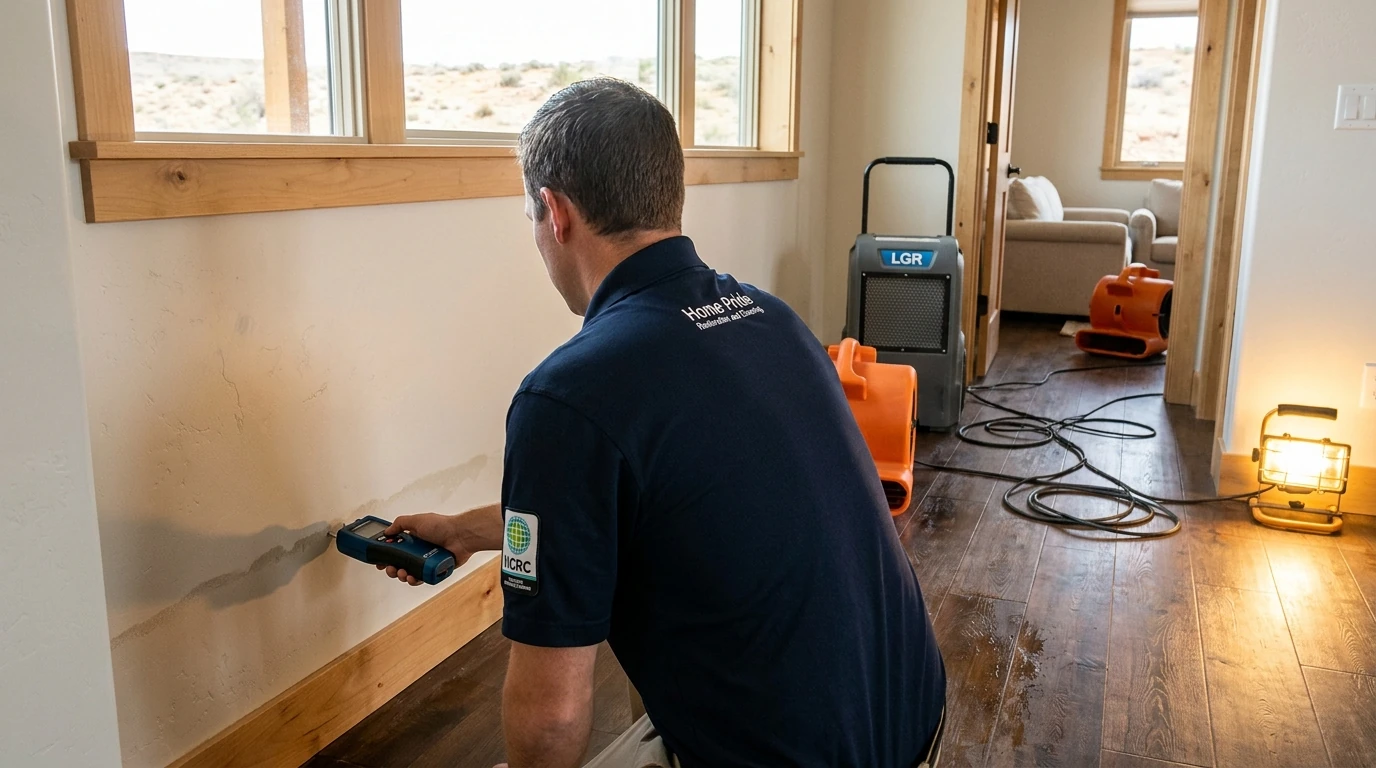
- Moisture mapping. Technicians use non-penetrating and penetrating moisture meters (Tramex, Delmhorst, or similar) to map every affected surface. This establishes the baseline your insurance adjuster needs.
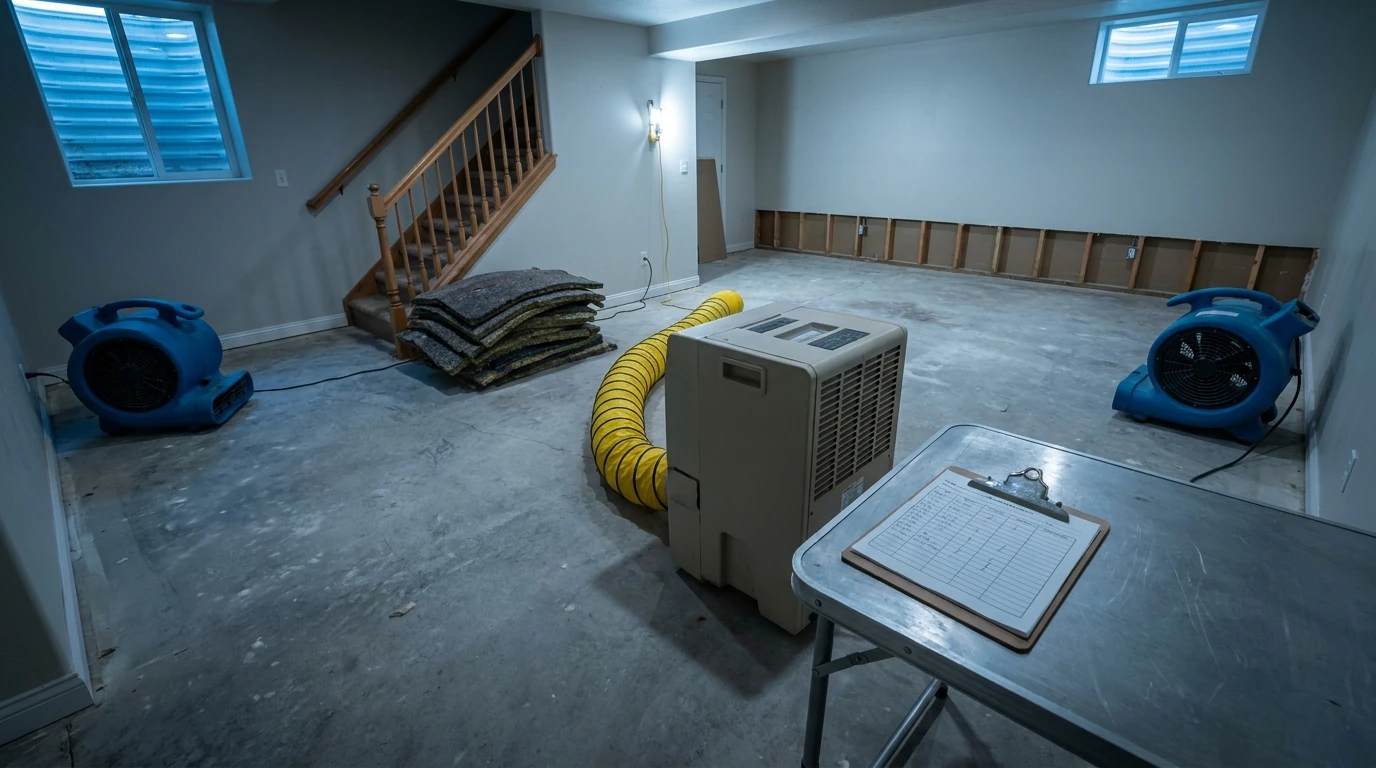
- Controlled demolition (if needed). Wet drywall below the moisture line is cut and removed. Wet insulation is pulled. Saturated flooring may be lifted. This is not destruction, it is the only way to dry wall cavities and subfloors.
- Drying system deployment. LGR (low-grain refrigerant) dehumidifiers and high-velocity air movers are placed per IICRC S500 psychrometric calculations, not guesswork. The number of machines, their placement, and the airflow pattern are documented.
- Daily monitoring. Technicians return each day to record moisture readings and adjust equipment. Drying typically takes 3 to 5 days for a Class 2 loss, longer for Class 3 or 4.
- Antimicrobial treatment. Applied to affected structural surfaces after drying to inhibit mold growth.
- Final clearance readings. Moisture levels must reach the IICRC standard for the material type before equipment is removed. This protects you from a mold problem six weeks later.
- Reconstruction scope. Once the structure is dry and cleared, a separate scope covers drywall replacement, flooring, paint, and any code-required upgrades.
For urgent situations, see What To Do in the First 24 Hours After Water Damage and the Burst Pipe Emergency Checklist for immediate steps before the crew arrives.
What Should You Do Right Now?
If you have active water damage, the most expensive mistake is waiting. Every hour of delay increases the drying time, the equipment cost, and the likelihood of mold growth. If the source of water is still running, shut it off at the main or the fixture shutoff before anything else.
Then call a certified restoration company for a moisture assessment. In the Saratoga Springs area and across Utah County and Salt Lake County, Home Pride Restoration and Cleaning LLC is available 24/7 at (801) 995-2437 and holds IICRC certification (license RC-25-0737). They handle water damage extraction, structural drying, sewage cleanup, and mold remediation, and they provide a written scope before work begins so you know exactly what the job covers.
If you’re not sure whether your situation is covered, read your policy’s water damage exclusions before you call your insurer. The restoration company can help document the loss in a way that supports your claim, but they cannot change what happened. The sooner you start the clock on proper drying, the better your outcome.
About Home Pride Restoration and Cleaning
Home Pride Restoration and Cleaning is an IICRC-certified restoration company serving Saratoga Springs, Lehi, Eagle Mountain, American Fork, Orem, Provo, and surrounding Utah communities since 1997 (license RC-25-0737). Their crews handle water damage restoration, burst pipe repair, frozen pipe restoration, appliance leak cleanup, basement flooding cleanup, sewage cleanup, storm damage restoration, fire and smoke damage restoration, mold remediation, and mold inspection and testing, along with carpet cleaning, odor removal, and crawl space encapsulation. Available 24/7 at (801) 995-2437.
Video Transcript
Just found water in your home and wondering what it’s going to cost? Here’s what Utah homeowners actually pay for water damage restoration in 2026. Most residential jobs in Utah run between fifteen hundred and eight thousand dollars, with the average around thirty-two hundred. A small clean-water leak caught within twenty-four hours might cost twelve hundred to thirty-five hundred dollars. That’s the best-case scenario. Larger losses — finished basements, sewage backups, or hardwood floors — can reach ten thousand to twenty thousand dollars or more. The three biggest cost drivers are the type of water involved, how long it sat, and how many materials need replacing versus just drying. Clean water from a pipe costs less to remediate. Sewage or water that sat for days is far more expensive because every porous material must be removed. Industrial air movers and dehumidifiers run for three to five days on average. Equipment, labor, and monitoring are all part of your restoration invoice. Most homeowners insurance covers sudden water damage — like a burst pipe — but not slow leaks or groundwater flooding. Check your policy before assuming. A certified restoration company will give you a written scope before work begins, so you know exactly what you’re authorizing. No surprises. Get an accurate estimate before the stress gets worse. Call Home Pride Restoration and Cleaning LLC at 801-995-2437 for a free estimate today.