Upholstery Cleaning in Saratoga Springs
24/7 upholstery cleaning in Saratoga Springs and surrounding areas. IICRC-certified, insurance billing accepted. Call (801) 995-2437.
Your sofa sees more daily contact than almost any surface in your home, skin oils, pet dander, spilled drinks, and years of ground-in dust work their way past the surface fibers and settle deep into the fill and backing. By the time fabric looks dingy or starts to smell musty even after vacuuming, the buildup has usually been accumulating for months. Professional upholstery cleaning reaches what a vacuum and a damp cloth can’t: the subsurface layer where allergens, bacteria, and odor compounds actually live.
What upholstery cleaning actually involves
Upholstery cleaning is a fundamentally different discipline from carpet cleaning, even though both involve fabric and extraction equipment. Furniture has variable pile depths, mixed fiber constructions, foam cores that can hold moisture, and decorative elements, piping, tufting, fringe, that require hand-tool work rather than a wand pass. A sectional sofa might combine a microfiber seat, a velvet back panel, and a treated arm fabric, each with a different safe cleaning chemistry.
The work starts with fiber identification and a manufacturer tag check (the W, S, WS, or X codes that specify safe cleaning methods). From there, technicians choose between hot-water extraction (steam cleaning), low-moisture dry-compound methods, or a hybrid approach depending on fiber type and soil level. Extraction equipment used on upholstery operates at lower pressure than carpet equipment to avoid distorting cushion foam or driving moisture into the fill. Drying time for a properly cleaned sofa typically runs two to four hours with airflow assistance, longer for dense foam cores or tufted pieces that trap moisture in pockets.
Leather upholstery follows a separate protocol entirely: pH-balanced cleaners, conditioners to restore plasticizers lost through heat and use, and no water-based extraction at all.
Our process
-
Fiber and soiling assessment. Before any product touches the fabric, we identify the fiber content, check the manufacturer cleaning code, and test an inconspicuous area for colorfastness and shrinkage risk. We also note the type of soiling, food-based, pet-related, oil-based, or general particulate, because each responds to different chemistry.
-
Pre-treatment and agitation. We apply an appropriate pre-spray (enzyme-based for organic soils, solvent-based for oil and grease, alkaline for general traffic soils) and work it into the fabric with a soft-bristle upholstery brush. This step breaks the bond between soil particles and fiber before extraction begins, skipping it is the single most common reason DIY or budget cleaning leaves fabric looking flat and dull.
-
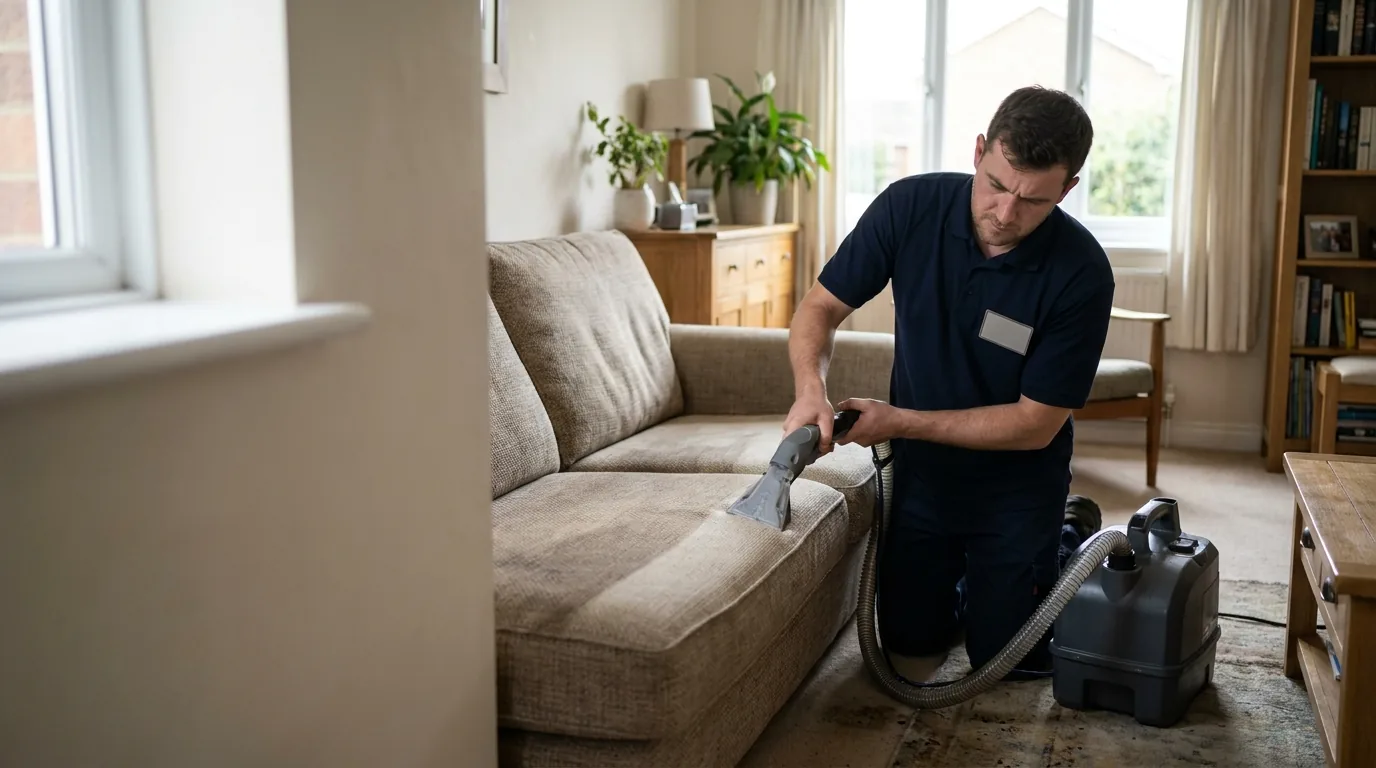
Hot-water extraction or low-moisture cleaning. For W- and WS-coded fabrics, we use a portable upholstery extraction tool that delivers heated cleaning solution and immediately vacuums it back, minimizing soak time. For S-coded fabrics (solvent-only), we use dry-compound or solvent-based methods with no water introduction. Leather pieces receive a hand-applied pH-balanced cleaner followed by a conditioner.
-
Detail work on seams, tufts, and crevices. Soil concentrates in the folds of tufted cushions, along piping seams, and in the gaps between seat and back panels. We work these areas by hand with narrow-head tools, this is where most production-speed cleaning operations cut corners.
-
Controlled drying and post-inspection. We groom the fabric back to its natural nap direction and position cushions for maximum airflow. Before we leave, we walk through the piece with the homeowner in good light to confirm soil removal and flag any pre-existing wear, permanent staining, or fabric damage that cleaning cannot reverse.
What separates a good upholstery cleaning from a bad one
The most common technical failure in upholstery cleaning is over-wetting. When too much water penetrates a foam cushion, it creates a reservoir that keeps the fabric surface damp for days, long enough for mildew to colonize the fill from the inside out. The fabric may appear dry to the touch while the core is still holding significant moisture. A trained technician monitors extraction rate and uses airmovers to accelerate drying; an undertrained one leaves and hopes for the best.
The second common failure is chemistry mismatch. Using an alkaline cleaner on a wool-blend fabric causes fiber swelling and permanent texture change. Using a water-based product on an S-coded fabric causes shrinkage and ring marks. Neither is reversible. IICRC-certified technicians are trained in fiber chemistry specifically to avoid these outcomes.
A third issue is ignoring the odor source. Deodorizing spray on top of a pet-urine-saturated cushion masks the smell for a few days and then it returns, because the uric acid crystals in the foam were never treated. Effective odor removal requires enzyme application timed to allow full biological breakdown of the odor compound, not a topical fragrance.
Seasonal and regional considerations
Saratoga Springs and the broader Utah Valley sit at elevation with low ambient humidity for much of the year, which is actually an advantage for upholstery drying times compared to coastal climates. That said, winter months with closed windows and forced-air heat mean indoor air is recirculated constantly, and dust, pet dander, and skin-cell accumulation in upholstery accelerates. Spring is typically the highest-demand window for upholstery cleaning after a season of closed-up indoor living. If you run a whole-house humidifier through winter, check foam cushion cores for any mustiness before warm weather arrives, low exterior humidity doesn’t help if interior humidity has been elevated for months.
Service area
Home Pride Restoration and Cleaning is based in Saratoga Springs and serves surrounding communities including Eagle Mountain, Lehi, American Fork, Cedar Hills, and Highland. The city-specific pages for each area link back here for full service detail.
If your furniture smells off, looks flat after vacuuming, or hasn’t had a professional cleaning in more than two years, call (801) 995-2437 to schedule an upholstery assessment and get your sofas, sectionals, and chairs cleaned the right way, fiber by fiber, not just surface-deep.
Frequently Asked Questions
How do I know whether my fabric can be safely steam-cleaned or needs a dry method?
My couch cushions smell fine on the surface but musty underneath — what's actually happening?
What's different about cleaning leather upholstery versus fabric?
How long does a sofa or sectional take to dry after professional cleaning?
Can professional cleaning remove pet urine odor from a sofa, or is the piece ruined?
Looking for the best upholstery cleaning company in Saratoga Springs?
Home Pride Restoration and Cleaning provides licensed and insured upholstery cleaning in Saratoga Springs, UT and the surrounding area, and has served local property owners since 1997. Customers rate us 5.0 out of 5 stars across 36 Google reviews. We answer calls 24/7 — call (801) 995-2437 for immediate help.
Need Upholstery Cleaning now?
We respond 24/7 across Saratoga Springs and surrounding UT cities.
Related Coverage
- Our Restoration Services
- Contact Home Pride Restoration and Cleaning
- Upholstery Cleaning in American Fork
- Upholstery Cleaning in Eagle Mountain
- Upholstery Cleaning in Herriman
- Upholstery Cleaning in Lehi
- Upholstery Cleaning in Orem
- Upholstery Cleaning in Pleasant Grove
- Upholstery Cleaning in Provo
- Upholstery Cleaning in Riverton
- Upholstery Cleaning in South Jordan