
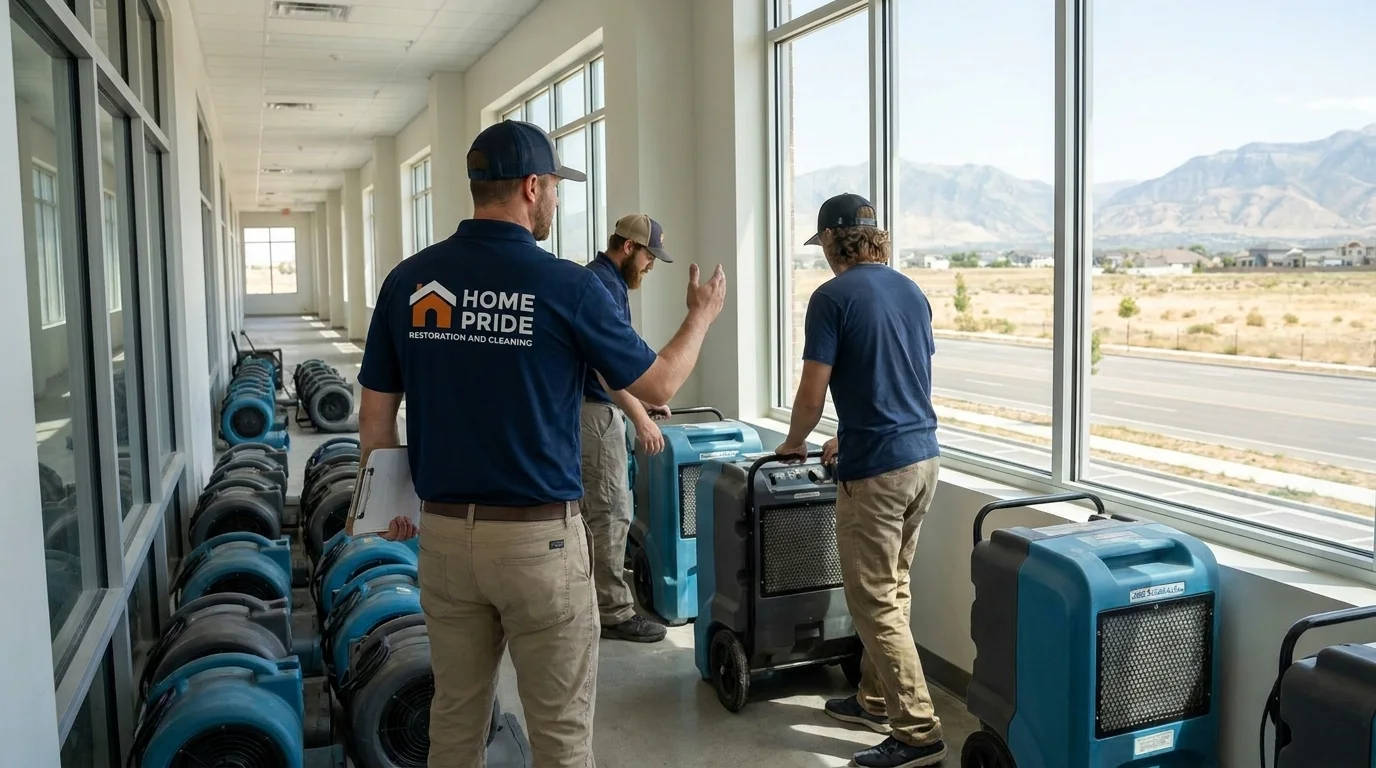
Large Loss and Catastrophic Response in Saratoga Springs
24/7 large loss and catastrophic response in Saratoga Springs and surrounding areas. IICRC-certified, insurance billing accepted. Call (801) 995-2437.
Large loss and catastrophic response describes a different category of problem than a single flooded basement or a stovetop fire. It’s what happens when a sprinkler head fails on the third floor of a forty-unit apartment building and water cascades through twelve units below, or when a hailstorm tears through a Saratoga Springs HOA and damages fifteen roofs in one pass, or when a warehouse fire leaves tens of thousands of square feet of inventory and structure to document and dry. These losses need crew coordination, equipment volume, and reporting discipline that a standard residential callout doesn’t require.
What large loss and catastrophic response actually involves
A large loss is generally defined by scale, not just by the type of damage: multiple structures or units affected, losses that run into six or seven figures, or events that require coordination between several adjusters, property managers, and sometimes legal counsel. The work itself still includes extraction, drying, demolition, and reconstruction, but at a scale where a single technician with a truck-mounted extractor can’t keep pace. Equipment needs shift toward desiccant dehumidifiers for large open floor plates, negative air setups between units in multi-family buildings, and generator power when a loss has taken out electrical service to part or all of a structure. Timelines stretch from days into weeks, and documentation has to track per-unit or per-area progress rather than a single moisture log for one house.
Our process
- Site-wide assessment and scope development. Before equipment moves in, we walk the full loss, whether that’s a building, a block of townhomes, or a commercial floor plate, and build a scope that accounts for every affected area separately rather than treating the loss as one undifferentiated job.
- Crew and equipment mobilization. Large losses need enough extraction units, dehumidifiers, and air movers staged on day one to hit every affected area within the same operational window, not sequentially over several weeks.
- Phased mitigation by priority. Units or areas with active contamination, structural risk, or tenant displacement get triaged first; lower-priority areas follow once the immediate risk is controlled.
- Daily moisture mapping and stakeholder reporting. Property managers, large loss adjusters, and sometimes legal teams need consistent documentation: moisture readings by room or unit, drying equipment logs, and photo records that hold up under claim review.
- Reconstruction scope handoff. Once drying and demolition are complete, we prepare a written reconstruction scope so rebuild work can start without a second round of assessment delays.
What separates a good large loss response from a bad one
The most common failure on catastrophic jobs is under-resourcing: a crew sized for a residential call gets sent to a commercial or multi-family loss, and drying times stretch far past what the structure can tolerate, which increases secondary damage like mold colonization in wall cavities or warped flooring that wasn’t caught early. A second common gap is documentation that doesn’t scale with the loss, logging one overall moisture reading for a forty-unit building instead of per-unit tracking, which creates disputes later when an adjuster asks why one unit dried in four days and another took three weeks. Large loss adjusters are specifically trained to look for consistent daily logs, equipment placement photos, and psychrometric readings tied to specific rooms or units, not just a summary narrative at the end. A response built for this scale accounts for secondary moisture migration between shared walls in townhome and condo construction, which is common in Saratoga Springs’ newer HOA developments, and structures the crew assignments so no unit sits untouched while another gets attention.
What does large loss and catastrophic response cost?
Large loss costs vary enormously depending on the number of structures or units affected, the category of water or extent of fire damage, and how quickly mitigation starts after the event. Every loss is different, and Home Pride Restoration and Cleaning provides a written scope of work before mobilization begins so property managers and adjusters know what’s included. Homeowners and commercial property insurance typically covers large loss mitigation and reconstruction when the cause is a covered peril, though policy limits and per-unit coverage terms vary and should be confirmed with the carrier early in the claim.
| Scenario | Typical range |
|---|---|
| Multi-unit water loss (per affected unit) | $3,500 - $9,000 |
| Commercial structure fire (per 1,000 sq ft) | $15,000 - $45,000 |
| HOA common-area storm damage (roof + exterior) | $25,000 - $150,000+ |
| Multi-family mold colonization following large water loss | $10,000 - $60,000 |
| Full structural dry-out, commercial warehouse | $50,000 - $250,000+ |
Seasonal & regional considerations
Saratoga Springs sees its heaviest catastrophic exposure during spring runoff, when snowmelt off the Wasatch Range raises groundwater and pressure on older storm drainage in surrounding areas, and during summer hailstorms that can damage roofing across entire subdivisions in a single event. Because much of the city’s housing stock is newer construction with shared-wall townhomes and HOA-managed common areas, a single storm or sprinkler failure often affects multiple units at once, which is exactly the scenario large loss response is built around rather than a standard single-family callout.
Service area
Home Pride Restoration and Cleaning handles large loss and catastrophic response for property managers, commercial owners, and HOAs throughout Saratoga Springs and surrounding Utah County communities including Eagle Mountain, Lehi, and American Fork.
If you’re managing a multi-unit water loss, a commercial fire, or storm damage across multiple properties, call (801) 995-2437 to start a site-wide assessment and get a written scope moving before secondary damage sets in.
Frequently Asked Questions
Does homeowners or commercial insurance cover large loss and catastrophic restoration?
What makes a loss qualify as 'large loss' instead of a standard residential job?
How is documentation different on a large loss job compared to a single-family claim?
How many crews and how much equipment does a catastrophic response actually need?
Who manages communication between the property owner, tenants, and the insurance adjuster during a large loss?
Looking for the best large loss and catastrophic response company in Saratoga Springs?
Home Pride Restoration and Cleaning provides licensed and insured large loss and catastrophic response in Saratoga Springs, UT and the surrounding area, and has served local property owners since 1997. Customers rate us 5.0 out of 5 stars across 36 Google reviews. We answer calls 24/7 — call (801) 995-2437 for immediate help.
Need Large Loss and Catastrophic Response now?
We respond 24/7 across Saratoga Springs and surrounding UT cities.
Related Coverage
- Our Restoration Services
- Contact Home Pride Restoration and Cleaning
- Restoration Services in Alpine
- Restoration Services in American Fork
- Restoration Services in Benjamin
- Restoration Services in Bluffdale
- Restoration Services in Cedar Fort
- Restoration Services in Cedar Hills
- Restoration Services in Draper
- Restoration Services in Eagle Mountain
- Restoration Services in Fairfield
- Restoration Services in Heber City
- Restoration Services in Herriman
- Restoration Services in Highland