Industrial Restoration in Saratoga Springs
24/7 industrial restoration in Saratoga Springs and surrounding areas. IICRC-certified, insurance billing accepted. Call (801) 995-2437.
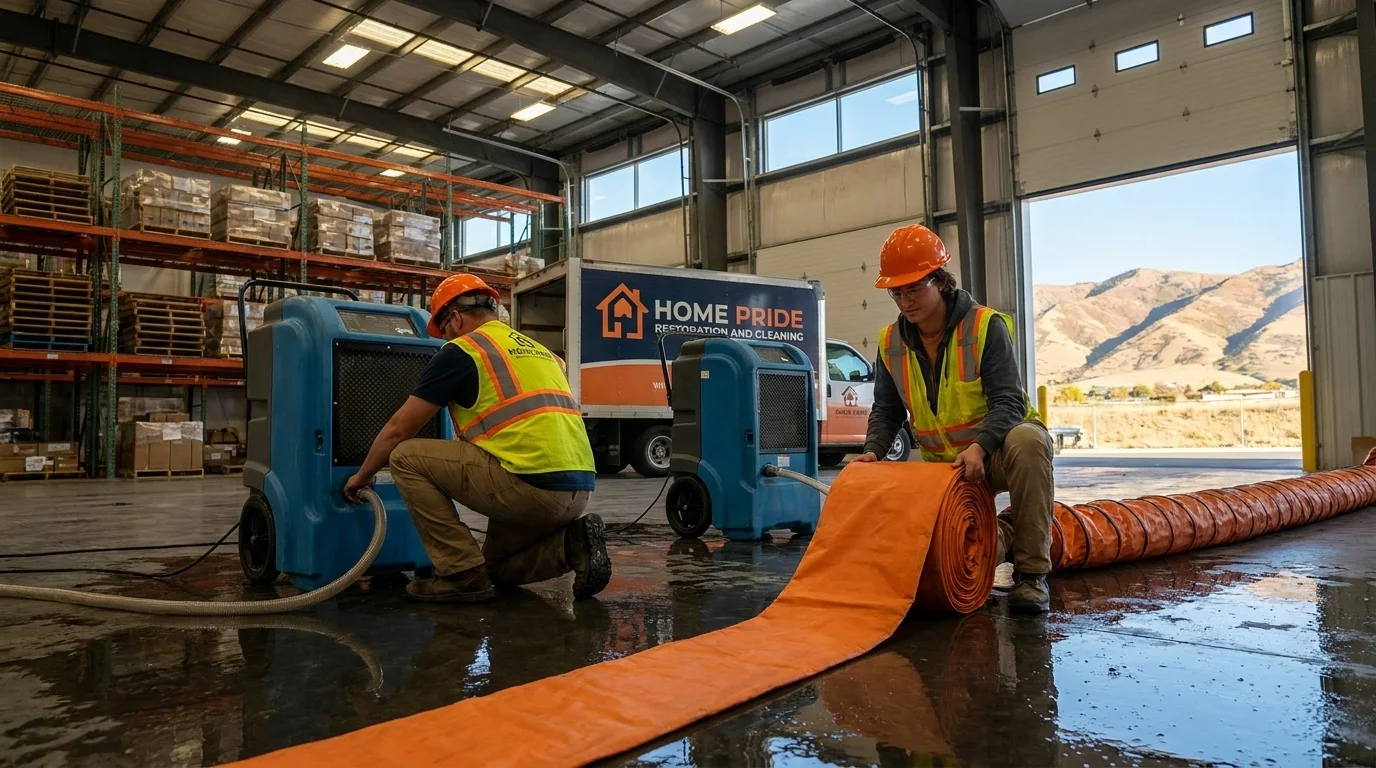
When a line goes down because of standing water in a warehouse, or a production floor sits under a haze of smoke after an electrical fire, the clock is different than it is in a house. Downtime has a dollar figure attached to it, inventory and raw materials are often unsalvageable the longer they sit wet or contaminated, and OSHA concerns around slip hazards, air quality, and electrical safety complicate what crews are even allowed to touch before the facility is cleared. Industrial restoration deals with that scale and that pressure: large square footage, specialized equipment, and a building that has to get back into production, not just back to “dry.”
What industrial restoration actually involves
Industrial and manufacturing facilities present a different set of problems than a home or small office. Concrete slab floors, open-web steel trusses, high bay ceilings, and large HVAC systems all behave differently when water, smoke, or mold are introduced. Water can travel long distances under raised flooring or through floor drains and trench drains before it ever shows up visually, and a facility with process equipment, control panels, or raw material storage adds a layer of risk that residential drying doesn’t touch. Industrial fire damage often means soot has settled into HVAC ductwork, overhead cable trays, and machinery housings, where it can corrode electrical contacts and bearing surfaces if it isn’t addressed quickly. Scope and timeline vary enormously with square footage: a single-zone loss in a 5,000 square foot flex space might be a multi-day job, while a full warehouse floor with racking and palletized goods can run weeks and require phased drying so sections can be brought back online as they clear.
Our process
- Facility assessment and hazard check. Before any equipment goes in, we walk the affected area to identify electrical hazards, structural concerns, and anything that needs to be isolated or shut down, including coordination with your facility manager or maintenance team.
- Moisture mapping and containment. For water intrusion, we use moisture meters and thermal imaging to track how far the water has traveled under slabs, behind wall panels, or into insulation, and we set up containment to keep affected zones separate from areas still in operation.
- Extraction, drying, or soot removal. Depending on the loss type, this means industrial-grade extraction and desiccant dehumidification for water, or soot characterization followed by HEPA vacuuming, thermal fogging, and surface cleaning for fire and smoke.
- Equipment and contents evaluation. Machinery, control panels, and inventory are assessed for restorability versus replacement, often in coordination with your equipment manufacturer or insurance adjuster.
- Monitoring and clearance. We track drying progress or air quality daily until the space meets the benchmark for the loss type, documenting readings throughout so there’s a clear record for your insurance file.
What separates a good industrial restoration response from a bad one
The biggest mistake on industrial losses is treating them like an oversized residential job. A crew that doesn’t account for how water moves through a slab-on-grade floor, or how smoke settles into overhead conduit and cable trays, will miss moisture or soot that resurfaces as odor or corrosion weeks later. Adjusters on commercial and industrial claims look closely at documentation: moisture logs, photos of affected racking or equipment, and a clear scope before demolition or disposal starts, because large-loss claims get scrutinized line by line. Good operators also coordinate drying or cleanup in phases so parts of the facility can reopen as they pass inspection, instead of holding the entire building hostage to the slowest-drying zone. And decisions about restorable versus unsalvageable equipment and inventory need to be made with documentation in hand, not guessed at, because that distinction often determines what the claim actually pays for.
What does industrial restoration cost?
Costs for industrial restoration scale with square footage, the type of loss, and how much specialized equipment or inventory is involved, so ranges below are industry-typical figures, not a quote. Every facility and every loss is different, which is why Home Pride Restoration and Cleaning provides a written scope of work before anything begins. Most commercial property insurance policies cover sudden water, fire, and smoke losses, though coverage for inventory, equipment, and business interruption depends on the specific policy and endorsements.
| Scenario | Typical range |
|---|---|
| Single-zone water intrusion, clean source | $3,500 - $9,000 |
| Multi-zone warehouse flooding with racking affected | $15,000 - $50,000+ |
| Fire and smoke damage, limited production area | $10,000 - $35,000 |
| Full facility soot removal, HVAC and overhead affected | $40,000 - $120,000+ |
| Mold remediation, isolated industrial zone | $4,000 - $15,000 |
Seasonal & regional considerations
Utah’s freeze-thaw winters put real stress on industrial roofing, dock doors, and exterior piping, and a cracked line or frozen sprinkler head can dump a significant volume of water onto a production floor before anyone notices. Saratoga Springs sits along the western shore of Utah Lake, where a number of newer flex-space and light industrial buildings have gone up along the main frontage corridors in recent years, many with slab-on-grade construction and large open floor plans that change how water and smoke move through the building compared to older multi-room facilities. Spring runoff and heavy summer storms can also push groundwater or surface water toward lower-lying loading docks and basement mechanical rooms.
Service area
Home Pride Restoration and Cleaning handles industrial and warehouse restoration throughout Saratoga Springs and the surrounding Utah Valley communities, including Lehi, Eagle Mountain, American Fork, and Pleasant Grove. Our team is IICRC certified and licensed (RC-25-0737) to work on commercial and industrial properties across the region.
If your facility has standing water, smoke damage, or a mold problem that’s threatening to shut down a production line, get a written scope of work started now so repairs and insurance documentation move in parallel, not one after the other.
Frequently Asked Questions
Does commercial property insurance cover industrial water or fire damage?
How does water damage behave differently in a warehouse or plant compared to a house?
Can a facility stay partially operational during restoration?
What happens to machinery and equipment exposed to smoke or soot?
How long does an industrial restoration project typically take?
Looking for the best industrial restoration company in Saratoga Springs?
Home Pride Restoration and Cleaning provides licensed and insured industrial restoration in Saratoga Springs, UT and the surrounding area, and has served local property owners since 1997. Customers rate us 5.0 out of 5 stars across 36 Google reviews. We answer calls 24/7 — call (801) 995-2437 for immediate help.
Need Industrial Restoration now?
We respond 24/7 across Saratoga Springs and surrounding UT cities.
Related Coverage
- Our Restoration Services
- Contact Home Pride Restoration and Cleaning
- Restoration Services in Alpine
- Restoration Services in American Fork
- Restoration Services in Benjamin
- Restoration Services in Bluffdale
- Restoration Services in Cedar Fort
- Restoration Services in Cedar Hills
- Restoration Services in Draper
- Restoration Services in Eagle Mountain
- Restoration Services in Fairfield
- Restoration Services in Heber City
- Restoration Services in Herriman
- Restoration Services in Highland